
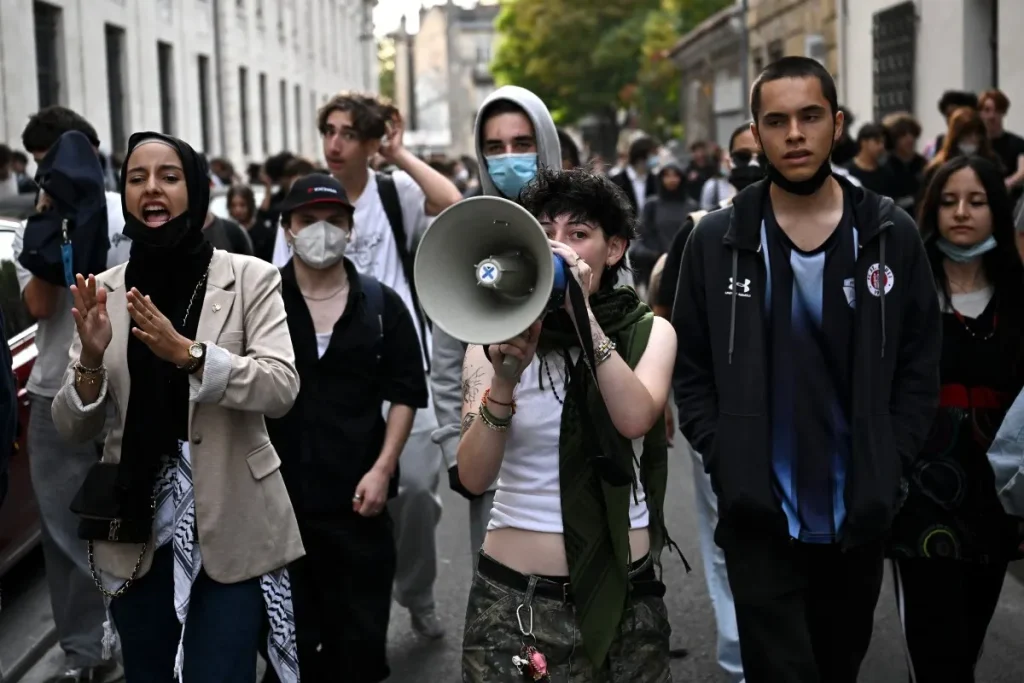
How did a protest at a single French school over a lack of teaching staff escalate so fast into nationwide, sometimes violent, protests? John Lichfield argues that the lycée protests are only a symptom of a country in deep trouble.
This is a dangerous week for France.
I said three weeks ago that the country is in trouble. I was wrong. It is in deep trouble.
Crises are piling on crises. There is a risk that the country will enter a kind of vicious circle or uncontrollable spiral.
The lycée protests will merge on Tuesday with marches by public sector workers who are complaining about government cuts and low wages. The demonstration will attract the usual fringe of trouble-makers from the anarchist ultra-left.
READ ALSO: Strikes and demos: What to expect from Tuesday’s ‘act 3’ of student protests in France
The lycée revolt was, in its origins, a justified protest against large classes, crumbling schools and teacher shortages. It has been infiltrated, and in some cases overwhelmed, by Far Left activists and disaffected teenagers from the inner suburbs of French cities who have more interest in setting fires and stoning the police than education.
READ ALSO: Explained: What are French students protesting about?
On October 17th, the lycée protesters may join the nationwide demonstration and blockages planned to complain about high fuel pump prices. The ghosts of the Gilets Jaunes are being invoked. More violence is inevitable.
The financial markets will observe the mayhem and may conclude that France is becoming socially unstable as well as politically deadlocked. France’s €3.5 trillion accumulated debt was once held mostly by calm, long-term investors. It is increasingly being bought up by hedge-funds whose business model is speculation. They love the smell of a crisis.
If they force up France’s borrowing costs – as they already are – there will be even less public money for agreeing compromise budgets, fixing schools, subsidising fuel prices or increasing civil servants’ wages.
And so the vicious spiral will continue.
A budget war (yet another) is already brewing in the National Assembly against the background of next spring’s presidential election. The bond markets will observe closely a speech on Tuesday by the presidential front-runner, the Far Right leader Marine Le Pen, in which she will list ideas for slashing €250 billion from public spending over five years. She is likely to rehash her previous, incoherent plans to take most of that money from the EU, immigrants and tax fraudsters.
Le Pen will doubtless benefit from the school blockages and street violence. Will she also be damaged by the scandal about the anti-semitic remarks made as a teenager by her Number Two Jordan Bardella? Maybe, a little.
In 30 years in France, I cannot remember a time with so many interlocking crises. What can be done? Not much. Not easily. The problems are long in the making and will be painful in the solving – if they can be solved at all.
The government was slow to react to the original lycée protests in the north-west Paris suburbs three weeks ago. They have now spread to almost a third of the 3,500 lycées in the country, from the multi-racial banlieues to rural towns.
The extreme violence, including the burning of 24 school buildings and 70 attacks on teachers, is inexcusable. It seems mostly to come from intruders, ranging from far-left activists to criminal teenage gangs which love any opportunity to attack the police.
Sending in the police to break up some of the original protests last month was a mistake. The French police are hopeless at crowd control. Crowds – even teenage crowds – love to provoke them. The police love to be provoked.
READ ALSO: France teen protester has hand blown off by police grenade
All the same, it is an unfortunate fact that without the violence we would not be talking about the lycée students’ grievances. Street violence is part of French politics. The scenes in recent days, partly encouraged by Jean-Luc Mélenchon’s Far Left, are a foretaste of what will happen if Le Pen is elected President on May 2nd.
And yet the spread of the protests in the last week cannot all be blamed on political manipulation and the contagion of social media. It suggests that high school student anger and anxiety is widespread and real. Why?
France is one of the highest spending states in the world. It supposedly invests more than the OECD average on public education – over €90 billion a year. Why then are classes overcrowded? Why is there a shortage of replacement teachers? Why are school buildings crumbling and unbearable in a heatwave? Why are teachers underpaid?
READ ALSO: Analysis: Why do French schools do so badly in international rankings?
One could ask the same sort of questions about the French state health service.
The trades unions and the Left blame the alleged cuts of the Macron years. Some mistakes have been made by successive Macron-era governments but health and education have, in theory, been shielded from budget constraints.
And yet many lycées have classes of 35 or more, endemic teacher shortages and decrepit buildings. Where is all the money going?
Here is a seldom spoken truth. Over one quarter of all the money spent on education in France goes on paying the pensions of retired teachers.
Those ex-teachers have earned their pensions. The problem is a system in which the active supposedly pay the pensions of the retired. The burden on the state, growing as longevity increases, means that “real” spending on French schools is well below the OECD average: €63 billion in 2025, from a nominal budget of €87 billion.
Much the same is true for the French health and defence budgets, which are not so high as they seem if pension payments are discounted.
Pensions, and how they are paid for, are a central factor in France’ s budgetary and economic problems. They swallow one quarter of all state spending. And yet most French politicians, from the Far Left to the Far Right and 70 percent of French people, opposed Macron’s muddled attempts to reform the pension system in 2023.
Everything connects. The lycée protests can only be solved by spending money that the government does not have. If the unrest helps to tip France into a full-blown debt crisis, the budget constraints will turn into jagged, outright spending CUTS.
France is not Greece. Imagine the street violence if that happens.