
For avid adventurers, the only true north is the Arctic. Just as the North Star guided centuries of old-world explorers, the untamed, icy wilderness of the Arctic continues to beckon travelers seeking the sublime. A land of extremes, where either the sun never sets, or darkness prevails 24/7; where roads are nonexistent, and—above a certain radius—survival depends upon navigating the wild. Where, even in 2026, large swaths of territory remain digitally uncharted. When you find that true north once, you’re destined to return again and again. It’s an affliction known as “polar fever,” and reader, I am a victim.
I’ve sailed beneath the Antarctic Circle and raced huskies in the Alaskan Arctic. More recently, I ventured into northern Canada, where I spotted polar bears on the Arctic tundra. But nothing rivals the adventures that awaited me in Lapland, above the Arctic Circle in Finland. Lapland, one of the most famous Arctic regions in the world, comprises 30 percent of the Finnish landmass and stretches across northern Sweden, Norway and Russia. But Finnish Lapland has the most to offer explorers, from activities to accommodations, and will be the focus of our itinerary here. It’s also the most accessible, with direct charter flights to Rovaniemi, Kittilä and Ivalo.
The first thing you notice when arriving in Lapland is the otherworldly light, filtering through the clouds in ethereal pink or reflecting upon the frozen wilderness in a deep twilight blue. What follows is an awareness of the supernatural silence, the eerie stillness of the boreal forest trapped and magnified by snowfall. While wintertime is magical, it isn’t the only season to visit this remote paradise. Though most travelers think of an Arctic vacation only in terms of the northern lights, there are advantages to visiting all 12 months of the year, whether you’re interested in outdoor pursuits or unspoiled nature.
Travelers can witness surreal natural phenomena throughout all four seasons—or rather, eight seasons, as the Indigenous Sámi calendar doubles the count. But how to determine which time of year is best for you? From the darkness of the polar night to the eternal sunshine of the midnight sun, read on for an insider’s guide to exploring Lapland.
Winter
Visit Christmas villages and sleep in glass igloos beneath dancing Northern Lights.
We’re starting with the most iconic time of year in the Arctic: the polar night of kaamos, when the sun never crosses above the horizon, leading up to the midwinter solstice. The sun is so low to the ground from November to January that it bathes the daylight hours in a deep indigo light, suffused with shades of violet and fluorescent pink, a perpetual sunset. You’ll feel you’ve reached the end of the earth (and you have, at least to the northern tip). And this is all before nightfall, when travelers have the highest chance of seeing the aurora borealis.
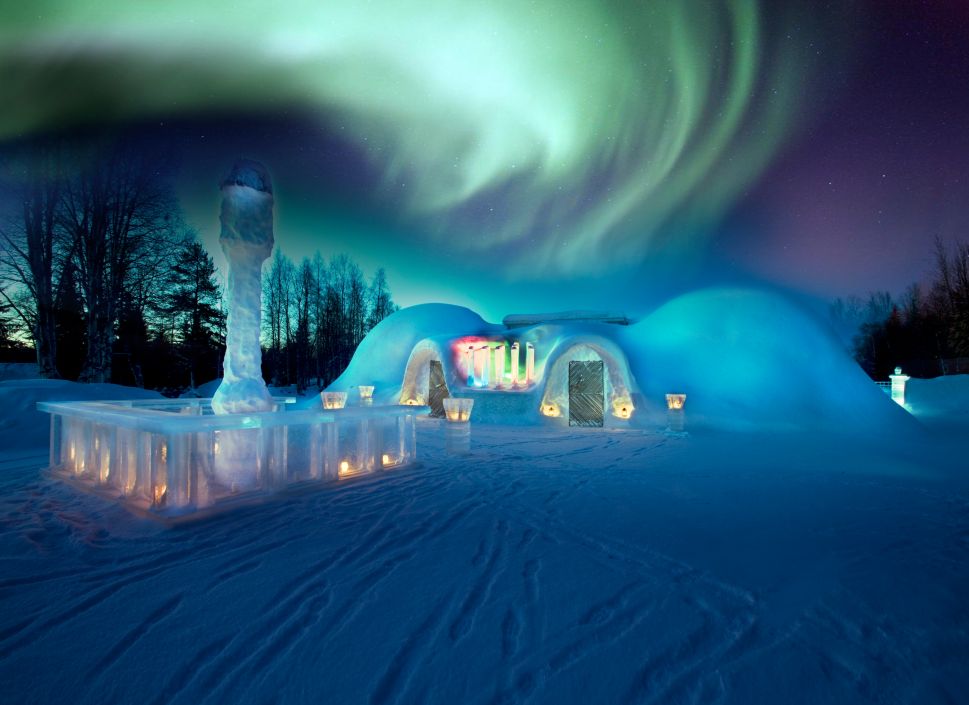
Winter (dálvi, in the Sámi language) is the prime season for chasing the northern lights, as the sky is dark from 4 p.m. until 9 a.m. And when they do appear, they’re as mystical as you’d imagine—a striking contrast from the blackened sky, reflecting off the ice crystals of the snowfields below. Capitalize on this supernatural evening lightshow by sleeping under the stars in a glass igloo at Arctic SnowHotel & Glass Igloos in Rovaniemi, one of the largest snow and ice hotels in the world. And, if the cold never bothered you anyway, opt to spend the night within the packed-snow confines of the hotel, beneath the ice art that’s constructed every winter. (Though, we suggest the cozy—and heated—igloos for the ultimate in hygge.)
If it’s holiday spirit you’re after, you’ve come to the right place: Rovaniemi is the home of Santa Claus Village, a festive dreamscape of outdoor fires and log cabins where guests can mail letters from the Arctic Circle. Check out the iconic ice sculptures and snow art at Snowman World, where guests can sled and ice skate, as well. Fuel up at Snowland, the world’s largest igloo restaurant, which offers regional cuisine and an ice dance floor (for when you’ve imbibed too many hot toddies). Finally, head to nearby Kittilä and book an overnight at Lapland Hotels SnowVillage, a wintry palace that’s rebuilt every year. Stay in the snowy confines of a Luxury Ice Suite, which provides guests with a three-course dinner to warm up for the proceedings and access to a kota cabin with a sauna, jacuzzi and indoor beds in case you can’t handle the freeze.
Snowland Rovaniemi.
Snowland Rovaniemi
Spring
Ski beneath a brilliant Arctic sun and embark on tundra wilderness safaris.
For the Indigenous Sámi population of the north, spring marks the official start of the new year: a return of the light and the awakening of the herd (the calendar is dictated by the migration of the native reindeer). The darkness of the polar night has passed, and in its wake, two new cycles emerge: snowdrift spring (giđđadálvi) when the sun returns above the horizon, followed by ice-break spring (giđđa), when the rivers break, and calves are born. February and March herald the gift of hankikanto (“snowcrust that carries weight” in Finnish), when the sun is shining, but a compact layer of snow remains. This time of year is ideal for outdoor activities, whether it’s participating in the Sámi tradition of herding reindeer or the modern pursuit of skiing, snowshoeing and fat-biking.
The above-freezing temperatures and extended daylight also make it the optimal time to book an active wilderness adventure—we suggest snowmobiling deep into the forest and visiting reindeer farms with Lapland Safaris in Levi. While the rest of Europe begins warming up, the Arctic remains a wintry paradise, with an otherworldly bichrome backdrop of sky and snow—you’ll be awed by the variations of blue and white from land to horizon. To visit during this time is to step into a winter wonderland, before the slush arrives in April. And while resorts further south are rapidly losing snowfall each season, mountains such as Levi in Kittilä, Pyhä in Pelkosenniemi and Ylläs in Kolari (the largest resort in Finland) boast world-class spring skiing, with over 186 miles of downhill and back-country terrain. The après scene is divine, with mid-mountain outdoor decks to capitalize on the sunshine and live music festivals.
You even have the opportunity to ski beneath the aurora, with downhill night skiing or guided back-country tours. The spring equinox in mid-March triggers geomagnetic activity, causing some of the brightest aurora displays of the year. Look out for the northern lights from your private villa or glass igloo at Octola, an ultra-luxurious and secluded wilderness lodge. Though only 20 minutes north of Rovaniemi, the retreat is hidden deep within the Arctic forest, offering husky sledding, snowmobiling, guided hikes and foraging in the wintry spring season.
Lapland.
Octola Lodge
Summer
Witness the Arctic in full bloom under the eternal daylight of the summer solstice.
On to the season of 24-hour daylight and abundance, with the arrival of the midnight sun in June and July, followed by August’s harvest season (syyskesä, or “autumn-summer” in Finnish). Yötön yö translates from Finnish to “the nightless night,” when the sun remains above the horizon, and the sky turns pink and yellow at midnight. This endless daylight causes the meadows and valleys of the Arctic to bloom into a field of gold that matches the sunshine overhead, with buttery globeflowers (kullero, the official province flower of Lapland) and marsh marigolds. Winter’s starkness is replaced by the bursting, colorful array of summer: the lilac spikes of alpine sow-thistles, the bright magenta of Lapland rosebays and the frosted white of arctic starflowers.
From wildlife viewing to indigenous cultural experiences, summer is the peak season to explore the storied forests and wilderness above the Arctic Circle. Capitalize on the pastel twilight with after-hours activities like hiking or Midnight Lake floating, a beloved Lapland pastime where you float weightless in a drysuit in the remote wilderness. Summer is also the best time to view wildlife, as the animals awake from the Arctic’s deep freeze. Over 150 species of migratory birds traverse the wetlands, and travelers can spot European brown bears, newly emerged from their hibernation to find a mate in late May. Sign up for a cultural eco-tour with Visit Natives, where you sleep in traditional lavvu tents and assist in the Sámi tradition of reindeer herding.
The 42nd annual Midnight Sun Film Festival will be held in June 2027 in a location 45 miles north of the Arctic Circle. The five-day event stages silent cinema concerts and screens films non-stop for 24 hours a day in accordance with the sun that never sets. Stay at Seaside Glass Villa, along the shores of the Gulf of Bothnia in Kemi, to watch the midnight sun from bed in your Finnish log-wood cabin. By day, embark on a canoe or kayak trip, or go island-hopping on a traditional wooden boat to Laitakari Island, home to unspoiled nature and rich local history. Or, stay in town at the Arctic Light Hotel in Rovaniemi and observe the otherworldly colors of the night sky from the skylight windows in your Aurora Loft. If you don’t catch the aurora, visit the northern lights theater for a virtual experience at the Arktikum Science Center and Museum in Rovaniemi, known as the “gateway to the north.”
Lapland midnight sun.
Visit Finland and Marko Junttila
Fall
Trek through the vibrant, colorful valleys during Lapland’s famous autumn ruska.
Winter is not the only time to enjoy the unique wilderness accommodations for which Lapland is so famous. Lapland is severely underrated in the fall, resulting in fewer crowds and lower prices. Capitalize on the peak foliage with a stay in the airy environs of the Arctic Treehouse Hotel in Rovaniemi. Autumn also marks the beginning of the northern lights season: the crisp, clear nights and minimal snowfall result in optimal aurora viewing. Stay in an igloo in the Lappish valley along the slopes of the Utsuvaara Fells at Levi Igloos – Golden Crown and dine beneath the stars on seasonal Nordic cuisine at their glass-roofed restaurant, Utsu.
Experience ruska (“colorful autumn”), a Finnish natural phenomenon in early autumn, when the birch forests and arctic flora explode into vibrant, fiery shades of orange, crimson and gold. This fleeting period in September is followed by “first snow” (ensilumi) in October. It marks the beginning of Lapland’s long and dark winter, but the terrain (and temperature) still remains manageable. The off-season is best for exploring the great outdoors, particularly for hiking trails across the remote terrain—Lapland covers over 30 percent of Finland’s landmass, but it’s home to only 3 percent of the population. Hike with huskies along the golden, forested paths of Tiitiäinen and visit a reindeer corral at the family-run Korvala Wilderness Estate.
Unsurprisingly, post-harvest is also the best time to sample Arctic cuisine, as it’s peak foraging season for lingonberries and cloudberries, also known as “Arctic gold,” and the reindeer roundup in September ensures the freshest tartare and stew for adventurous diners. Finally, the Finnish capital, Helsinki, will be the departure point for all international travelers, regardless of the season you visit. Stay at Lapland Hotels Bulevardi to extend your Arctic getaway (and indulge in the in-room sauna) and enjoy a last supper at Kultá Kitchen & Bar—truly adventurous travelers will order the reindeer tongue, because when in Rome!
Fall in Lapland.
Courtesy Visit Finland and Marko Junttila