
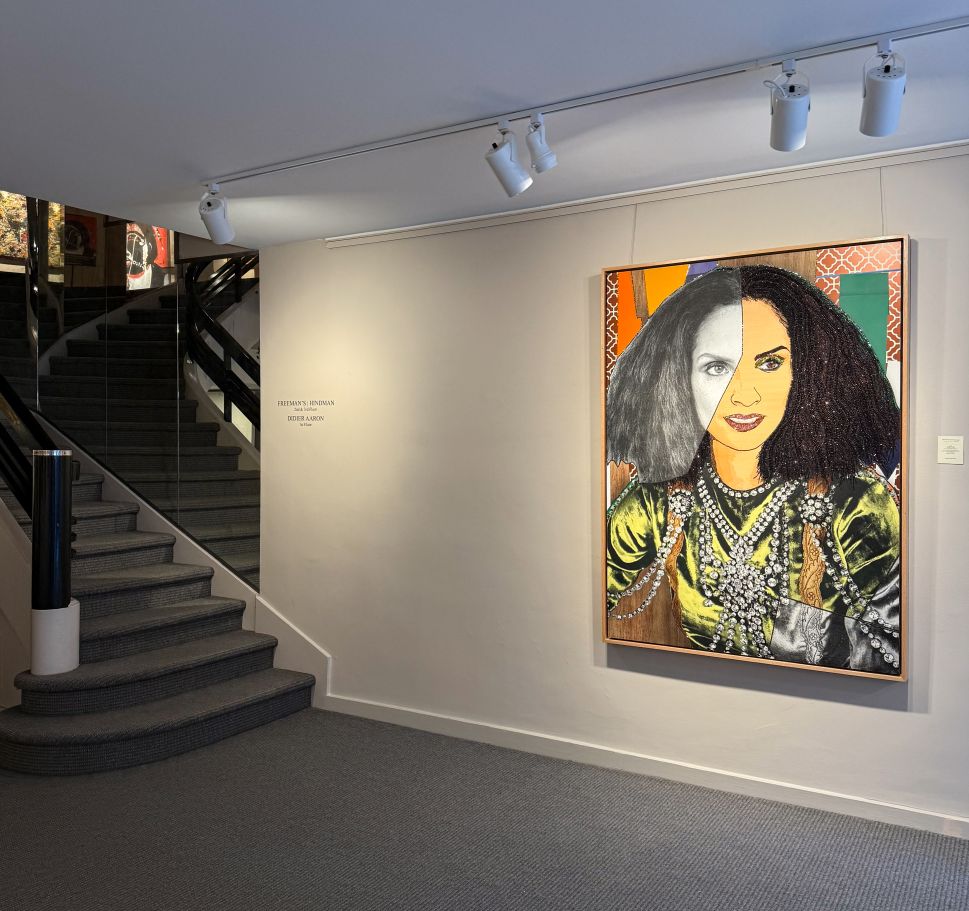
The oldest auction house in the U.S., Freeman’s has built a depth of expertise and a regional presence few competitors can match. Yet the art market has changed dramatically since Tristram B. Freeman, a British print seller, founded the house in Philadelphia in 1805, and auction houses have had to evolve, adapting to shifts in buyer and seller behavior, technological advances and an increasingly crowded art market ecosystem.
Leading Freeman’s into its next phase of innovation and global expansion is Muys Snijders, appointed CEO in June. A recognized industry leader with 25 years of experience, Snijders most recently served as senior vice president and head of Art Services at AIG Private Client Group, now Private Client Select. Previously, she led global client strategy and oversaw auction and private sales at Christie’s and worked at Bonhams as a Post-War & Contemporary specialist. Named one of the Top 50 Women Leaders of New York and one of The 10 Most Influential Women Changing the Face of Business, Snijders was also one of Observer’s 2025 Art Power Index honorees.
Freeman’s opened its New York saleroom in 2024, when Hindman and Freeman’s merged under a single organization. Observer recently visited the auction house’s bustling East 67th Street townhouse, where we saw Chinese ceramics, ink paintings and tomb sculptures slated to go on the block during Asia Week New York. Nearly 300 lots were offered on September 18, in Freeman’s main Asian Art sale, bringing the series to a total of $3.7 million.
The highlight was a monumental Chinese blue-and-white “Nine Dragons” vase from the Qing Dynasty, whose style suggests a 19th-century date and an original destination in the household of a prince or another high-ranking member of the Qing court. Rediscovered recently outside Philadelphia, it had last appeared on the market in 1943 through Yamanaka & Company, the influential Asian art dealership that helped bring major Chinese works and collections to Europe and the U.S. The vase drew substantial pre-sale interest, with at least 10 bidders registering in advance for the lot, which required a deposit. It sold for $1,036,800.
Earlier that day, the house had staged a single-owner sale of Chinese snuff bottles from the estate of Dr. Thomas Klein, which drew bidders from around the world and pushed many of these exquisite, often curious objects well past their estimates. “It took them four hours to sell 117 snuff bottles, just because there was so much competition,” Ben Farina, senior vice president of Asian arts, told Observer as he walked us through the rooms with Snijders. The sale achieved $687,168, nearly quadrupling its presale estimate, with every lot sold. At its close, Farina announced that 88 more lots from the collection would be offered in an online auction ending October 8.
Freeman’s Asian art department runs on connoisseurship and long-term relationships, and its strongest objects often emerge unexpectedly from American private collections, sometimes after decades off the market. Here lies an advantage that extends across all of the house’s departments: longstanding relationships, regional sourcing and decades of market presence, particularly in Philadelphia and Chicago, have given Freeman’s unusually deep roots in specific local markets.
“We also have regions that we travel into, which others may not have, where we have deep roots, so there might be more visibility in those particular regions, whilst of course preserving our international connectivity,” Snijders explained. A large share of Freeman’s business still comes from estates, often at difficult moments for families. The opportunity, Snijders said, lies in offering a holistic solution rather than cherry-picking the most expensive works. A single estate might contain a $500,000 object alongside works valued at $5,000 or less, a range she views as a strength, one that opens collecting to buyers at different stages and price points.
Snijders is especially attuned to this more personal approach to collections and estates. She returned to the auction business after several years in art insurance, an experience that changed how she thinks about collectors. “When the auction hammer comes down, the auction business is ultimately pretty transactional. What I learned from being outside of it is how a client actually lives with the art, what they continue to collect, and the different phases they go through as collectors,” she said.
Her time in insurance also showed her how rarely collectors confine themselves to a single category. Freeman’s encyclopedic approach responds to that reality, allowing the house to handle an entire estate across fine art, decorative arts, luxury and other fields. “I really feel this house is there for the entire estate and for collectors across all different genres. It is more like a treasure trove of opportunities, and it feels much more accessible,” according to Snijders. “When you walk around here, these are all unique and extraordinary objects, but they do not always carry the same price tags. There are individual items at half a million dollars, but there are also pieces that might make $5,000 or even below that.”
That experience also made her acutely aware that the transfer of ownership is often a deeply emotional, complicated moment: “What I have really learned is also about those difficult decisions collectors have to make at the end: What are we going to do? How do we do the planning? There are so many people going through that right now. When you are in the business of protecting the art and protecting the assets, and then you get to that moment when the assets are going to transition in terms of ownership, to me it is almost like an artwork becomes a bit of an orphan and needs to find a new home. What I love here is that tender love and care. We can be an integral part of what the estate could be and what the family fiduciary might want that to look like.”
With the so-called Great Wealth Transfer underway, Freeman’s is well placed to serve as a conduit for collections changing hands. Snijders, however, is wary of assuming inherited wealth will automatically flow back into art. The next generation, she said, will decide for itself what it values and may not preserve the hierarchy of objects established by parents or grandparents. In her view, Freeman’s role is not to dictate those choices but to explain why objects matter, provide historical context and reveal the full range of what a collection contains.
“I think we are also in the business of attributing value to objects that have meaning and value, and helping guide and educate people on why objects are important, why they can be exciting and how they can help you differentiate yourself from everybody else – especially in this age. Be a little bit different. Be a bit more unique,” she argued. “I do believe that craftsmanship and objects that have been made with history will always prevail in some way. All of us have memories, connotations and emotions attached to objects and to certain time periods. I think that will continue to exist; it may just look different.”
When she took the helm in June, Snijders set two immediate operating priorities: keeping the volume side of a middle-market auction business profitable as costs rise and preventing the house from becoming a mere liquidation service as more material comes to market. “As we scale and grow the business, and as more volume comes in through the generational wealth transfer, I think we are very well-positioned. But how do we balance that with ensuring the curatorial care, stewardship and boutique-scale interaction are not compromised? That is one of my highest priorities.”
Asked how Freeman’s can compete for collections without trying to outbid Sotheby’s and Christie’s for every trophy estate, she pointed to flexibility, regional relationships and full-estate service. Having worked at the top end of the market, Snijders understands its appeal but has no interest in defining Freeman’s by chasing it, seeing equal value in the stewardship that estates and family collections require. “What attracts clients to sell with us versus somebody else is that we can bring a level of innovation and flexibility that’s not always there. We’re not bound to certain sales cycles or certain sale dates.”
Breaking free of the traditional auction calendar has been a focus since her first day. “We are reconsidering the traditional auction calendar. In some categories, such as Asian art, it still makes sense to align with events like Asia Week New York. In others, we can create our own moments when there is less noise and get better attention,” she reflected. The team was initially hesitant to depart from the established cycle, but Snijders has watched that attitude shift as specialists grow more comfortable creating their own moments rather than fitting into someone else’s. “Auctions are hard because they are cyclical, so another strategic initiative is asking how we present something to the market every month and move away from being so bound to the cyclicality of the market. Collectors are curious all the time.”
With that in mind, Snijders said she plans to make greater use of Freeman’s spaces in New York, Palm Beach, Philadelphia and Chicago for collaborations, including possible partnership exhibitions with galleries that lack a permanent New York presence. Following a path larger auction houses have increasingly explored, she is also interested in formats that sit between traditional auctions and conventional retail, particularly in categories where Freeman’s sees growing demand. “Traditionally, private sales have tended to be associated with a certain value level. I am trying to demystify that a little because we have an entire market here. Why would we not do more private sales at accessible price points?”
American art, Americana, furniture and folk art have long been among Freeman’s core strengths, and Snijders believes these categories may be poised for renewed interest, since their emphasis on craftsmanship, reuse and individuality aligns with younger collectors’ concern for sustainability. Luxury is another fast-growing area. Freeman’s holds handbag, couture and single-owner fashion sales, and Snijders sees potential for more retail-style presentations, especially in New York and Palm Beach.
Freeman’s regional reach allows it to surface collections that larger international houses may not access in the same way, and Snijders intends to pair those local relationships with stronger operational infrastructure and technology. A new bidding system and better client data should help specialists understand behavior across categories and regions. Her years visiting collectors’ homes, Snijders said, taught her how much can be inferred from the way people collect: a handful of works can often reveal adjacent interests, opening the door to cross-category recommendations.
Freeman’s is also turning to technology to streamline back-office processes such as know-your-customer checks, contracts and compliance. A.I. may help with the volume side of the business, particularly in generating standardized first-pass catalog entries or condition-report frameworks, though expert review remains essential. “A.I. can possibly help us as well, particularly when we look at the volume business and almost pre-cataloging. But I do think that, particularly at lower price points, you still need an expert’s eyes,” Snijders said, noting that senior specialists are training the A.I. and setting standards for repeatable administrative tasks, freeing specialists for the intellectual work of attribution, condition, context and connoisseurship.
Freeman’s has also carved out a strong position in the market for long-overlooked artists whose work is resurfacing amid renewed interest—and rising prices. “We are known for it now,” Snijders said. “The advantage is that, if you have already been in that market for a while, you know more of the players, who is interested and who is involved. Then you become known for it, and people pull you in.”
Josef Šíma’s Europa (1927) sold at Freeman’s in New York in April for $1,522,000 against an estimate of $300,000-500,000, the second-highest auction result for the artist. The painting had resurfaced from the Ingersoll Family Collection in Philadelphia after nearly a century out of public view. Freeman’s postponed the sale while the work underwent further provenance research, authentication, X-ray imaging and infrared examination. Once authenticated, it returned to auction and surpassed expectations.
The top lot of the house’s Post-War & Contemporary Art Sale in New York on October 1 is another rediscovery: Alderman Merriam’s Shells, a painting of seashells by Gertrude Abercrombie that resurfaced after decades and carries a $150,000-250,000 estimate. Abercrombie gave the work to a doctor in 1952 in exchange for a medical procedure. Its current owner, who bought it for just $30 at a Michigan estate sale, recognized it only after visiting the artist’s retrospective “Gertrude Abercrombie: The Whole World Is a Mystery” at the Milwaukee Art Museum. Flipping through the exhibition catalog, the consignor found an archival photograph of the very painting—a reproduction of a September 14, 1952, Chicago Tribune review of Abercrombie’s exhibition at Newman Brown Gallery, showing the canvas in its original frame with the actual shells it depicts arranged in front of it. Noticing that Freeman’s had sponsored the Milwaukee exhibition, the owner contacted the house directly and consigned the painting. Leading Abercrombie scholar Dr. Susan Weininger later authenticated the find.