
At Paris Fashion Week, living designers bow beneath the names of their late founders. The spring-summer 2027 womenswear calendar spans Sept. 28 through Oct. 6, and across those shows, editors and buyers study the set of a shoulder or the drop of a skirt for proof that a house remains itself under a new creative director. Paris prizes novelty, though it prefers the new to arrive with provenance and immaculate paperwork.
The French word “maison” describes the core of the work. It moves attention away from the lone auteur and toward an institution of workshops and archives, giving each successor a structure to inhabit. The modern couture house arrived in 1858 with an English accent, when Charles Frederick Worth and Otto Bobergh opened at 7 rue de la Paix. Worth offered models of his own design for clients to choose from, shifting authority from wearer to couturier. Eventually, France made taste an administrative matter. Since 1945, haute couture has been a legally protected designation. A commission under the minister of industry reviews eligibility each year. Haute Couture Week remains distinct from the ready-to-wear calendar, although the Fédération de la Haute Couture et de la Mode coordinates both.
French bureaucracy can certify a couture house, but the more delicate work of surviving a founder falls to whoever inherits the business or takes charge of its collections. The histories of these seven Parisian houses reveal just how much of a founder’s legacy was the work of someone else.
The Long-Surviving Paris Fashion Houses
Louis Vuitton
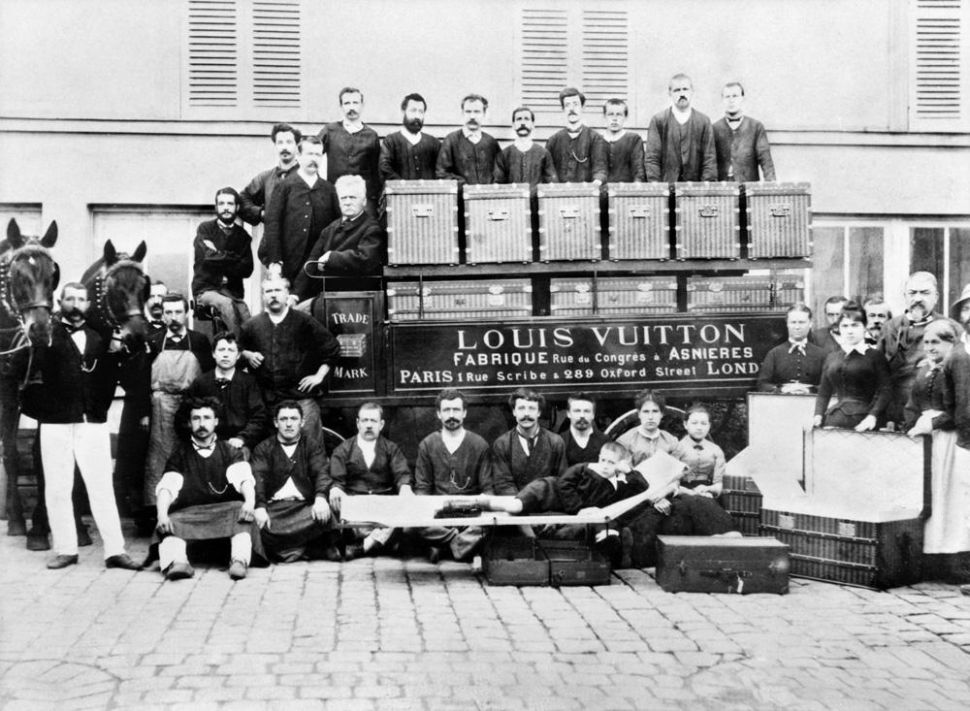
Louis Vuitton’s monogram began as a memorial and a defense against imitators. In 1896, Georges Vuitton arranged his father’s initials in a repeating pattern across the company’s luggage. The material changed in the late 1950s, when Claude-Louis Vuitton developed a coating process that made monogram canvas more flexible, allowing a covering for rigid trunks to take on softer shapes. By 1959, the Speedy, originally a travel bag called the Express, had appeared in monogram canvas as a handbag. Nicolas Ghesquière drew on the trunks themselves for his first women’s collection in 2014. His Petite Malle borrowed the box construction and metal fittings of luggage made for banker and philanthropist Albert Kahn, reducing them to a bag small enough to wear over the shoulder. Now part of LVMH, the house revisits Georges’ pattern for its 130th anniversary with Monogram Origine, a linen-and-cotton jacquard in pastels drawn from the archive. Time Trunk bags reproduce old luggage hardware and wood grain in trompe l’oeil.
Louis Vuitton family.
Louis Vuitton
Hermès
Robert Dumas married into Hermès, then applied a saddler’s eye to objects beyond the stable. The son-in-law of Émile Hermès designed the company’s first silk scarf in 1937 and also developed the handbag that would later become known as the Kelly. For his Chaîne d’ancre bracelet, the house says, he adapted the oval anchor links he saw along the Normandy coast. These accessories widened a harness maker’s clientele beyond riders before Dumas became head of the business in 1951. His son Jean-Louis took charge in 1978, extending the family succession that now places two sixth-generation cousins at the top: Axel Dumas leads the business, and Pierre-Alexis Dumas oversees artistic direction.
Hermès.
Hermès
Chanel
At Chanel, the family dynasty is actually called Wertheimer. Pierre Wertheimer and his brother Paul entered the perfume business with Gabrielle Chanel in 1924, beginning the family’s long association with the house. Its public image came to depend heavily on the designers who interpreted Coco’s work. Karl Lagerfeld began reshaping that identity in 1983, eventually making his own image almost as familiar as hers. His longtime collaborator Virginie Viard succeeded him in 2019, before Matthieu Blazy joined from Bottega Veneta in 2025. For fall 2026, Blazy wove Lurex and silicone into tweed suits that shimmered and turned partly transparent, showing them with untucked shirts. The choice of designer remains with the Wertheimers. Le Monde reported in 2024 that Pierre’s grandsons, Alain and Gérard, owned the company outright, and Reuters described Chanel as privately owned by the family in 2026.
Coco Chanel.
Chanel
Lanvin
Before she inherited the company, Jeanne Lanvin’s daughter changed what it sold. Marguerite, born in 1897 and later known as Marie-Blanche de Polignac, inspired the children’s clothes that expanded her mother’s business beyond millinery. Their relationship became the company emblem through Paul Iribe’s drawing of a mother bending toward her child. Jeanne also commissioned Arpège as a birthday gift for her daughter in 1927, nearly two decades before Marie-Blanche assumed the presidency after her mother’s death in 1946. She continued designing collections until 1950. The label now belongs to Lanvin Group, and Peter Copping directs its collections. His winter 2026 Compagnon and Venus bags feature geometric leather inlays inspired by Art Deco.
Jeanne Lanvin.
Lanvin
Dior
Christian Dior led the company bearing his name for little more than a decade. His first collection appeared in 1947, with the disciplined waist and expansive skirt soon called the New Look. Yves Saint Laurent entered the atelier as Dior’s assistant in 1955 and was just 21 when he took over after the founder’s death in 1957. His 1958 Trapèze collection loosened the founder’s silhouette, releasing the waist so the dresses floated from the shoulders. Later successors returned to Dior’s fitted tailoring, including Maria Grazia Chiuri, who designed a new version of the Bar jacket in 2024, nearly eight decades after the original. Jonathan Anderson took responsibility for the women’s, men’s and haute couture collections the next year.
Christian Dior.
Dior
Goyard
Founded as Maison Martin in 1792, the business took François Goyard’s name in 1853. His son Edmond introduced Goyardine canvas in 1892, drawing the family’s history into its surface. The house says the dots recall logs carried by Goyard ancestors, and the chevrons repeat the Y in their surname. A vintage trunk brought a future owner into the story in 1974, when Jean-Michel Signoles found one in a Paris antiques shop. He became a collector and, in 1998, bought the company itself. Under his ownership, Goyard added workshops in France and opened boutiques abroad.
Goyard.
Goyard
Schiaparelli
The couture house that Elsa Schiaparelli closed in 1954 began its return in 2006, when Diego Della Valle bought the name and archives. He waited for the former premises at 21 Place Vendôme to become available, reopening at the address in 2012. Christian Lacroix’s tribute collection in 2013 preceded the resumption of couture shows in 2014. Daniel Roseberry became creative director in 2019 and carried Schiaparelli’s surrealist motifs to the red carpet and stage. For Ariana Grande’s performance at the 2025 Oscars, he designed a glittering gown with a heel rising behind her shoulders. The V&A’s exhibition guide connects it to Dorothy’s ruby slippers in “The Wizard of Oz” and the shoe hat Schiaparelli created with Salvador Dalí.
Schiaparelli gowns.
Schiaparelli