
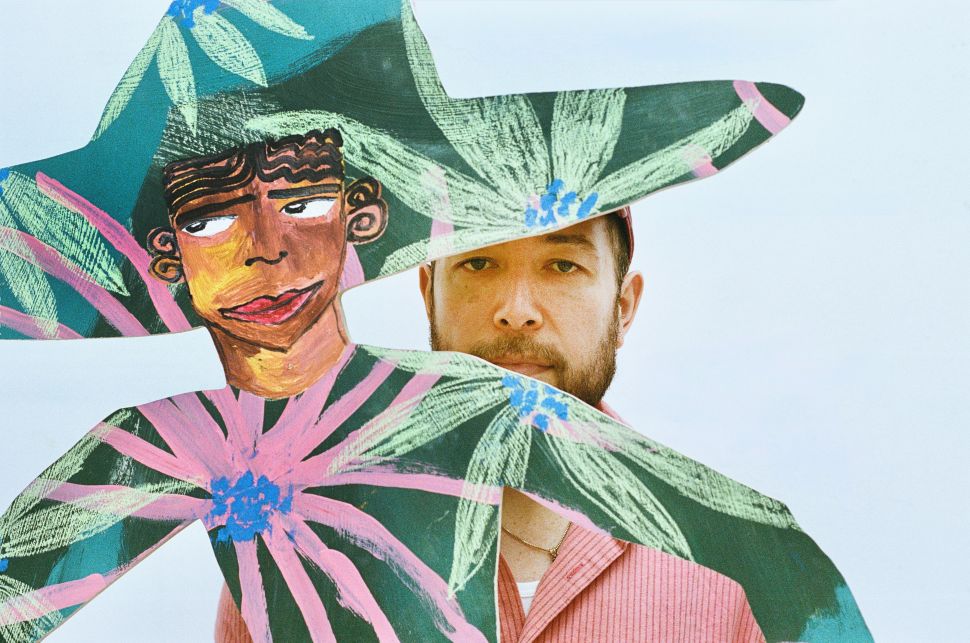
There is a diasporic narrative focused on migration, displacement, longing and the desire to re-establish a sense of belonging that animates the artist Studio Lenca (known otherwise as José Campos) and his practice. But there is also a sense of hope and joy, expressed through color and the playfulness of his cartoonish style. “Color is important because color is about joy,” Campos tells Observer. “I don’t see joy as the opposite of a difficult history. It’s often a way for people to survive difficult histories.”
Campos left El Salvador as a child during the civil war, grew up undocumented in the U.S. and later trained in dance before moving into visual art. By 2023, he had already embarked on a meteoric yet sustainable rise, both institutionally and in the market, beginning with a series of solo presentations across different markets. He showed with Tang Contemporary Art in Seoul, Bangkok and Hong Kong, as well as with EDJI Gallery in Brussels, Kates-Ferri Projects in New York, Halsey McKay Gallery in New York and Carl Freedman Gallery in Margate, which began working with him following his period at Tracey Emin’s residency and sold out his presentation at Untitled Miami last year. Around the same time, the Parrish Art Museum acquired the 15 life-size painted wood figures from “Chisme” for its permanent collection, and his work entered the collection of Pérez Art Museum Miami.
The artistic nom de guerre Studio Lenca reflects both the multidisciplinary nature of Campos’s practice and the deep roots his work maintains in the culture of his homeland. “Studio” refers to a space of experimentation rather than a fixed physical studio, something that can continually shift—a laboratory, an art studio, a fashion studio or a photographic studio. “Lenca,” meanwhile, refers to the Indigenous Lenca people of El Salvador and Honduras and, more personally, to Campos’s own ancestral connection to El Salvador.
Art for Campos has always been, first and foremost, a way to interrogate identity and explore this longing for a country he had no real memories of, but which he could imagine and project himself into through his family’s stories. His most recent paintings are populated by highly stylized, often monumental figures. They can read simultaneously as alter egos and archetypes, as portraits of an individual projecting into the collective. These recurring characters first emerged from Campos’s obsession with the Historiantes of El Salvador and their traditional dances. “That was a moment in my life when I was a dancer myself,” he said. “I was studying ballet in the U.S., and I thought to myself, ‘I wonder what kind of dance comes from El Salvador?’ What’s interesting is that I was interested in learning about where I come from.”
Campos’s early investigation into Salvadoran traditions became part of a larger attempt to assemble the fragments of an identity he had inherited but not fully experienced firsthand: “I don’t really have memories of childhood there because I was four years old. But I have the stories that I grew up with through my mother. It was really about wanting to know about yourself, trying to put all these puzzle pieces together. That’s how I came to the figures.”
As he began experimenting with paint, color became a fundamental part of his practice. “It has a way of transporting you to a different place. For a long time, my studio was in the U.K., and I felt very disconnected from being Latino and being Salvadoran. Color became a way for me to create that environment in my studio.”
Much of his practice has been an attempt to build a space of expression, identity, empathy and belonging. Even now that Campos can return to El Salvador quite often, people there sometimes identify him as “American,” a term he deliberately resists because, as he points out, America extends far beyond the United States. Then, when he is in the U.S., people increasingly identify him with the U.K. It is an ambiguity of identity and belonging shared across diasporas, and, according to Campos, the result is a persistent feeling of belonging everywhere and nowhere at once.
For this reason, he no longer thinks of the work simply as an attempt to reconnect with a lost origin. Increasingly, he sees his practice as a way of holding space for people who have experienced the same forms of invisibility that shaped his own life. “If a gallery wants to have a show, now I think, how can we talk about immigration through the work?” he reflects. “How can we create an understanding of these communities?”
Campos frequently works directly with migrant and undocumented communities, including people at the U.S. border and, more recently, undocumented teenagers in New York in a project at MoMA PS1. Operating under the artist-run platform LA ESCUELA___, alongside artists including Laura Anderson Barbata and Lizania Cruz, he embarked on this collective learning project in Homeroom this fall, charting pedagogies from Latin America and South America and the Caribbean with diasporic communities in Queens and across New York.
The political climate in the United States has made the conditions surrounding those collaborations increasingly sensitive, Campos says. He is now having more conversations about safeguarding the people he works with and is careful not to publicize gatherings involving undocumented participants or expose them unnecessarily. He believes such communities possess their own knowledge and answers; what they often lack is the space in which those experiences can be expressed and recognized.
His works operate in a similar way; Campos describes them as “ninjas.” They have a chameleonic quality that allows them to move across contexts and defy rejection, even from certain viewers, precisely through their color and playfulness. A viewer may initially be attracted to the painting through its color, composition or beauty, only to encounter the migration story or political perspective embedded within it afterward. For Campos, this ability to bring people into proximity with experiences they might otherwise resist is part of art’s power: “What’s interesting to me is how these figures move through different situations, and that is directly linked to my own experience of navigating the U.S. as an undocumented person. You have to be creative. You always have to be watching who’s around you, never fully relaxing.”
Notably, he places his painted figures in moments of beauty, leisure and repose, creating a tension between vigilance and the possibility of rest. Most often, they do relax, suspended beneath their large hats in the bright sun, surrounded by lush tropical greenery. Sometimes these natural landscapes, this lively botanical life, seem to enter into them, merging and breathing as a single organism in a generative symbiosis that nevertheless still suggests the tension between natural and anthropic environments.
Three things come to his mind when Campos thinks about nature and landscapes. First, nature does not care about man-made borders, including political borders. He also connects landscapes to forms of knowledge he associates with El Salvador: “For example, my tía knows that it’s going to rain soon because she looks at the water in the river. That’s a different type of understanding that I miss when I’m in the U.K.”
Lastly, he believes even the most lush tropical landscape hides its pitfalls. He has often imagined what it might have meant simply to live peacefully within the country’s beautiful environment—a possibility unavailable to many people, which means landscape is also political. “People who travel from Central America and South America to the U.S. go through these beautiful jungles and beautiful deserts, but they become very dangerous places,” he notes. “So it’s about thinking through the landscape and how we navigate it.”
Although Campos is best known as a painter, he resists defining himself exclusively through painting. His path toward the medium began through dance and video, and sculpture; performance and moving image remain integral to his practice, and he considers himself a multidisciplinary artist.
That expansive approach is particularly visible in his latest exhibition at LagoAlgo in Mexico. There, cut-out figures occupy the physical space alongside a mural conceived as a landscape, creating an environment rather than a conventional presentation of discrete artworks. Titled “Hacer Lugar“—”to make space”—it extends Campos’s thinking about how communities are formed. Having worked in numerous classrooms and community rooms, he has come to believe that a space is never defined simply by its architecture. What gives it meaning are the conversations and relationships taking place within it. His installations attempt to produce environments capable of holding precisely those relationships. “I’m always looking to make work that touches on different points of my life or other people’s lives in order to create an environment that can hold community,” he explains. For him, this idea is inseparable from diasporic experience. When an original sense of home has been disrupted, community can become a way of producing another form of place.
That principle also informs new works created for The Armory Show in New York, where he is focusing specifically on the Salvadoran diaspora and the circulation of money between migrants and the countries they have left behind. Campos grew up with the experience of sending money back to El Salvador, a practice shared by diasporic communities around the world: “Currency becomes almost like a map of relationships between countries, and that’s quite interesting.”
In his presentation with Kates-Ferri Projects, he will debut a new series of works inspired by those reflections and by the fate of the Salvadoran colón, the country’s former currency, which was displaced when El Salvador adopted the U.S. dollar. Through it, Campos addresses the economic and political relationship between El Salvador and the United States while also invoking a longer colonial history—the colón itself was named after Christopher Columbus. “Something that once held value now becomes something that holds memory, and that’s quite interesting,” he says. The presentation’s title, “Money Dance,” refers both to the movement of money across borders and to a tradition he remembers from Latino weddings, in which guests line up to pin money onto the bride or groom. “It’s a way of helping pay for the wedding, really; diasporic communities leaning on each other.”
In the works, currency is both a social and an economic device. These new works speak to migration, colonial history and political relations, but also celebrate the ways diasporic communities sustain one another across borders. Rather than resolving the question of home, Campos’s practice inhabits that uncertainty, using movement, community and the construction of new spaces as ways of imagining forms of belonging that are not dependent on a single place but can instead be found within us all.