
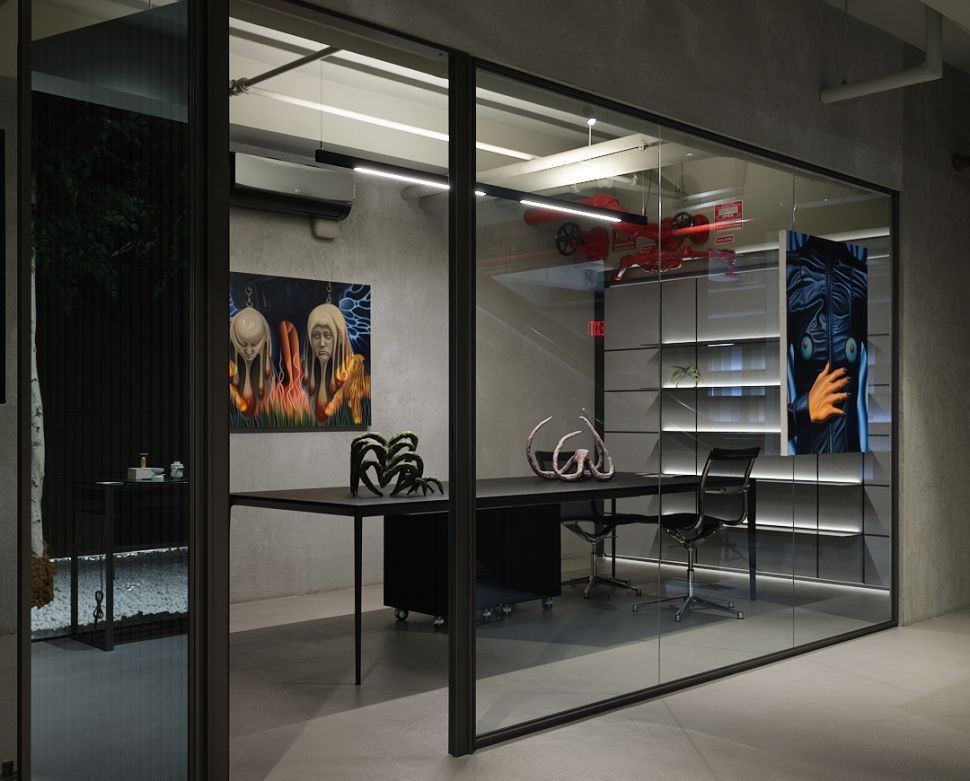
SPLIT LEVEL Fair integrates paintings and sculptural works into a glass-walled office setting inside Rimadesioâs New York showroom.” width=”970″ height=”781″ data-caption=’SPLIT LEVEL returns to New York’s Rimadesio (102 Madison Avenue) for its second edition October 1-3, 2026. <span class=”media-credit”>Courtesy of SPLIT LEVEL</span>’>
The launch of a new art fair always invites the same question: do we really need another? Yet even as there are real concerns about sustainability in an ever-more-crowded fair calendar, it’s refreshing to see new art fairs emerge specifically to test models that are a direct response to some of the biggest challenges galleries, and the broader market, face today. SPLIT LEVEL Fair, which returns for its second edition October 1-3, is one such fair. With its community-driven format, it is part of a growing group of salon-style, booth-free “dealer to dealer” fairs that offer the visibility and engagement of a conventional art fair while allowing participating galleries, and the host venue, to share resources.
Hosted at Rimadesio’s two-level NoMad flagship showroom, SPLIT LEVEL takes a playful approach to installation within the design-centered space, turning it into a community hub where art is displayed alongside an expansive program of performances, talks and activations. The fair’s founder, artist and dealer Jaqueline Cedar, intentionally avoided one of New York’s already saturated art weeks with the goal of encouraging slow looking and deeper engagement.
Cedar moved into gallery work as an extension of her own practice, launching the artist-run Good Naked, a nomadic independent gallery whose ethos and model reflect not only the adaptability of the SPLIT LEVEL format but also the very conditions from which it emerged. “I could have easily operated in a more experimental way without selling work,” she tells Observer, recalling how Good Naked grew out of her desire to curate and develop alternative opportunities for artists. It quickly grew a substantial exhibition program, and during the pandemic, she began organizing shows in parks and other nontraditional settings. “As an artist who didn’t come from the gallery side, and who was really interested in understanding that world, you realize that sustainability is a big part of surviving as an artist and as a gallery.”
That model eventually led Cedar to Rimadesio, which had expressed interest in collaborations. When it offered exhibition space for Good Naked, she quickly realized that its scale and short-term programming model could accommodate something larger. She was tapping into an often underestimated potential, particularly in a city like New York: even as real estate costs remain high, businesses in other creative industries are often interested in collaborating with art organizations for mutual benefit, generating new opportunities for visibility and engagement on both sides.
Cedar quickly asked whether she could invite other galleries. Rimadesio agreed, and she began reaching out to dealers and arts professionals with whom she already had some relationship, through previous exhibitions, Good Naked projects, NADA, Future Fair or other collaborations. The inaugural edition of SPLIT LEVEL brought together 15 galleries, largely drawn from this existing network. This year, 16 exhibitors were selected through an open call for the first time, resulting in a roster that brings together a wide variety of programming and business models, reflecting different approaches to building and sustaining contemporary art practices.
Some, such as SPILL 180, operate as interdisciplinary art spaces supporting experimental artists, creative technologies and research-driven projects. Others, including Good Naked itself and The Sphinx, operate as itinerant curatorial projects developing exhibitions across shifting contexts and locations. Still others, like Kelly-McKenna Gallery, Artist Estate Studio and Blah Blah Gallery, combine contemporary exhibition programs with art advisory or artist management, operating between artists’ studios and the marketplace and providing management, archival, strategic and promotional infrastructure to support artists’ careers and preserve their legacies.
“When I invited collaborators into this opportunity last year, a major intention was to help sustain and build networks across galleries and platforms,” Cedar says, arguing that one of the main reasons galleries participate in fairs is to make their programs more sustainable. “It’s also an enormous advertising opportunity for most spaces. I knew this could be a way to pool networks and build on those conversations.”
Another goal of the fair is to explore new contexts for exhibiting contemporary art and to bring together exhibitors who are similarly navigating the relationship between experimentation, artist support and commercial sustainability. Because Rimadesio is built around the structures and objects of domestic life, it naturally creates a more intimate, familiar environment where visitors tend to linger longer and conversations unfold differently than they might in a conventional white cube. “There’s an element of people staying longer when there’s a comfortable space to inhabit and when it feels familiar, and the conversations around looking become different,” Cedar notes.
The showroom does come with certain constraints: exhibitors cannot drill into the walls. But as Cedar points out, limitations can often create opportunities for experimentation. “We’re not drilling into anything; the work has to exist within the space as it already is. So we’re stringing things from the ceiling and placing them on bookshelves and in drawers. It becomes a much more playful approach to the way you can live with work in that kind of environment.”
The setting also allows Cedar to introduce programming aligned with her longstanding interest in theater and video. “My father is an actor, and I’ve always been very interested in bringing theater and video into art spaces and commercial spaces, which is less common in a fair context,” she explains. Rimadesio has two screens in the showroom, allowing for video programming as well. Cedar also wanted to stage a theatrical piece that moved between rooms, something the space made possible. “We collaborated with a playwright to write something specifically for that location.”
Although SPLIT LEVEL feels more like an expanded exhibition or multidisciplinary community platform, Cedar intentionally calls it a fair because commerce and sustainability remain central to the project, and people need to understand that the works are for sale, not just on display.
The fair’s purpose is to cultivate new collectors and younger audiences by creating a setting where people can spend time, return for programs, speak with artists and gallerists and learn about different gallery models. “There’s an educational element to it as well,” according to Cedar. The talks, performances and other activations are therefore not separate from the commercial side; they help create the kind of extended engagement she wants the fair to encourage. “I wanted to give people living and working in New York a chance to have something they could really spend time with,” she adds.