
With midterms right around the corner, there’s no better time to check out “Turn the volume up!” at the Nasher Museum of Art. Curated by the museum’s Xuxa Rodríguez, the new show is a survey of protest art drawn mainly from the permanent collection, spanning from the 1930s through today. Highlighting blue-chip practitioners like Kara Walker, Carrie Mae Weems, the Guerrilla Girls and Chuck Close alongside less flashy names like Marielle Plaisir, Robert Colescott and Sam Durant, the exhibit is organized in six sections—Remarks, Organize, Records, Dissents and Petition—and explores how communities mobilize and advocate for justice.
Just as speeches in Congress are put on record, so can average citizens go to City Hall or public meetings and say, “I’d like my remarks recorded.” Similarly, artists in the show have compiled their own remarks commenting on historical and current injustices, like Colescott’s The Wreckage of the Medusa, his 1978 prologue to Théodore Géricault’s immortal 1819 painting, The Raft of the Medusa, depicting survivors of a shipwreck that made headlines at the time. Colescott’s response is to change the context of the disaster to comment on his own country and Jim Crow era injustices that persist today.
“He’s here right after the ship is sunk. He’s centralizing it in the United States and talking about the history of racism and discrimination,” Rodríguez says of Colescott’s acrylic canvas, one of the few loaners for the show. In it, the ship’s captain hides his face in shame as a stereotypical black man swims like a shark toward a buxom blonde. “You have that person in power, who’s the captain, kind of covering his eyes and ignoring the caricatures that are around him. I like to think of it as Colescott making a very incisive comment on when you know what’s going on, you can perpetuate problems that you have the power to change.”
“Turn the volume up!“
Artists: Various
Venue: Nasher Museum of Art
Address: 2001 Campus Drive, Durham, NC
Through: July 11, 2027
In the same gallery, Kara Walker’s 2005 series of screen print and lithographic compositions feature her trademark silhouettes of slave figures commenting on images from a Harper’s Magazine pictorial history of the Civil War. Her additions project the personal toll of war on slaves along with all non-combatants, an attitude missing from Harper’s mainly anodyne imagery.
“We had, from the beginning, exclusions built into the design of the nation. So, you have 250 years of amending and coming back in to rewrite and expand and extend policies to include folks who were never part of the original conversation,” observes Rodríguez. “It’s an ongoing struggle that we keep returning to because we keep finding what else needs addressing and what else needs tending to.”
On the wall opposite Walker’s prints, the Guerrilla Girls keep an account of the art world’s most egregious practices in their Most Wanted: 1985-2008. A crowd pleaser is their movie poster for the fictional film, The Birth of Feminism, starring Pamela Anderson as Gloria Steinem, Halle Berry as Flo Kennedy and Catherine Zeta-Jones as Bela Abzug, a Jerry Bruckheimer production directed by Oliver Stone. Nearby hangs their 1991 list of the most bigoted galleries in New York with an accounting of how many shows from 1989-1990 included works by women and minority artists. Leo Castelli rings up zero on both accounts, likewise Gagosian, Gemini G.E.L. scores two and one respectively and Pace edges them out with three and one.
“That was just like 30 something years ago. It’s very recent history. How many women had one person exhibitions at New York City museums last year? And it’s like between the Guggenheim, the Metropolitan, the Modern and the Whitney,” notes Rodríguez. “I hope what guests take away is that they can do something like this as well. Maybe they don’t necessarily identify as artists themselves, but they can take action in these ways.”
The section labeled “Organize” is an invitation to citizens to form caucuses and devise strategies for exercising and ensuring their right to democratic participation through both protest and the vote. Included are screen printed signs by Bill Fick—George Floyd in red on yellow with an upraised fist, a black and white photo of a young John Lewis with the phrase “the vote is precious,” and “Justice for All!” beneath a tiger head. Marielle Plaisir’s sumptuous 2020 collage J. Baker is a recent acquisition on exhibit at the Nasher for the first time. It depicts iconoclast Josephine Baker striking a playful pose and crossing her eyes opposite a French nobleman and his dog in a stylized tropic setting.
“Not only in terms of her work internationally in music and entertainment, but also her work in the civil rights movement as someone who was a very loud speaker in that conversation, Baker was also an early queer activist who was openly bisexual, very visible to folks, and showing that you too are accepted in the popular sphere,” says Rodríguez of Baker, who also worked as a spy during the Nazi occupation. “Through irreverence, she knocks down and dismantles problematic power structures.”
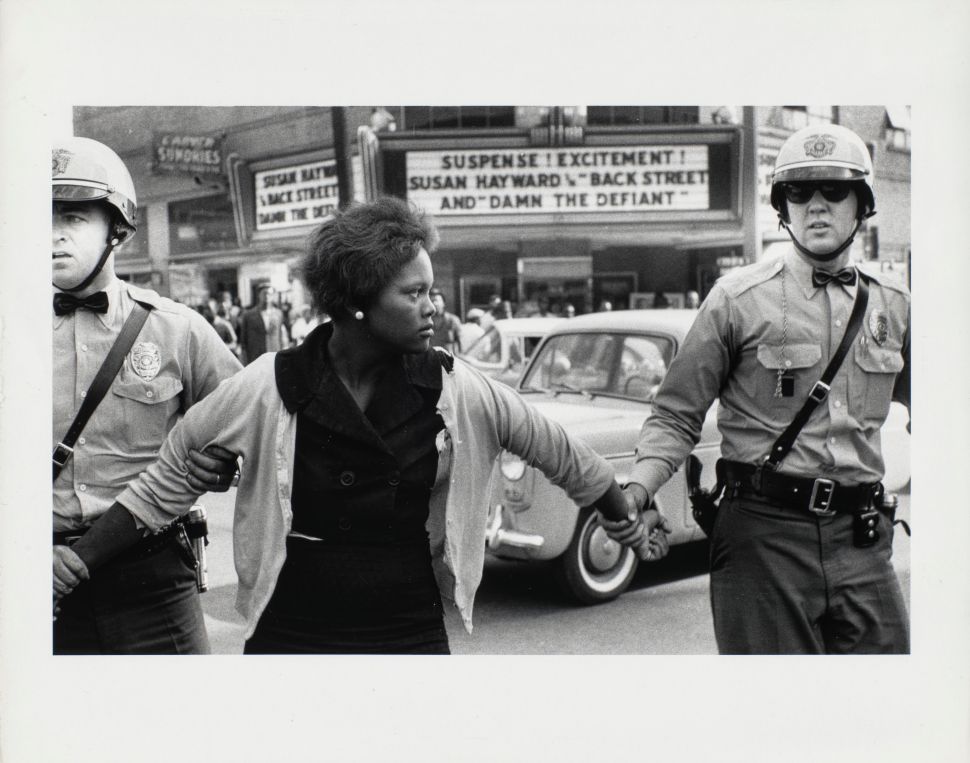
Print and lithography comprise most of the show, but also collage and, of course, photography, which makes up much of the section entitled “Records.” Included are images of ordinary people, so often the targets of injustice, like the workers in Milton Rogovin’s black and white shots from 1976-1977, and his Mexican miners from the 1980s. Most striking is Spider Martin’s shot of MLK speaking to a crowd following the Selma March. Unlike most images of King, this one includes the crowd, an essential element in the civil rights icon’s greatness.
The final gallery, “Petitions,” includes digital works like Jordan Eagles’ BE-AI, a 2023 series using A.I. to generate images of gay men donating blood. He asked OpenAI’s ChatGPT to convince him why gay men may not donate blood. ChatGPT responded that discrimination is wrong. When Eagles asked DALL-E, OpenAI’s image generating software, for depictions of queer, gay and non-binary men donating blood, it conjured stereotypes of queer men—same body type, same hairstyle—with glitches that render them something other than human.
“This community is very diverse, but here you have the same stereotype over and over through a software that has just said, ‘I’m not supposed to discriminate,’” notes Rodríguez. “There already seems to be bias being aggregated in the algorithm.”
While the organizational thrust of “Turn the volume up!” is sometimes haphazard (not sure why Chuck Close’s photo portrait of Al Gore falls under “Organize,” or why Jamal Cyrus’ flattened horns in Conga Bomba are “Dissent”), the thesis of the show is that every voice matters, no matter how insignificant and powerless many feel.
“People need to speak up,” says Rodríguez as the finishing touches are put on the show and guests gather in the lobby for the preview. “It’s foundational of the United States to be like, how can we make it better? How can we change it? And to criticize America isn’t to hate America.”