
Early this year, much of the world tuned in to watch Alex Honnold climb the Taipei 101 skyscraper live from Taiwan, but Honnold’s greatest achievement had already been captured on film long ago. Free Solo (2018) documented his effort to become the first person to climb Yosemite’s El Capitan without ropes of any kind, and its shots are far more impressive than anything Netflix would ever produce.
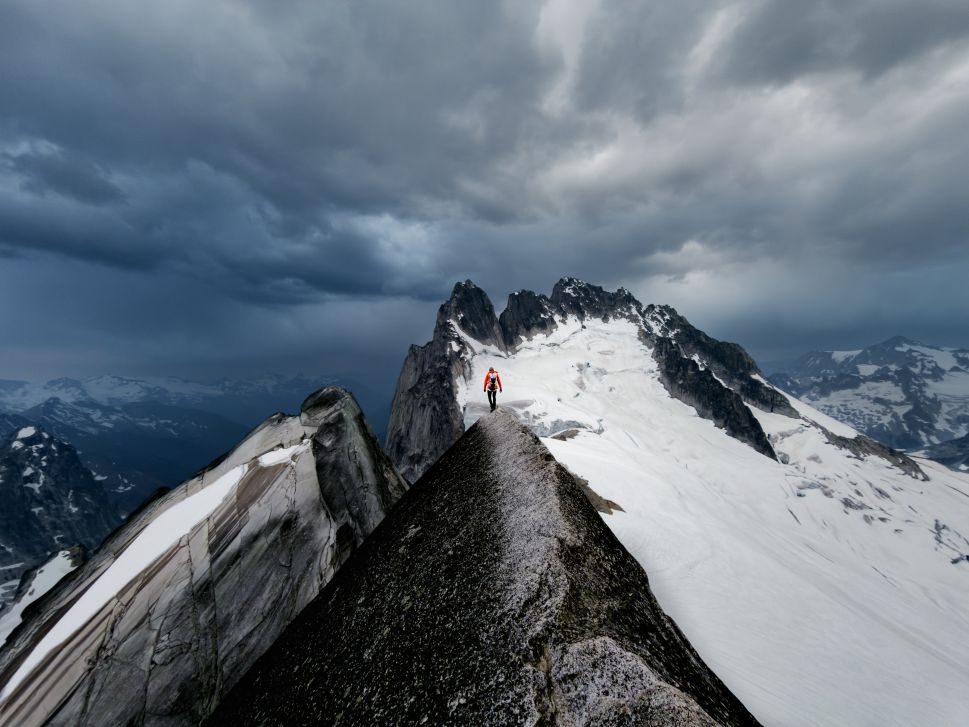
Those wild close-ups come courtesy of the film’s co-director Jimmy Chin. This week he was one of three artists in “What Holds Us,” a this-weekend-only group exhibition in Chelsea presenting the work of Chin, Alex Prager and Jack Davison. (From there, the exhibition will travel to London and Shanghai.) Chin’s contribution features his typically gorgeous shots of mountains, in this case the Bugaboos in southeastern British Columbia. There are sweeping vistas, textured crags and a shot of his climbing partner Conrad Anker gazing at the snow-topped peaks that recalls the Rückenfigur of Caspar David Friedrich and the German Romantics.
“Normally I don’t get the opportunity to go and just make art, just shoot for a show,” Chin, who worked with Apple on the project, told Observer. “It’s a more personal creative idea and vision that I could shoot to. It’s not to cover an editorial story, it’s not for a commercial client. They said, ‘Carte blanche.’” It was an opportunity he had to take, despite being on deadline for a book and a film.
Chin’s contributions came together in just 36 hours spent on the mountain after the airline lost his luggage. The resulting photos, though gorgeous, reflect that bare-bones existentialism. “I’ve always been interested in that intersection of human passion and purpose and meaning, intersecting with these incredible, wild, raw landscapes,” he said. “These places have brought me so much life, and yet have also taken life away from me. Friends.” He does not consider this morbid. “These are the places that make me face my mortality on a consistent basis, and that actually has an impact on my choices. I think we tend to shy away from thinking about it. In a lot of cultures, it’s something that you do examine.”
“These places make me feel so insignificant, in the best way,” he added. It would be hard not to feel minuscule around the towering Bugaboos. After the Rückenfigur photo, a storm moved in with winds gusting at 70 miles per hour. Chin had to hold on not to get blown off the ridge. “But I would rather have this than a clear blue sky. It’s so much of the feeling of these places.”
Alongside the panoramas hang more experimental abstractions. These glacial textures were shot from a helicopter on the way out—the streaked blue-white fields read as brushstrokes. “I’m Chinese and grew up doing calligraphy,” said Chin. “I wanted something striking that you couldn’t wrap your head around, because you just don’t know what it is. There’s so much beauty and creativity in nature that you never really expect. I wanted to isolate it and extract it. These are the pieces that are easy to miss.”
It turns out that all you need to make some great photography is a helicopter, a phone and placidity about your own death.