
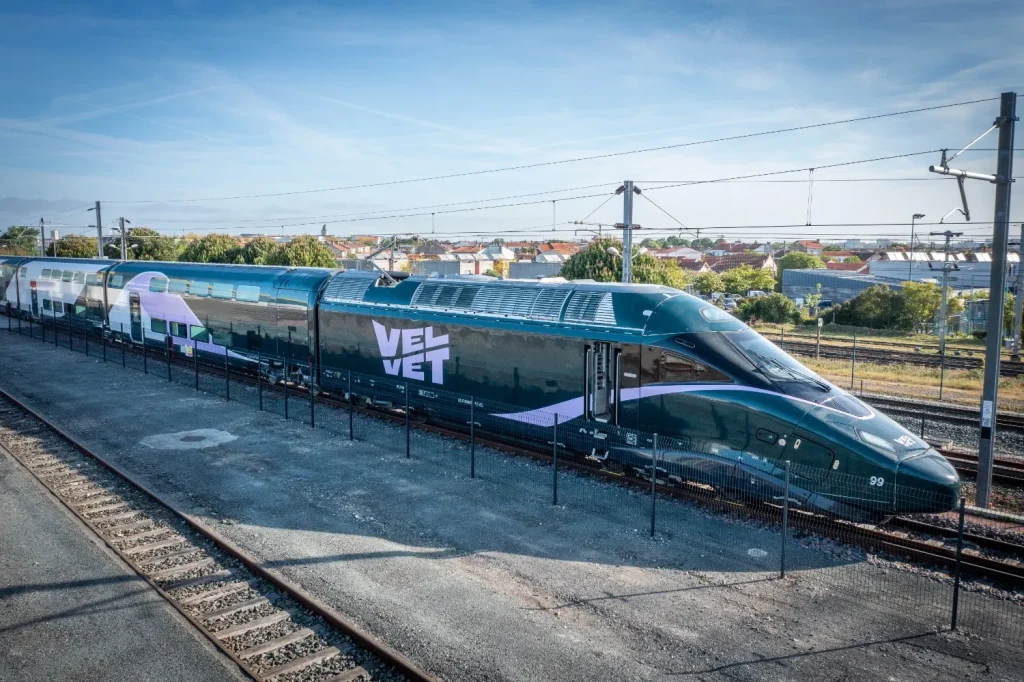
France’s mighty state-owned rail company SNCF is facing competition with the arrival of new operators on French routes – but will more competition actually mean cheaper tickets for passengers?
It had a monopoly on French train travel for decades, but EU rules mean that SNCF has been forced to accept competition – with operators including Italy’s Trenitalia and Spain’s Renfe already running trains on some routes, while French start-up Velvet is preparing to launch high-speed services from 2028.
The latter has received its initial authorisation and plans to offer around 10 million additional seats on routes including Paris-Bordeaux, Paris-Nantes and Paris-Rennes.
And more competition could be on the way for cross-Channel journeys, too. Virgin has received approval in the UK to operate up to 20 daily return services from London to Paris, Brussels and Amsterdam from 2030, potentially ending Eurostar’s decades-long monopoly on passenger trains through the Channel Tunnel.
The increasing competition has a myriad of potential effects, but for passengers there is one big question – will it mean cheaper train tickets?
France’s train competition
Since it was created in 1938, the Société Nationale des Chemins de Fer Français – aka SNCF – dominated the French market, but as the European Union pushed to open national rail markets to competition and revitalise the sector, other operators have gradually entered the French market.
The rapidly growing demand for rail travel – fueled in part by climate anxiety as people ditch planes for trains – is one reason competition is becoming increasingly important.
SNCF’s TGV services carried 126 million passengers in France in 2024, or 163 million when its European activities are included. The company expects that figure to reach 240 million by 2034 which is around 50 percent more passengers than today, and plans to increase its TGV capacity by 25 percent over the same period.
Competitors, therefore, tend to pitch themselves as offering extra services to supply the demand, rather than poaching passengers.
Trenitalia – Italian company Trenitalia entered the French high-speed market in 2021. It operates its Frecciarossa high-speed trains on routes including Paris-Lyon and Paris-Marseille.
For a Paris-Lyon trip with SNCF this Friday, a one-way ticket costs €115, compared with €63 with Trenitalia. In response, SNCF has matched these fares with Ouigo, its low-cost subsidiary. On average, fares on the Paris-Lyon route have fallen by 10 percent since competition began, according to France-Info.
READ MORE Ouigo: Everything you need to know about France’s low-cost trains
Renfe – Spanish operator Renfe has also entered the French market, although its expansion has been more limited and complicated than initially expected.
Renfe previously worked with SNCF on international services, but after the French company ended the partnership in 2022, Renfe sought to develop its own services between France and Spain. However, difficulties getting its trains approved for use in France have limited its expansion. Renfe now operates services between Lyon and Barcelona and Marseille and Madrid, while the direct Paris-Barcelona service is only operated by SNCF.
Mark Smith, a rail travel expert behind the train guide The Man in Seat 61, described the Paris-Barcelona route as “underprovided and overpriced”, arguing that there is room for more trains and lower fares.
Velvet – The biggest new company to France’s domestic high-speed market is likely to be Velvet, which is planning to launch services from Paris to Bordeaux, Nantes, Angers and Rennes from 2028.
The company plans to add around 10 million seats a year to these routes, arguing that existing services are already struggling with a shortage of capacity.
Velvet told The Local, “today 15 percent of passengers cannot find a seat between Bordeaux, Nantes, Angers, Rennes and Paris because trains are full. If nothing is done, this will be 25 percent by 2030.”
The train company’s president, Rachel Picard, had also said the company’s objective is not simply to take SNCF passengers, but to “make the train market grow”.
Le Train and Kevin Speed – Le Train is a private French high-speed rail operator preparing to challenge SNCF’s long-standing position with regional high-speed services in western France, with planned direct links including Bordeaux-Nantes, Bordeaux-Rennes and Rennes-Paris. The company says it wants to offer a different high-speed experience, with trains designed around accessibility, luggage and bicycle space. The launch is expected in 2028.
Another start-up, Kevin Speed, is planning a low-cost high-speed service called Ilisto, aimed at providing frequent services between Paris and regional cities. Its model is intended to offer high-speed travel at more accessible prices. The company had initially hoped to launch earlier, but in September 2026, it announced that its planned start had been pushed back to 2030.
Why is rail competition so difficult in France?
Jon Worth, independent railway commentator, told The Local that “access to railway tracks and train paths, access to stations, the ability to sell tickets effectively and maintenance facilities” all present problems for potential competitors in France.
But he said private operators can overcome some of these obstacles. For example, Velvet has access to its own maintenance facility near Bordeaux, because it does not have access to SNCF maintenance infrastructure. Meanwhile, Trenitalia sends its trains back to Italy for maintenance, but these barriers make entering the market more complicated.
The ticketing issue is particularly important. Unlike flights, where consumers are accustomed to comparing dozens of airlines through different websites, France does not yet have the same culture of comparing multiple train operators.
But that may soon change – the French Senate has adopted a measure that would require the SNCF Connect website and app to sell tickets from competing operators from December 31st, 2027, although the legislation still has to complete the parliamentary process.
Another reason competition is so difficult, according to Worth, is that French passengers are accustomed to only thinking of SNCF when they want to take a train.
Mark Smith echoed that opinion, saying the company “has been entrenched in French culture for many years”.
So will the price of tickets go down?
More competition does not necessarily mean every passenger will benefit in the same way. One concern raised by Jon Worth is that competition tends to work best on the busiest routes, where there is enough demand to support several operators.
“If you’re in a smaller town, you may lose out from competition,” Worth said – it’s notable that a lot of the new routes connect Paris and other French cities, rather than the smaller towns.
Mark Smith sees congestion as a potential downside, but said that the experience of countries such as Italy shows that the additional capacity can outweigh the problems. Competition there brought more trains and helped expand the overall high-speed rail market, rather than simply dividing the existing passengers between operators.
So the crucial question – will it mean cheaper tickets?
Velvet said it was too early to say what price difference would be offered against the SNCF but still said passengers could expect lower prices.
The company told The Local: “As trains are full, passengers only see the highest prices. Making 10 million additional seats available on these routes will help to slow the rise in prices for all passengers and enable them to choose the train over other modes of transport that produce more CO2”.
Mark Smith also sees the Italian market as an example of what can happen when competition is introduced. In Italy, the arrival of Italo alongside Trenitalia increased choice and helped expand the overall high-speed rail market, rather than simply dividing the existing pool of passengers between two companies.
Smith expects a similar dynamic in France. But he cautioned that passengers should not necessarily expect prices to keep falling indefinitely. “You could see an initial dip in prices when a competitor enters”, he said, “before fares recover to a sustainable long-term level”.
Jon Worth added that he expects competition to drive up the number of trains and reduce prices, at least to some extent.
When it comes to the Eurostar, there are additional problems including the fee that the tunnel operator GetLink charges to operators, which adds to the price of tickets.
So how expensive is SNCF anyway?
Of course, it depends on the route with the high-speed TGV routes the most expensive while the slower local TER routes are usually cheapest. For longer journeys, SNCF also has its budget line OuiGo, which offers cheaper tickets and a more basic experience (eg no buffet car, limit to the number of bags).
Here are some example fares for different routes next Friday (about a week after publication), travelling in the evening during the busiest period, with SNCF and on a one-way ticket.
Paris-Marseille: €138
Paris-Nantes: €101
Paris-Bordeaux: €130
Paris-Barcelone: €139
Lyon-Barcelona: €136
Paris-London (Eurostar): €190