
Does the world need yet another art fair? It’s a question that comes up whenever another one is announced. But the discussion changes when it comes to dealer-run alternative events created to address specific gaps in the fair system while eliminating entry barriers and creating more fluid exchanges. This was the case for PAVILION, which, after Taipei and Hong Kong, has opened its first edition in Seoul.
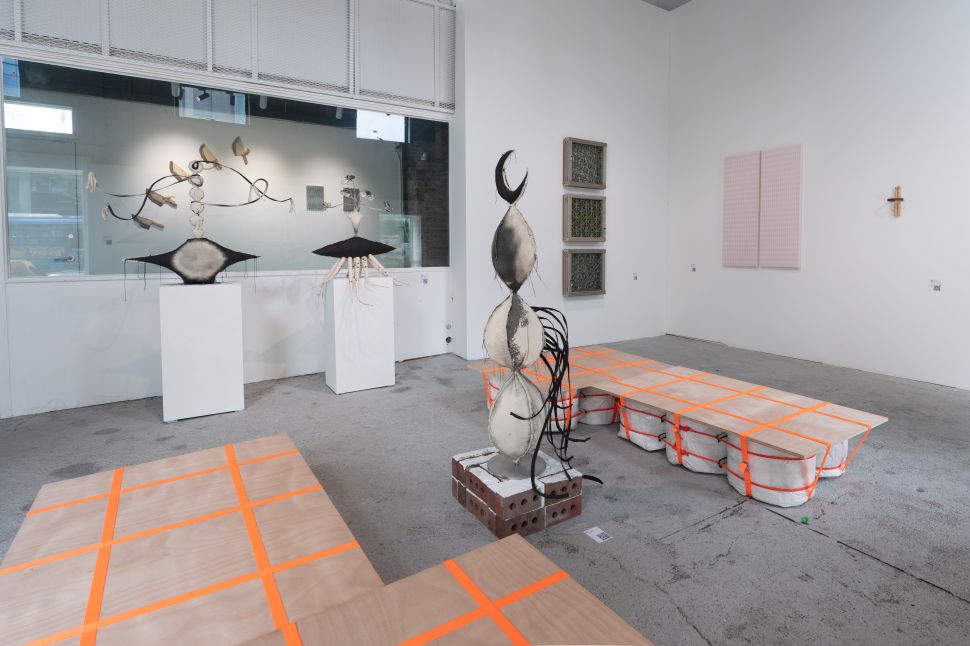
Ahead of Frieze Seoul and Kiaf, PAVILION took over the city’s Kumsung Cultural Space (KCS), which acted as a partner. Despite that, exhibitors are still paying a fee to cover operational costs as part of a community effort to mount the fair. PAVILION’s boothless structure, spread across three buildings, makes it feel like part of the neighborhood and accessible to broader audiences. The QR codes accompanying the artworks enhance that impression, providing information on both the artists and galleries, along with prices of unsold works.
The roster of 17 inaugural participants includes a group of younger, dynamic galleries from Seoul and the broader APAC region, alongside nonprofit art spaces such as CURRENT PLANS in Hong Kong, YPC in Seoul and Starch in Singapore. “I think people have grown tired of hearing that every city is the next huge international art hub, and they just want something authentic. My friends in Seoul feel this way too and wanted to do something more responsive, grounded and fun,” PAVILION co-founder Willem Molesworth told Observer ahead of the opening on Tuesday, which was jam-packed and extended from the afternoon into a party that continued late into the evening. Performances, talks and social activities have been central to the PAVILION model since the beginning. “The opening was great and very successful! Galleries made a number of sales and wonderful connections and contacts,” Molesworth said the next day. “I think this format is really working and will continue to grow.”
But does Seoul need it? Given the abundance of local talent, particularly on the emerging side, and the growing demand for cultural experiences, especially among younger audiences, it seems so. According to government data, 77 percent of Koreans in their 20s attended at least one cultural or arts event in 2025, compared with 70.8 percent of people in their 30s and 57.7 percent of the population overall. Among people 60 and older, the rate was only 31.6 percent. The MMCA (Korea’s National Museum of Modern and Contemporary Art) drew a record 3.37 million visitors in 2025, up 15 percent year over year, and 63.2 percent of all visitors were in their 20s and 30s.
Considering the range of prices at Frieze and its ilk, PAVILION is clearly courting younger and newer collectors who want to get involved in the arts but are still operating at or below the few-thousand-dollar (or few-million-KRW) threshold. Several of the exhibitors are from Seoul, including relatively young spaces such as Ranee and Sangheeut, as well as somewhat more established ones such as Foundry.
Founded in 2023 as a home gallery, Ranee is presenting a group of younger, promising talents, including the hyperrealistic yet psychologically and bodily fragmented works of Korean painter Haeun Oh, which explore the potential for modes of existence that extend beyond fixed identities. The paintings are priced quite accessibly at under $6,000. Similarly promising but much darker are Wheedong Kim’s cinematic frames capturing suspended moments, drawn from discarded photobooks found in Tokyo’s secondhand bookstores. The gloomy tones and vintage-looking texture give those enigmatic images a “ghostly” quality, embodying the passing of time in the very fabric of the scene. All of Kim’s works are priced around $1,000 or less.
There is also a series of works by Jiwon Park inspired by Tefnut, the Egyptian goddess and generative force that nourishes and waters the earth, evoked through a fluid use of color and imagery that transforms symbolic presences into a mythical landscape. Park’s tiny paintings inside vintage jewelry boxes originate in the belief that the world can be reduced to minuscule particles and rendered radically accessible. These works are selling in the low thousands, and some sold in preview.
Meanwhile, Foundry is presenting fantastical fabric creatures by Korean artist Sang A Han, who uses thread to explore recombination and coexistence between beings. Her practice has evolved through recurring motifs such as flowers, tendrils, pagodas and thresholds into structures that move between body and space, evoking universal emotions such as love, devotion and care. All are priced under $10,000.
Starch, an artist-run nonprofit art space from Singapore, is showing small altars and memorial objects by Moses Tan. Exploring queerness, they embody acts of hidden intimacy and veneration while employing allegory and codedness as modes of resistance. Also in the presentation is Rusydan Norr’s delicate embroidery made from dried wheatgrass roots, an intimate piece that reflects on the ability of roots to grow and build resilience beyond the reach of light, becoming a metaphor for human effort through negotiation, adaptation and time. The piece sold on the second day.
At the entrance hang the paintings of Kim Myungchan, a young Korean artist presented by Shanghai-based Brownie Project. By employing airbrush on aluminum plates, Myungchan gives the paintings a blurry, screen-like effect, emulating digital images while playing with glitches and interference to reflect the complex spectrum of human existence and perception today, constantly oscillating between physical and digital dimensions. Established in late 2019, Brownie Project describes its program as “exploring artistic innovation and social impact within our turbulent times.” All four paintings sold quickly.
Meanwhile, Molesworth’s own Hong Kong gallery, PHD Group, is presenting one of Japanese artist Sasaoka Yuriko’s robotic puppets following her memorable show at the gallery in 2024 and ahead of a major commission at the Mori Museum. “We have had a number of visitors say they prefer our format and want to see it expanded into something larger,” Molesworth said. “I hope to give them that next year.” PHD Group’s presentation extends into the architecture itself, with Chan Ting’s uncanny green sculptures appearing around the doorway like something rooted, invasive and slowly overtaking the space. Covered with an uncanny green, slimy substance that calls to mind some buildings in Hong Kong—places marked by a stratification of historical memories—the works also suggest decay and something invasive entering a space to transform it, much as PHD Group itself did when it occupied a 1970s rooftop clubhouse in 2021.
Another nonprofit space, CURRENT PLANS, is showing Tiger Wong’s Pork Knives, directly inspired by Hong Kong’s rich cultural heritage and drawing from From Beijing with Love. Made of ceramics, these stoneware editions turn an industrial weapon into a meticulously crafted object, reframing its absurdity and dark humor while paying tribute to the city’s layered history. Each is priced at $760.
Opposite, screened in a contained alcove against a raw brick wall, is a video by performance artist and costume designer MI Pak, presented by Sangheeut, in which imaginary creatures build a parallel world that allows us to confront contemporary conditions, exploring the boundaries and dissonances between personal identity and social environments. Titled Russian King Crab 1kg 33,000KRW (2026), the video is the final chapter of a trilogy centered on the “Russian King Crab,” a creature from the Mi Pak Encyclopedia, an ongoing compendium of imaginary creatures she began in 2019. Founded in 2021, Sangheeut is one of Seoul’s most experimental exhibition spaces, particularly when it comes to performance and video works that challenge conventional ways of looking at and presenting art.
Context specificity at Design Miami Seoul
There could be no better venue for Design Miami in Seoul than the neo-futuristic Dongdaemun Design Plaza (DDP), designed by Zaha Hadid. The expansive architectural space feels at once geological and futuristic, like a spacecraft paired with some calcareous or coral reef structure with flowing curves and metallic surfaces that seem less constructed than poured. Held in collaboration with the Seoul Design Foundation and the Seoul Metropolitan Government, Design Miami Seoul runs through September 6.
Extending across a single open floor but with a much more contained and curated format compared with editions in Miami and Paris, the core of the fair is its “In-Situ” section, which offers a platform for emerging Korean talent in design. Among the highlights here is the beautiful ME-IN Mother-of-Pearl Corset and dress by LEJE, a duo composed of designers Je Yangmo and Kang Juhyeong, who bring previous experience with brands such as Alaïa, Lanvin and Balmain. Their approach is deeply rooted in Korean tradition and craftsmanship, engaging with materials that have accompanied Korean making for centuries and reinterpreting that heritage through an experimental, contemporary perspective.
That dialogue with tradition is also in Kwon Jungmo’s use of hanji, traditional Korean paper. Both his Window Series and the more articulated El Techo modulate the light present in the space, elegantly shaping it through subtle gradations ranging from luminous surfaces to deep shadows. The designer’s creations have found a place in luxury and hospitality—Kwon has undertaken collaborations and lighting design and production projects with Hermès, Hyundai Motor Company, Nao Restaurant, IHG Hotels & Resorts, Janu Hotels and Nexon Foundation.
Tapping into the similarly ancient ceramic tradition of the region are the creations of Nara Yuki, a Japanese ceramicist and architect and the eldest son of the Ohi pottery family, whose history spans more than 350 years. Yuki reactivates and reinvents this heritage through the possibilities of digital space, applying 3D CAD, programming and digital modeling to traditional ceramic production. Digitally conceived, these sets of data are still ultimately translated through the alchemical process of firing, using techniques passed down through generations. Evoking at once a skeleton and a plant, his sinuous Bone Flower sculpture is priced at around $5,000.
Similarly inspired by nature are the gentle forms of Son Taeseon’s sculptural objects, whose curves and sinuous turns seem to emulate the vitality of botanical life. Here, too, the biomorphic contours and tactile textures expand the object well beyond its function. Prices range from $800 to $6,000.
Particularly intriguing and playful, but with a distinctly organic feeling, is the sculptural structure Guseul n.1 by WKND Lab, the Seoul-based design studio founded by Lee Halin and Jun Eunji. The duo reinterprets traditional Korean crafts and materials through a contemporary design language spanning material research, objects, furniture and installation. Featuring a piece priced at $10,000, the studio has already presented its work at major international platforms and institutions, including Design Miami/Basel, Leeum Museum of Art, Collectible Brussels and Alcova.
Even more playful, but with surrealist undertones, are the shirt lamps conceived by Shin Sozak, a Seoul-based furniture designer whose practice reconsiders furniture at the intersection of function and form. Eerie and uncanny, his sculptures result from a kind of cadavre exquis, as he completes the architecture of the object with unexpected elements (here shirts) that disrupt both its conventional use and meaning, suggesting the potential of an “open ending” process of creative reinvention and reinterpretation of the ordinary material world around us.
This year, Design Miami launched a contained Gallery Program, with six international galleries presenting on the central open floor, including ALEX TURCO ART GALLERY from Miami/Udine, Charles Burnand Gallery from London, IN GALLERY from Seoul, SIDE GALLERY from Barcelona, STACK by studio MOTO from Ghent and Vagujhelyi from New York/Medellín.
“Our first edition in Seoul exceeded every expectation, and this year we’re building on that momentum because we believe there’s a real appetite globally for Korean and regional Asian design,” Design Miami CEO Jen Roberts told Observer. “We saw it firsthand in the response to In Situ last year, in the caliber of galleries and designers working across this region, and in how fast serious collectors started paying attention once they saw the work. The format had to grow to match that.”
Following its success at NOMAD Abu Dhabi, Vagujhelyi, a design brand by Spanish, New York-based designer Diego Villarreal Vagujhelyi, brought to Seoul a selection of pieces from his collection “POSTURA,” including new works in which he has been experimenting with a dustier white patina. His bronze objects are both ergonomic and emotional, shaped by the postures we adopt in daily life and molded around the movement of the hands, so that each object fits naturally within our physical encounter with it—which always becomes an emotional one as well. This distinctive approach emerged while he was helping his mother with post-disaster relief in Puerto Rico. In their fluid, tactile forms, these objects still evoke the malleability of mud, suggesting the possibility of reshaping the world through a gentler handling of matter. All are priced under $25,000. “There has been great feedback from curators and we have closed a couple of sales but let’s see what happens till the end of the week—fingers crossed,” Villarreal told Observer. For him, Design Miami Seoul has offered the opportunity to connect with international architects and designers from Korea and the broader region and to begin circulating his designs on this side of the world.
Meanwhile, Barcelona-based Side Gallery is staging a dialogue between contemporary designers and makers from Japan and South Korea. Titled “Resonance,” it tracks similarities in shared aesthetic approaches and craft traditions while reflecting on the ways this traditional knowledge has evolved through experimentation and material research. Staged in a white curved display, the presentation brings together works in ceramics, bamboo, lacquer and wood by Japanese artists Koichi Io, Junpei Kawaguchi, Hashimoto Tomonari, Yuji Ueda and Kodai Ujiie, here in dialogue with creations by Hyeokjin Jung, Lee Jeongwon, Somyeong Lee, Yeunhee Ryu, Park Sung Jun, Park Sung-Youl, Dahyeon Yoo and Gyuhan Lee, working across metal, fiber, wood, ceramics and glass.
Much more industrial, futuristic and function-driven is STACK, the first furniture collection by Ghent architecture practice studio MOTO, founded in 2017 by architects Mo Vandenberghe and Thomas Hick. The project began pragmatically rather than as a collectible-design exercise: during the pandemic, when MOTO moved into an office whose long-term future was uncertain, the firm could not find an archive cabinet that was light, adaptable and able to grow with the studio. They decided to design their own system, built from folded aluminum components that lock together without screws. Here, it is arranged so that visitors can move through it almost architecturally rather than encounter it as furniture. The idea is an “Architecture of Home”: compact, portable and reassemblable with every move, adapting to changing spatial needs and uses.
Arguably, there is real potential for Design Miami Seoul to expand with each new edition while maintaining an identity distinct from its fairs in Paris and Miami. The key is to continue anchoring the fair in the context in which it takes place, show commitment and champion the material and aesthetic sensibility that continues to hover generatively between innovation and tradition.
Next year, when Frieze moves into the DDP, the space will become the new hub of art week, which will likely foster wider enthusiasm and grow the audience for both fairs. “We’re excited about what this means for DDP and Seoul as a whole. This is a location that’s becoming a real global center for art and design, and we’re looking forward to our continued investment in that,” Roberts said.