
After launching in Taipei last year and hosting its signature edition in Hong Kong in March as an “evolution” of Supper Club, the more fluid and unconventional fair Pavilion is bringing its third edition to Seoul, adding another event to the city’s ever-expanding art week. Held in partnership with Kumsung Cultural Space (KCS) on September 1-6, the upcoming edition of the alternative fair pushes even further against the traditional booth-centered structure, shifting the focus toward artworks and relationships.
Participating galleries include PHD Group—the Hong Kong gallery led by two of the fair’s co-founders, Willem Molesworth and Ysabelle Cheung—alongside younger spaces such as Sangheeut in Seoul, NORITO in London, Brownie Space in Shanghai, Ara Contemporary in Jakarta and FOUNDRY in Seoul, as well as established names including Tomio Koyama in Tokyo and ShangART in Shanghai, Beijing and Singapore. The 17-participant roster also includes a group of international nonprofit art spaces such as CURRENT PLANS in Hong Kong, YPC in Seoul and starch in Singapore. Taking cues from alternative models such as Basel Social Club, Pavilion is built around a similarly community-centered, experimental and collaborative approach, with a strong talks and performance program integrated into the structure of the fair.
“Seoul is an incredible city with an amazing art scene, but like so many art hubs it also craves something different, a sort of gathering that speaks the same language as the local scene and meets it where it stands,” PHD Group founder Willem Molesworth told Observer. “I think people have grown tired of hearing that every city is the next huge international art hub and they just want something authentic. My friends in Seoul feel this way too and wanted to do something more responsive, grounded and fun.”
Molesworth sees Pavilion as offering not just an alternative to traditional art fairs but also a new paradigm for cultural gatherings—one still grounded in human encounters and authentic moments of exchange and connection. “It just morphs depending on where you place it, but it always ends up being really authentic and special. So why Seoul? Because Seoul wants it, and it deserves it!”
KCS is centrally located in Yongsan-gu, which Molesworth describes as one of the city’s most exciting and lively districts, filled with restaurants and places to gather. “We’re incredibly fortunate to be working with KCS Seoul and Kumsung Publishing as our Venue Partner, who have lent us three of their spaces that we’ve asked BEAU, our Architecture Partner, to help us adapt.”
Meanwhile, Frieze returns to Seoul on September 2-5, finally avoiding, for the first time, the long-criticized overlap with The Armory Show in New York—now part of the same portfolio. Running alongside the historic Kiaf at COEX, the two fairs now appear to have refined their partnership after some initial tensions, maintaining distinct profiles in both exhibitor selection and offerings while collaborating on ticketing and the overall organization and promotion of art week. An expansive program extends throughout the city via Neighborhood Nights across Seoul’s gallery districts.
“We’re in our fifth edition and now the fair reflects a clearer sense of Seoul’s position. Seoul has developed a distinct place within the international art landscape, and I think that is increasingly visible in the fair itself.” Frieze Seoul director Patrick Lee told Observer. “Neighborhood Nights and our expansive citywide program are also an important part of that. For me, it speaks to a market and cultural ecosystem that has matured beyond the initial excitement of discovering Seoul, towards a deeper understanding of what the city, its artists and its institutions are contributing to the global conversation.”
Aiming to establish a more specific profile within the Asian art ecosystem, Frieze Seoul this year has adopted a more curated approach under the title “Beyond the Canon,” placing greater emphasis on the fair’s role in contextualizing practices that have been overlooked or remain less familiar. At its core are questions about which art histories still lie beyond the Western-centered canon of 20th-century art, which contemporary practices and galleries operate outside the cities that usually attract attention first, how materials have been reactivated and reinvented in parallel across different geographies and how these histories can be integrated into the ongoing reassessment of a more global art-historical narrative.
“This year’s curatorial formats reflect the breadth of the fair, from spotlighting underrepresented histories of 20th-century artists to practices centered on craft and materiality that connect with Korea’s own traditions, to leading and emerging galleries from around the world,” Lee said.
This year, the fair features three distinct curated sections. The first is “Material Practice,” curated by Hyeyoung Cho, which focuses on the growing cross-disciplinary exchange between contemporary art, craft and design, from traditional media to emerging material technologies. “Focus” also returns but, for the first time, expands beyond Asia under the guidance of Seolhui Lee, providing a platform within the fair for emerging practices and galleries founded within the past 12 years.
Highlights include Cub_ism_ Artspace’s presentation of the densely symbolic world of Lilyjon; São Paulo gallery Yehudi Hollander-Pappi making its debut in the country with an immersive installation by Brazilian digital and new-media artist Gabriel Massan; Foundry Seoul spotlighting Omyo Cho’s botanically inspired high-tech-inflected sculptures in steel and glass; and N/A presenting Muyeong Kim with new hand-colored photographs staged at Seodaemun Prison alongside leather sculptures, just as the rising Korean conceptual artist receives a first institutional solo exhibition at Art Sonje.
That effort to move past established narratives becomes most explicit in the debut of “Spotlight,” curated by Wonseok Koh, which presents 15 monographic perspectives on 20th-century artists, with a particular focus on work produced between 1950 and 1990. Among the highlights is work by photographer Han Youngsoo, presented by BAIK, whose photographs portray postwar Seoul beyond either devastation or triumphalist modernization, capturing both the period’s challenges and vitality.
Ames Yavuz, meanwhile, presents Po Po, one of the first Myanmar artists to exhibit abroad in the 1990s, with a series of previously unexhibited works produced between 1986 and 1990 under Myanmar’s political isolation and censorship, including works from his “Painting for the Blind” series. Yoshiaki Inoue Gallery is presenting Etsuko Nakatsuji, one of the early and still underrecognized precursors of postwar Japanese installation art, while Tansbao Gallery will spotlight Lain Singh Bangdel (1919-2002), an artist, novelist and art historian who developed one of Nepalese modernism’s most international careers while playing a key role in shaping the movement. YOD Gallery will feature Nobuo Sekine (1942–2019), whose practice helped shape Mono-ha and continued to develop across five decades.
“Spotlight” also extends that revisionist lens beyond Asia, with figures such as Djordje Ivačković, a Serbian-born abstract painter and avant-garde jazz musician who occupied a distinctive position in the dialogue between European and American abstraction, presented by Double Q. Die Galerie, meanwhile, focuses on the oeuvre of German artist and filmmaker Karl Otto Götz, tracing his trajectory from the CoBrA movement to his pioneering role in postwar European Informel abstraction.
Meanwhile, stealing the scene in the main section will clearly be Gagosian, with a solo booth devoted to Damien Hirst and featuring iconic works from several of his most celebrated series, including Pill Cabinets, Spin Paintings, Spot Paintings and Treasures.
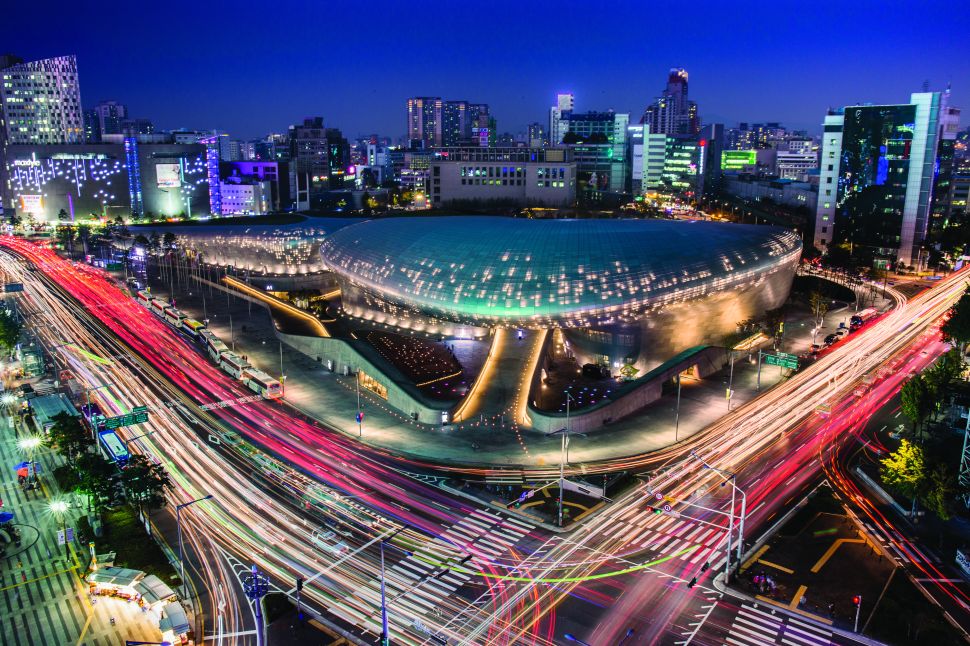
The biggest news for Frieze, however, is that this will be its last edition at the conveniently located, multilevel COEX shopping mall and convention center, as the venue prepares for renovation. Frieze Seoul’s sixth edition will instead be held at the Zaha Hadid-designed Dongdaemun Design Plaza (DDP) in the Dongdaemun district, where Design Miami Seoul is taking place this year. Opened in 2014, the building has become a civic landmark for design, fashion and contemporary culture, hosting events and exhibitions including Tom Sachs’ expansive “Space Program: Infinity” in 2025, his fifth imaginative trip to the cosmos—complete with a full-scale Apollo-era Landing Excursion Module that seemed made for the building’s futuristic architecture.
Meanwhile, Design Miami is returning for its second Seoul edition on September 1-6, with a VIP preview on August 31. Held in collaboration with the Seoul Design Foundation and the Seoul Metropolitan Government, Design Miami Seoul provides a global platform for Korean and regional design through its “In-Situ” section. This year’s participants include beformative (Kiyong Lee), Byungsub Kim, Coco Sung, DesignSurfing (Yen-An Chen, Object Weiv, Li-Sheng Kang, Hsieh Chen Lin), Fabrikr, Haemi Lee, Mokamjunamoo (Hwan Tae Kim), Hyunhee Kim, Il Hoon Roh, Jieun Park, Jinsik Kim, Jongin Lee, Jung Hoon Lee, Jungmo Kwon, Kew-Hong Lee, Kyung Ran Choi, LEJE, MANO Design Studio (Bo Ah Kim), Nara Lee, NICEWORKSHOP × Roham Shamekh, SABO, Sangwoo Koo, Seongil Choi x Hyunseo Kim, shallwedance (Kyunggu Lee), shinsozak, Somyeong Lee, Soohyun Cho, Sukwoo Lee, Taeseon Son, WKND Lab and Woorim. Holding the program together is this year’s curatorial theme, “Resonance,” which explores how design carries memories, knowledge and emotions across time and place.
Following the response to its first edition, Design Miami is also launching a Gallery Program in Seoul for the first time. Six international galleries will take part this year: ALEX TURCO ART GALLERY from Miami/Udine, Charles Burnand Gallery from London, IN GALLERY from Seoul, SIDE GALLERY from Barcelona, STACK by studio MOTO from Ghent and Vagujhelyi from New York/Medellín.
“Our first edition in Seoul exceeded every expectation, and this year we’re building on that momentum because we believe there’s a real appetite globally for Korean and regional Asian design,” Jen Roberts, CEO of Design Miami, told Observer. “We saw it firsthand in the response to In Situ last year, in the caliber of galleries and designers working across this region, and in how fast serious collectors started paying attention once they saw the work. The format had to grow to match that.”
If last year’s goal was to create a platform for Korean design and introduce it to Design Miami’s global audience passing through Seoul, this edition pushes further toward an intercultural conversation shaped by the curatorial theme “Resonance.” The goal is “to showcase Korean and regional design and get them in the room with international galleries and collectors on equal footing,” Roberts said, noting that Seoul is also a UNESCO City of Design. “What struck us early on is how naturally heritage and craft sit next to some of the most forward-looking design thinking anywhere. That’s exactly why this is a market we’re building for the long term, the same way we think about Paris and our Miami Beach flagship. We believe in the artists and designers working in this region, and this edition is us putting weight behind that.”
The question now is whether Design Miami Seoul and Frieze will both run at DDP in 2027. For now, Kiaf has confirmed it will remain at COEX in 2027 and maintain its partnership with Frieze Seoul through shared ticketing, marketing and programming. For now, Design Miami has no plans to move, according to Roberts. “We’re excited about what this means for DDP and Seoul as a whole. This is a location that’s becoming a real global center for art and design, and we’re looking forward to our continued investment in that.”
This new wave of fairs follows a year in which many dealers reported a much slower, if not stagnant, market compared with the frenzy of earlier editions. Kiaf will host 175 galleries from 18 countries for its 25th edition this year, while Frieze will feature more than 130 galleries from 30 countries. Frieze will see several notable departures since last year, with international dealers including Perrotin, Massimodecarlo, Mai 36 Galerie, Galerie Eva Presenhuber, MISAKO & ROSEN, Jessica Silverman and Galerie Peter Kilchmann not returning. Even several nearby Hong Kong galleries—including de Sarthe, Blindspot Gallery and Kiang Malingue—are absent this year. Antenna from Shanghai and New York galleries Carvalho and Albertz Benda are also not returning. Others, however, particularly from Southeast Asia as well as South America, are joining for the first time, confirming the vibrancy of these rising regional art scenes.
Nonetheless, expectations are higher for a stronger turnout this year as the Korean economy has begun to recover, with political normalization following the June 2025 presidential election, fiscal support, recovering consumption and exceptionally strong semiconductor exports helping stabilize an export-driven economy. (The OECD forecasts 2.6 percent growth in 2026, driven particularly by the semiconductor cycle.)
International dealers returning to Seoul this year will be hoping to see that recovery translate into renewed confidence among a broader group of buyers and, ultimately, into sales across the week’s expanding roster of fairs, drawing both local and, with luck, international collectors. That optimism may also be supported by the city’s growing popularity as a tourist destination, fueled by the Korean Wave. Tourism has continued to grow across the country, with inbound visitors rising from 17.5 million in 2019 to a record of approximately 18.7 million in 2025. This year, tourism has accelerated even further, with foreign arrivals surpassing 10 million by the third week of June and reaching 10.71 million in the first half of the year, up 21 percent year over year.