
In the horrible geography and chronology in which I went to college, you could tell much about a person by the posters they hung in their dorms. The jocks would always have their bikini babes, or the one with the members of t.A.T.u. kissing each other, which was said to be a powerful aphrodisiac. We intellectuals turned our nose up at that kind of thing, favoring instead posters for movies directed by the Coen Brothers or Quentin Tarantino. The art students would inevitably have the work of Alphonse Mucha (1860-1939), which always manages to feel timeless, instructive and engaging to the eye.
Explanation for this durability can be found in an exhibition at the Nelson-Atkins Museum of Art, “Timeless Mucha: The Magic of Line,” which argues that he was an infrastructure project as much as he was a graphic designer. The sturdy line Mucha worked out in Paris in the 1890s became a piece of visual plumbing that generations could tap into when looking to channel attention through certain pipelines. Organized by the Mucha Foundation in Prague in collaboration with the museum, the exhibition gathers nearly 150 objects across 10 sections that track him from art student to the inventor of “le style Mucha” and then out the far side, into psychedelic rock posters, a Grateful Dead album cover and American comic books. A final section handles The Slav Epic, his cycle of 20 monumental paintings of Slavic history, by digital reproduction, which goes to show how durable his style is. It works on screens just as well as it works above an unmade twin bed.
“Timeless Mucha: The Magic of Line“
Artist: Alphonse Mucha
Venue: The Nelson-Atkins Museum of Art
Address: 4525 Oak St, Kansas City, MO
Through: August 30, 2026
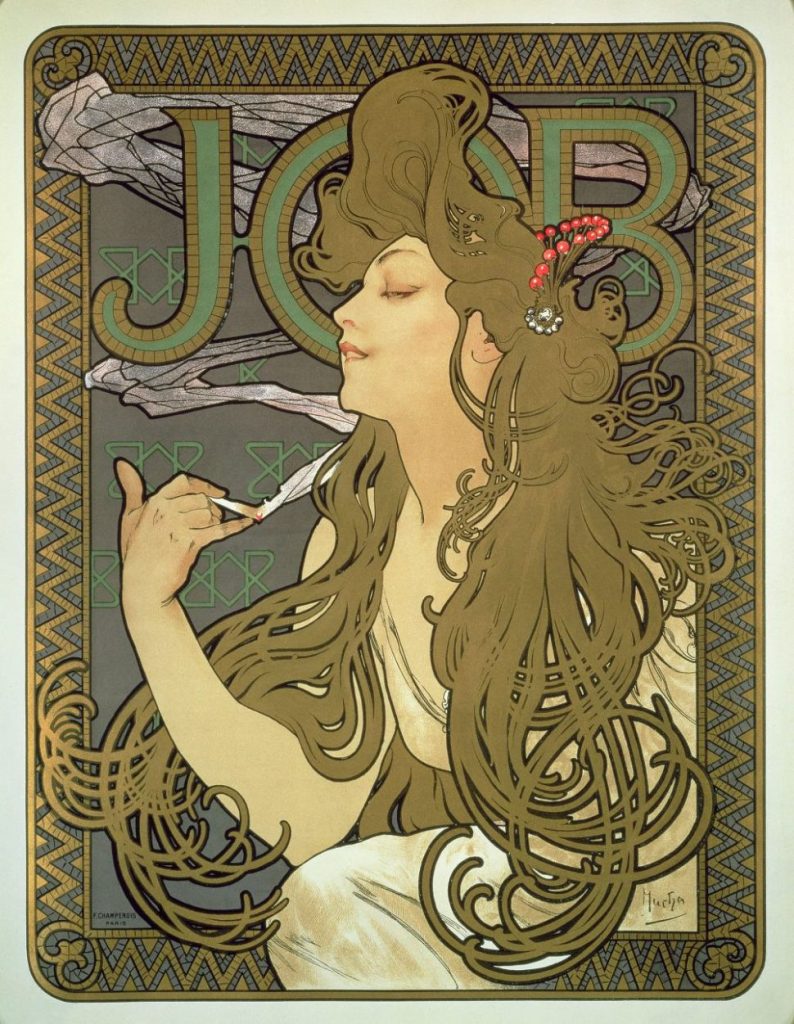
Mucha’s JOB (1896) is an exemplary work. Created two years after the term “New Woman” reportedly entered circulation, it is an advertisement for JOB rolling papers, and its gold zigzag border borrows from Byzantine mosaics. The woman smokes in profile with her eyes closed, and the smoke rises to merge with the tangle of blonde hair swirling around her body. Hair worn loose like this was controversial in its day, as was the wantonness of the cigarette, but it’s arguably a vibe.
If Mucha’s work came to be appropriated by the psychedelic movement, it doesn’t seem to have been something he would have opposed. The Arts: Dance (1898) emerged from the experiments of Albert de Rochas, whom Mucha met at a Theosophical Society meeting and whose hypnosis sessions he hosted in his own studio in an effort to find a scientific basis for ESP and occult phenomena. Mucha thought that straight lines fatigue the eye, whereas alternating straight and curved lines give it rest. It’s tempting to read Dance along those lines, the straight edges standing in for the known world and the curves for everything unseen.
Among my favorite works in the exhibition demonstrating Mucha’s influence has to be the cover of Ninjak (1994) by the great Joe Quesada, the former editor-in-chief of Marvel, here working for Valiant Comics. Ninjak is an obscure character, but this cover sees him standing off-center as a seductive female form emerges through a mandala that Mucha could have drawn himself. Here, the Mucha style is a little too seductive. Though Ninjak is probably the hero in this situation, he comes across as a party pooper, the stiff dude with a sword cramping the style of this woman. It’s only a matter of time before they option him for a movie.