
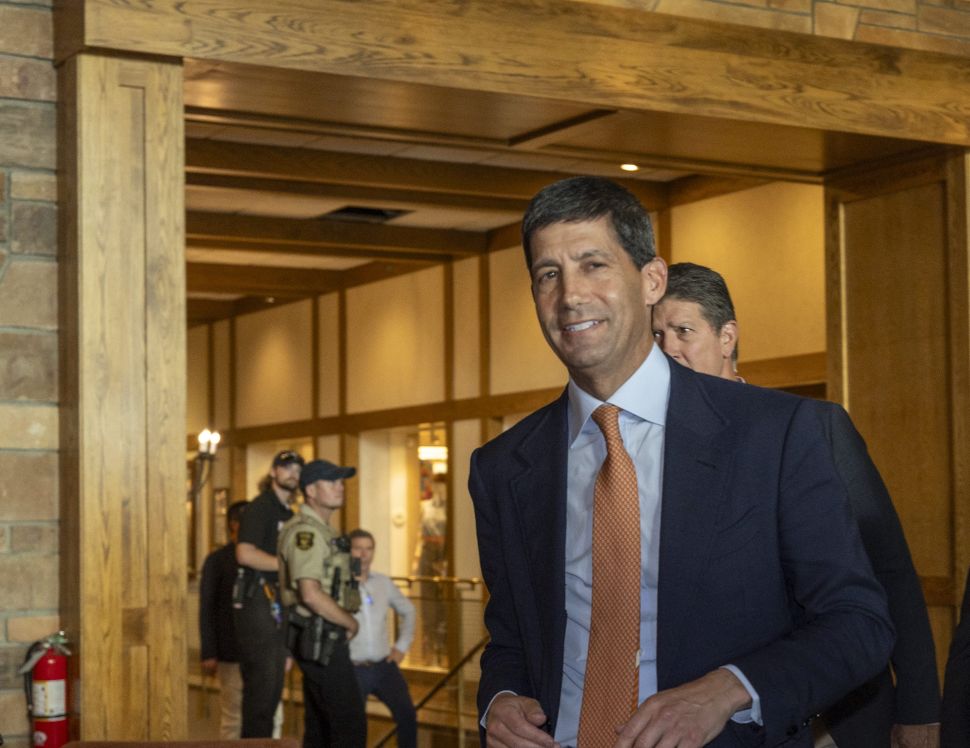
Kevin Warsh attends a dinner at the Jackson Hole Economic Symposium August 27, 2026 in Jackson Hole, Wyoming. ” width=”970″ height=”748″ data-caption=’Kevin Warsh warns inflation remains too high but rejects forward guidance on interest rates in his first Jackson Hole address. <span class=”lazyload media-credit”>Getty Images</span>’>
Federal Reserve Chairman Kevin Warsh is concerned that inflation remains too high, but he’s not providing a clear direction on whether and when the central bank will raise interest rates.
The new Fed chair took the podium today (Aug. 28) at the Jackson Hole Economic Policy Symposium to give his first address, just after his 100 days as head of the central bank.
“I stand here today committed to a discipline, not to a decision,” Warsh told a room of economists, policymakers and government officials in a live-streamed speech.
The Fed operates under a dual mandate to maximize employment and keep consumer prices stable. Warsh acknowledged the severity of heightened consumer prices. The Consumer Price Index (CPI) held at 3.4 percent year-over-year in July, while the Fed’s preferred inflation gauge, the Personal Consumption Expenditures (PCE) price index, rose 3.7 percent. The CPI has now grown well above the Fed’s 2 percent target for 65 consecutive months—the longest streak in about 50 years.
At the latest Federal Open Market Committee (FOMC) meeting in July, Warsh acknowledged that, while the labor market is strong with full employment, inflation remains too high. But he was tight-lipped about what the Fed’s next move would be. The FOMC kept the federal funds rate unchanged at 3.50 percent to 3.75 percent, although three of the 12 voting members dissented in favor of a 25-basis-point rate hike.
Why Warsh refuses to give clarity
Warsh is known for his distaste for providing the market with the so-called “forward guidance,” a regular practice adopted by his predecessors since the 2008 Financial Crisis, arguing that it runs the risk of misjudging economic trends and misleading investors.
“It was essential at the time, and we introduced it with much fanfare,” Warsh said of the time when the practice was introduced and when he was serving as the Fed’s youngest board governor under then-Chair Ben Bernanke. “But, as with other legacies of crises past, I believe that the practice has overstayed its welcome. In normal times, the role of forward guidance should be limited and circumscribed. Otherwise, it risks creating ambiguity in the name of clarity.”
In the past, the Fed’s forward guidance on interest rates was a major market-moving force. Warsh believes this creates a risky loop that amplifies the room for errors. “If markets rely materially on the Fed’s guidance and the Fed relies on market prices, we are all more likely to be blinded to new developments…and more likely to commit errors in policymaking,” he said.
How Warsh plans to tackle inflation
Instead of giving specific predictions, Warsh said he and his colleagues will focus on constructing “more reliable models and more robust rules” to guide policy decisions. This comes down to understanding the underlying forces driving inflation.
For example, there are 199 individual components of the PCE index. Over the past 12 months, the overall PCE increased 3.7 percent. But only about half (54 percent) of goods and services in the PCE basket showed price increases above 3 percent. Over the past six months, this percentage has dropped slightly, suggesting fewer goods are experiencing rapid price increases. Warsh noted that the 54 percent number is well below the post-pandemic high of about 77 percent but remains well above the 32 percent level in the two decades preceding the pandemic.
“We’ll do this knowing that accuracy in economic forecasting is still just an aspiration,” he cautioned. “With so much changing so fast in geopolitics, global supply chains, and technology, it’s wise to be modest about what we can and cannot know.”
A “new Treasury-Fed accord” becomes a complication
Since before taking office in May, Warsh has called for a “new Treasury-Fed accord” — referencing the 1951 Treasury-Fed Accord — to redefine the working relationship between the two institutions. He argued that the lines between fiscal policy (managed by Treasury) and monetary policy (managed by the Fed) had grown blurred over the past 15 years, largely due to the Fed’s massive purchases of government debt.
Treasury Secretary Scott Bessent publicly agreed to the principles of Warsh’s proposed accord. However, his fiscal policy approach leads some observers to believe he could conflict with Warsh’s goals.
While the Fed operates by its employment-price mandate, the Treasury’s primary job is financing government operations, including managing government debts. As the national debt soars past $40 trillion, 30-year Treasury yields recently spiked past 5.25 percent, driving up the cost of federal debt service and mortgage rates. In response, Bessent deployed bond buybacks—doubling operational targets from $2 billion to at least $4 billion per session—to keep long-term yields low and reduce the cost of financing national debt. But this directly affects long-term interest rates, the realm of the Fed. Critics say that if the Fed is attempting to raise interest rates to curb inflation, a Treasury intervention pulls in the opposite direction.