
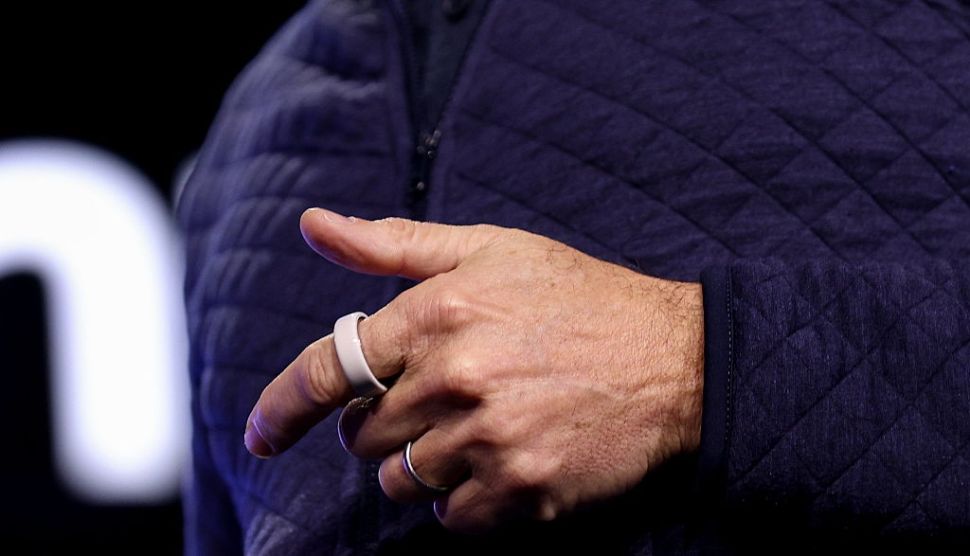
Oura CEO Tom Hale wearing an Oura ring on Health Summit stage during day three of Web Summit 2025 at the MEO Arena in Lisbon, Portugal. ” width=”970″ height=”556″ data-caption=’An Oura ring is seen on the finger of CEO Tom Hale. <span class=”lazyload media-credit”>Carlos Rodrigues/Sportsfile for Web Summit via Getty Images</span>’>
When the U.S. Open main draw begins Sunday in Flushing Meadows, players will settle into the usual rhythm of matches, practice courts and media rounds. This year, they’ll also be offered Oura Rings. Under a new five-year agreement with the U.S. Tennis Association, the Finnish smart-ring maker has become the USTA’s first wearable partner. The deal comes as Oura prepares for a closely watched IPO and faces the challenge of proving it is more than a trendy tech accessory worn by celebrities and athletes.
Oura confidentially filed to go public in May. The listing could happen as soon as September and would seek $3 billion in fresh capital at a $16 billion valuation, according to Bloomberg. Oura was last valued at $11 billion, after raising more than $900 million in a Series E round in October 2025.
Oura’s $6-a-month subscription unlocks detailed sleep data, heart-rate trends and other health insights in its app, turning a ring purchase into a source of recurring revenue. A public filing could reveal how much of the company’s growth comes from membership fees rather than one-time ring sales—and, if disclosed, how long customers stick around.
Oura’s Finnish roots and rapid growth
Co-founders Petteri Lahtela, Kari Kivelä and Markku Koskela launched Oura in 2013 in Oulu, Finland, drawing on engineering experience from Nokia and Polar, the Finnish heart-rate-monitor maker.
In 2015, Oura raised $652,000 through a Kickstarter campaign, surpassing its $100,000 goal in 15 hours. That year, the company also raised its first $2.3 million in seed funding, led by Lifeline Ventures.
Oura’s leadership changed as it moved from a niche smart-ring maker to a mass-market brand. Lahtela, the company’s founding CEO, transitioned to president and chief innovation officer in 2018, when Harpreet Singh Rai took over as CEO. Rai, who had joined Oura as an investor in 2016, oversaw the launch of its third-generation ring before stepping down in December 2021. In 2025, Rai sued Oura over his compensation package. The case remains unresolved.
COO Michael Chapp served as interim CEO while the board searched for a successor. After a months-long search, the board named Tom Hale CEO in April 2022. Hale had been president of Momentive and previously held roles at HomeAway and Adobe.
Hale was already an Oura user. During a stressful period in 2021, Hale struggled with sleep and later wrote that the ring’s feedback helped improve his mood and overall health. Under Hale, Oura has pushed beyond its early audience of Silicon Valley biohackers, adding women’s health features and placing its rings in retailers such as Best Buy and Target rather than selling primarily through its own website.
Oura has reported rapid growth. By September 2025, the company said it had sold more than 5.5 million rings, including more than 2.5 million since June 2024. Revenue exceeded $500 million in 2024. In November, Hale told CNBC that Oura was on track for $1 billion in sales in 2025 and that 2026 revenue could run “close to $2 billion.”
Those figures will bring familiar public-market questions: how much it costs Oura to win new customers, whether margins will hold as the company expands in retail and how it plans to compete with Samsung and lower-priced rivals.
Oura’s sports pitch
The USTA agreement gives Oura another platform from which to make its case. The company says its members have logged more than 5.5 million hours of tennis, evidence that the ring already has a foothold in the sport.
Under the deal, Oura will offer on-site fittings and recovery education in player areas. It will also have on-court branding at Arthur Ashe and Louis Armstrong Stadiums, including virtual LED messaging visible to broadcast viewers. Beyond the U.S. Open, the company will sponsor the USTA League National Championships and collaborate on health and wellness studies for coaches.
For elite players, Oura’s pitch is straightforward: constant travel, demanding match schedules and disrupted sleep can make recovery difficult to judge by feel alone. The company wants its readiness score to look less like a consumer-wellness novelty and more like another tool in an athlete’s training routine.
The USTA deal is part of a broader sports push. In February, Oura became the official wearable of Team USA, with its rings offered to U.S. Olympians and Paralympians during the Milano Cortina 2026 and Los Angeles 2028 Games. In April, it signed an agreement with U.S. Soccer covering all 27 national teams.
This month, Oura added tennis stars Coco Gauff and Taylor Fritz as ambassadors for a campaign spanning digital, print and out-of-home advertising across New York City. “These partnerships are part of Oura’s long-term strategy to work with athletes who share our vision for a more thoughtful, sustainable approach to health and performance,” chief marketing officer Doug Sweeny said in a statement.
The strategy comes as wearables gain traction. U.S. retail revenue for fitness-tracking devices rose 88 percent in 2025, while smart rings’ share of category revenue climbed to 75 percent from 46 percent a year earlier, according to Circana.
Oura would also enter a crowded and unpredictable market for high-growth technology companies. SpaceX completed a record-setting offering in June, while OpenAI and Anthropic are reportedly considering trillion-dollar listings.