
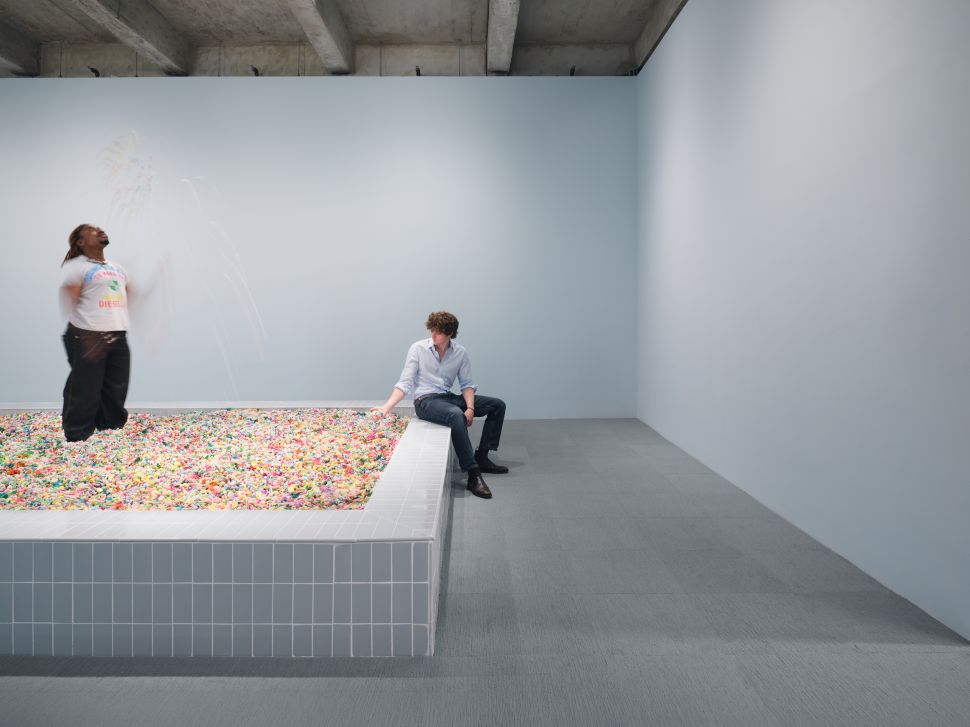
Summer exhibitions often come and go without much notice, but in the middle of August in New York, a pop-up show at Salon 94 managed to capture the attention of both the art world and the broader public with a playful commercial strategy that made art feel accessible and enjoyable to visitors of all ages and backgrounds. Staged in the sumptuous Salon 94 townhouse, CJ Hendry’s “Pastel” was simultaneously an art exhibition, hands-on installation and concept shop.
At its center was a large pool filled with pastel-colored beads drawn from Hendry’s visual universe: flowers, smiley faces, Juju and Balloon Dog. Visitors could select beads and assemble them into bracelets, necklaces or charms, taking home a piece of Hendry’s artistic universe for just a few dollars. Drawings, editions and branded objects were also up for sale alongside her trademark caps, T-shirts, jewelry trunks, leather trays and acrylic keyrings. There was something for every budget, from $1 for a single bead and $50 for a bucket to $55 for a T-shirt and $499 for editions. Original drawings ran into the thousands.
The Australian artist first made her name with hyperrealistic drawings of familiar objects—paint smears, flowers, luxury goods and everyday materials—rendered with such extreme precision that they became uncanny optical illusions. Playing with sensory overload, excess and spectacle, she pushes realism or something even better to an extreme that has proven extremely successful with broader audiences. This strategy extends into her immersive environments, in which audiences can move, touch, choose, taste, collect or otherwise participate. Her practice operates within a Warholian logic, combining a Duchampian conceptual approach with an engagement with, and critique of, consumer and pop culture. At its core is a continuous testing of the boundaries between art object and commodity, and between retail and the art market.
Hendry does not come from a traditional art background, having worked in fashion before becoming a full-time artist. (She was once employed by Chanel and had a strong interest in luxury goods, which have shown up frequently as subjects in her work.) Even now, she rejects rigid classifications, embracing this inherent ambiguity as a source of fluid hybridity and adaptability across contexts. “I feel like I’ve always been a commercial artist, so this isn’t different in any way. For me, this makes sense in my art practice,” Hendry told Observer when we spoke after the closing of the Salon 94 pop-up. “I don’t have an art degree. I’m very inexperienced, but I know that when I go to a museum or a gallery, I want to feel that the space is generous. I want people to come away with something. It doesn’t need to be expensive, but just a portion of that moment that can live on a little bit longer.”
Another recent “concept,” as Hendry describes these installations, was her “Flower Market,” which, after opening in Rockefeller Center last year, landed in Hong Kong. Running from March 19-22, 2026, at AIA Vitality Park on the Central Harbourfront, the installation contained more than 150,000 plush flowers representing 26 designs, displayed inside a greenhouse-style pavilion reached through a hedge maze. Two designs were created specifically for Hong Kong: the Bauhinia, referencing the city’s emblem, and the “Henderson Flower”/Allium, tied to Henderson Land’s anniversary and visual identity. Admission was free with registration, and every registered visitor received one complimentary blossom. Additional flowers were available for purchase; Time Out listed them at HK$38 each. That is arguably a very low threshold for entry and participation, but also one that introduces other levels of commerce once visitors are emotionally and physically engaged with the work. Vogue Hong Kong later reported that more than 20,000 people attended over the four days. It’s likely some of them went on to buy swag or editions.
Hendry’s work engages with the dynamics that drive symbolic consumption: the acquisition of things we don’t strictly need but to which we attribute value because of the meanings we associate with them. She stages an experience of desire, play and possession that luxury has long understood and the art world has often forgotten. From those markets, Hendry has also absorbed and appropriated the strategy of price laddering, making her symbolic universe accessible across multiple price tiers.
She continues to produce original, one-of-a-kind works, though less frequently, as she is increasingly drawn to physical environments where more people can participate. “The drawings are delicate and intimate, but they’re made for one person at a price point they can afford, and then they get shipped off, and no one sees them again. I might post about them on social media, but that’s it. It’s really transactional,” she said, arguing that exhibitions like “Flower Market” or “Pastel” are much more democratic.
Hendry is currently preparing to present “Mere Mortals” at Phillips New York, a new body of work on view August 28-30 featuring 52 original characters conceived as collectible trading cards. The idea began at home, while watching her children trade cards with friends, and developed into an entire cast of eccentric characters assembled from mismatched parts and childhood nostalgia. The exhibition brings that world to life through collectible merchandise, claw machines and other interactive elements, giving visitors a hands-on way to play, explore and collect. It’s yet another playful and therefore accessible experience of both art and commerce likely to translate attention into sales.
The artist is part of a relatively limited but growing group of artists who have built expansive commercial and imaginative ecosystems around their practices: Takashi Murakami with Kaikai Kiki, KAWS, Daniel Arsham (particularly through his Pokémon collaborations), Tom Sachs with his multiple participatory and speculative projects, and Kasing Lung with his imaginative world of “The Monsters.” Not coincidentally, these artists are particularly popular among younger collectors, as they have succeeded in creating shared rituals of belonging, building active communities through buying, trading and playing together—something that feels increasingly urgent in an age of technology driven alienation and disconnection.
They’ve also built entire imaginative and narrative universes around objects while democratizing access to those universes by making them available at different levels. That model differs significantly from the high-end art market, which often isolates the act of buying until it becomes a form of passive status signaling. Asked whether she sees “Mere Mortals” and other works potentially evolving into franchises, Hendry responded that she has not planned for that but remains open to the possibility. Nonetheless, she was careful to distinguish them from phenomena such as Pokémon or Labubu, which she described as major cultural and commercial forces with a much broader degree of symbolic penetration.
At the same time, she readily admits that her characters are informed by familiar visual worlds, including The Simpsons and Toy Story. Familiarity is, after all, a factor in how people respond to images, and Hendry is very transparent about reference, appropriation and process. She is also forthright about her use of A.I.; she doesn’t understand why artists should conceal the tools that enter their process. “I did try to use A.I. for ‘Mere Mortals,’ but it wasn’t consistent enough in the design, and it didn’t make the style I wanted, so I drew them on my own,” she explained. “I’m very comfortable being open and honest about the creative process.”
While Hendry’s installations are designed for intergenerational participation, she is very much tapping into the “kidulting” trend. Particularly in the aftermath of the pandemic, young adults—especially Millennials and Gen Z—have increasingly engaged with activities, objects and experiences traditionally associated with childhood: toys, collectibles, games, plush objects, playful environments and craft activities. This is not necessarily a form of regression, but rather nostalgia, stress relief, social participation and a desire for more joyful forms of connection. Consumer objects have always been central to Hendry’s practice, but now that she has three children, she has found herself living among building blocks, toys and trading cards, which has pushed her to imagine those familiar things differently. Ironically, when we spoke, she described herself as a serious, intense and direct person rather than a naturally playful one. The apparent ease of the work, she stressed, is the result of a great deal of hard, highly controlled labor.
This sense of tactility and physical interaction, in fact, is another important dimension of the experience, particularly in the age of A.I., when so much cultural consumption is becoming increasingly screen-based and immaterial. “I’ve sold art online for many years, and over the last couple of years, I’ve found it a little lackluster. I think it’s really important to build these worlds where people come and experience them,” Hendry said.
That kind of physical, interactive experience, participating in an imaginative world and a narrative built around objects, has become increasingly important to her in a culture where shopping, sharing and much of daily life have migrated online. “That’s why we put a lot of effort and energy into these physical experiences,” she added, pointing to “Flower Market” as an example. “Flowers are not available online. We would make way more money doing it like that, but that’s not interesting. It’s about the storytelling of these markets, where you come and select your stems.”
Even with “Pastel,” one had to come in and experience the sheer quantity of beads, and their tactility—a very different experience from buying small packets of beads on Amazon. “We’ve exaggerated the scale. We’ve brought you to the exhibition in person so you can experience the exaggerated nature of the concept as a whole. It’s all just very silly. That’s the point,” Hendry explained, emphasizing that she is not interested in simply making objects and placing them in a store. A toy such as Juju, or even a bead, becomes compelling only when it sits inside a larger imaginative environment.
This approach makes her an ideal artist for brand collaborations, which opens additional channels to support the production of her ambitious installations, as happened recently in Hong Kong. Hendry also sees no need to remain within a single art-world structure and is open to working with brands that can support these ambitious productions, but only “brands that are open to doing kooky shit.”
Exhibitions like “Pastel” cost hundreds of thousands of dollars to produce. “Most of the time, we’re funding these ourselves,” she clarified. “It’s really important for my practice that any amount of money we make in the practice gets reinvested back into more concepts and into the team, so we can continue to build these environments.”
Art has always had, and still has, everything it needs to maintain a privileged position as a tool for human connection, even amid the disruption of A.I. and screen-based living. Yet the art market is arguably at an inflection point in which it will need to rethink how artworks circulate, how they are exchanged and how their production is supported. It’s likely that we’ll see more new market channels opening up and business models beyond the traditional gallery system, which, even across the course of art history, has never been the only possible model.
The new forms of collecting and patronage that emerge from this shift may be built more on accessibility than elitism, on experience and storytelling rather than opacity and on democratization rather than exclusivity. And if we’re lucky, these new paradigms will incorporate play, something that has always been at the very heart of human creativity. After all, as Hendry put it, “It’s always a balance between the commercial side and whether it’s still fun.”