
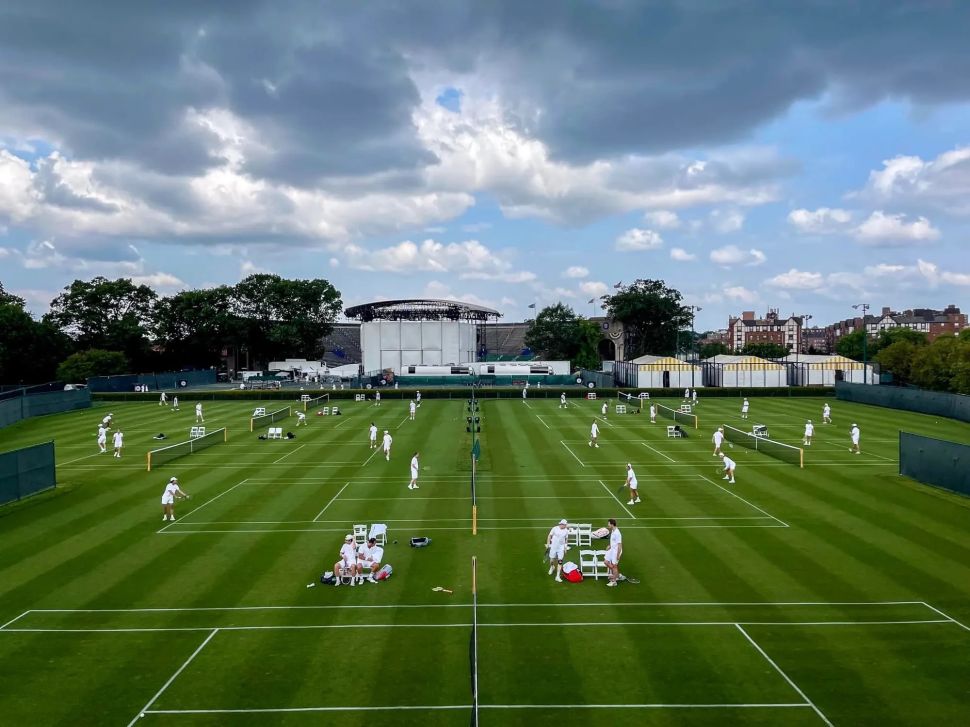
A New York City tennis permit costs $100 and arrives in the mail about three weeks later. From the first Saturday in April through the Sunday before Thanksgiving, it buys access to roughly 500 public courts shared by 8 million people. The rest comes down to a paper sign-up sheet taped to a fence at 7:30 a.m. and the man on court 3, who is 90 minutes into a singles match and has yet to look up.
The court scramble has intensified because tennis is having one of its periodic fits of glamour. Luca Guadagnino put a love triangle on a hard court in Challengers. Zendaya finished the job in Loewe stilettos skewered with tennis balls and a racket-print skirt for the London premiere. Wimbledon released its largest retail collection yet. Nearly 10 million more Americans now play than in 2019, and investors, including Andre Agassi and Kim Clijsters, are backing Ballers, a racquet club built to feel like a night out.
While fashion can sell the uniform, it cannot manufacture provenance. The clubs in this guide were founded between 1868 and 1928, all but one before the international federation that now governs the sport was created. They staged national championships, preserved grass courts on land worth far more as real estate and gave royalty, industrial fortunes and champions a place to meet on nominally equal terms. A few have loosened around the edges. Newport lets the public book its lawns, while Forest Hills accepts applications from anyone prepared to ask. At the top, the gate still opens by personal introduction: Wimbledon requires four written endorsements, while Barcelona demands four sponsors in good standing. Tokyo does not grant permanent membership to foreigners at all. What is clear is that at these clubs, a fine backhand matters less than being known by someone already inside.
The Most Exclusive Tennis Clubs
1 Tennis Pl, Forest Hills, NY 11375
Before Flushing Meadows, the U.S. Open lived here, in a horseshoe stadium behind a mock-Tudor clubhouse in the garden suburb of Forest Hills, Queens. Thirteen players founded the club in 1892 with three rented clay courts, and it went on to host the national championship from 1915 to 1977. This was the ground where Althea Gibson broke the sport’s color line in 1950, and where Arthur Ashe won the first U.S. Open in 1968; the stadium later booked the Beatles and Bob Dylan. It is a faded breed of grandeur, easier to join than the clubs at the very top, and better for it if you care where the game has actually been. Initiation has run around $1,500, a rounding error by the standards of this list, and the club still takes applications from people who simply ask. Nearly 1,000 members play there now, across 38 courts and four surfaces, grass included.
West Side Tennis Club.
West Side Tennis Club
All England Lawn Tennis & Croquet Club
Church Rd, London SW19 5AG, United Kingdom
There is no harder room to enter in tennis. The All England Club dates to 1868 and has hosted the Championships since 1877, now the only Grand Slam played on grass. Membership is capped near 375, and getting your name onto the list takes four current members willing to vouch for you in writing, two of whom must have known you for years. The shortcut is to win the tournament. Every singles champion is offered honorary membership on the spot, which is how Serena Williams and Roger Federer both belong, and the Princess of Wales serves as patron. What it costs is almost beside the point. The club publishes nothing, but the tennis writer Simon Cambers, after checking with sources inside, shared the annual subscription fee on his Substack this June—it’s about £150, roughly $198.
All England Lawn Tennis & Croquet Club.
All England Lawn Tennis & Croquet Club
155 Av. Princesse Grace, 06190 Roquebrune-Cap-Martin, France
The prettiest clay in tennis spills down a terraced hillside above the Mediterranean here, technically on French soil just outside the Monaco border, though the Grimaldis have always treated it as theirs. It opened in 1928 and runs more than 20 courts, nearly all of them clay. Every April, it hosts the Rolex Monte-Carlo Masters, where Rafael Nadal won a barely believable 11 times. Membership is drawn from the set that summers on this coast: old shipping money and Formula 1 drivers who relocated for Monaco’s tax rate. The last schedule the club made public, for the 2018-19 season, listed a €7,000 admission fee and €1,385 in annual dues, about $7,560 and $1,496, respectively. It has published nothing since. A booking here is a social credential before it is an athletic one. The dress code is, naturally, whites.
Monte-Carlo Country Club.
PH Sebastien Darrasse
Real Club de Tenis Barcelona 1899
Carrer de Bosch i Gimpera, 5-13, Les Corts, 08034 Barcelona, Spain
Spain’s grandest tennis institution has carried a royal warrant since close to its 1899 founding; the “Real” in the name was a gift from the crown. It sits in the well-heeled Pedralbes district and plays across 18 clay courts, one of them an 8,400-seat stadium that stages the Barcelona Open—the Godó—each April. Spanish champions have come through these courts for a century—Arantxa Sánchez Vicario, Conchita Martínez, Tommy Robredo—but the club’s patron saint is Nadal, a record 12-time winner of the tournament who had the center court renamed for him in 2017. Entry runs through four sponsors, each with three years’ standing behind them, and ends with buying a share in the club. What the share costs, the club has never said.
Real Club de Tenis Barcelona.
Real Club de Tenis Barcelona.
International Tennis Hall of Fame Tennis Club
194 Bellevue Ave, Newport, RI 02840
Tennis keeps its shrine at the Newport Casino, the shingled Gilded Age pleasure ground that McKim, Mead & White built in 1880 for the robber barons who summered here. It staged the first U.S. National Championships in 1881, the tournament that eventually became the U.S. Open, and today it holds the International Tennis Hall of Fame, where the game enshrines its own. Each July, the ATP’s Hall of Fame Open comes through—the tour’s last grass event in America. Part museum, part working club, it also keeps some of the only competition grass in the country that the public can book, provided you arrive in whites. It is the one club on this list that prices itself in the open: $2,400 for an individual summer membership in 2026, or $250 an hour on the lawn for anyone who reserves ahead.
International Tennis Hall of Fame.
Discover Newport
44 Price St, Toronto, ON M4W 1Z9, Canada
Considered by most accounts to be the oldest surviving lawn-tennis club anywhere, the Toronto Lawn Tennis Club has held its ground in Rosedale, the city’s most rarefied enclave, since 1876. It ran the first Canadian Championship in 1881, a tournament older than the U.S. Open and beaten only by Wimbledon, and later hosted Davis Cup ties and touring pros like Pancho Gonzales and John Newcombe. Its real notoriety now is social. This is old-money Toronto’s clubhouse, private enough that the city magazine once ran a long piece on the “turf war” between its established members and its newer ones. The renovation at the center of that fight pushed initiation fees to roughly CAD$40,000, about $29,000, and a senior member’s annual dues to near CAD$7,800, about $5,700. The club is closed for the rebuild until 2029.
Toronto Lawn Tennis Club.
DigitalProperties
Av. Olleros 1510, C1426CRB Cdad. Autónoma de Buenos Aires, Argentina
South America’s most storied tennis address hides behind wrought-iron gates in leafy Palermo, where the club has stood since 1892. Every February, its clay show court hosts the Argentina Open, and the crowd brings football-ground noise to a members’ lawn. The place is the cradle of Argentine tennis, the ground that raised Guillermo Vilas and, later, Juan Martín del Potro, and its reach runs past sport; the novelist Adolfo Bioy Casares was a member. Its center court carries Vilas’s name.
Buenos Aires Lawn Tennis Club.
Buenos Aires Lawn Tennis Club
489 Glenferrie Rd, Kooyong VIC 3144, Australia
For most of the 20th century, the Australian Open was decided on the grass at Kooyong, which Australians still call the spiritual home of their tennis. Founded in 1892 and set in Melbourne’s genteel southeast, it held the national championship until the tournament moved downtown in 1988, and its lawns crowned the Australian greats, from Rod Laver to Margaret Court. Four members sign your application—a proposer, a seconder and two referees—and then you wait, two to four years for a restricted membership and as long as six for a junior who joined the queue at 13. These days, it stages the Kooyong Classic, a pre-Open exhibition that still pulls big names in for a low-stakes hit.
Kooyong Lawn Tennis Club.
Clive Brunskill
5-6-41 Minami-Azabu, Minato-ku, Tokyo 106-0047, Japan
The club traces itself to 1887, when courts went in on the grounds of the British Legation, and was formally founded in 1900 on land leased from the Imperial Household Agency—ground that now holds the National Diet Building. It settled in Minami-Azabu in 1940 and never left: 10 clay courts on some of the most expensive land in Tokyo, a short walk from the Arisugawa gardens. Emperor Hirohito watched a match here in 1954, and the Imperial Family still belongs, alongside diplomats from more than 20 nations. Two sponsors and residency in Japan get you considered. Permanent membership, though, belongs exclusively to Japanese nationals. Foreigners, however long they stay, are admitted on five-year terms.
Tokyo Lawn Tennis Club.
Tokyo Lawn Tennis Club