
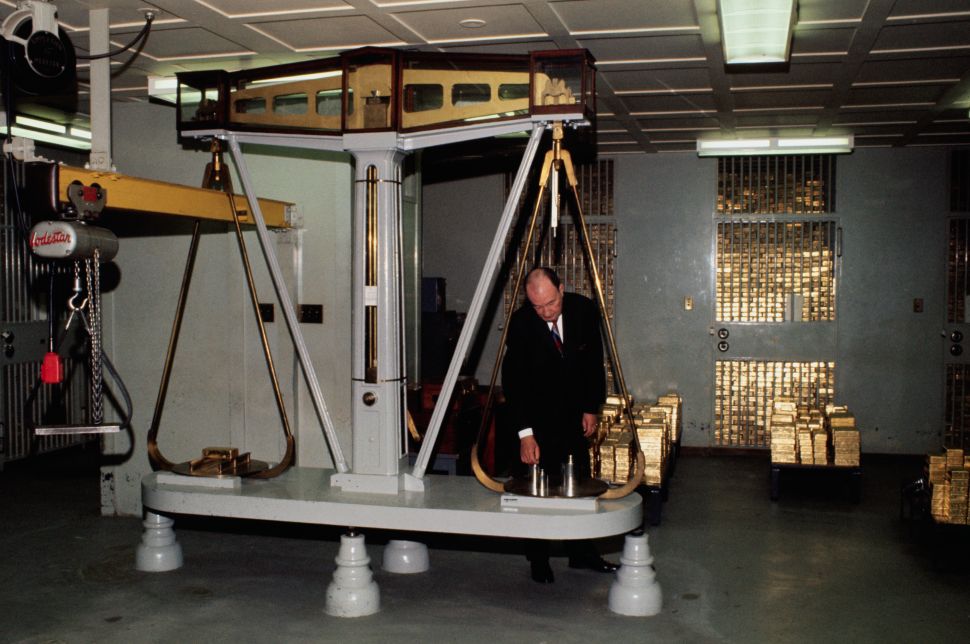
This week, central bankers gather in Jackson Hole to debate the future of money: the mechanics of policy, the promise of financial innovation, the architecture of a faster, more digital system. It is worth noting what the world’s most conservative investors are doing while that conversation unfolds. Central bank reserve managers, those who steward the savings of nations, have just made the oldest possible choice. In 2025, gold overtook U.S. Treasuries as the largest single asset in global official reserves for the first time since 1996.
That fact is usually filed under the safe-haven story: gold rises when investors are frightened. That framing misses what is actually happening. Strip away the crisis narrative, and what remains is a question of monetary power and financial infrastructure. The distinction at its heart is simple: a U.S. Treasury is a promise. It is the liability of the U.S. government, recorded in an account that can, under certain circumstances, be frozen. Gold sitting in your own vault is no one’s liability. No issuer, no credit counterparty and no sovereign that can default on it.
The European Central Bank (ECB) is careful to note that much of the crossover reflects gold’s price, which has risen sharply. That is true, and it is also beside the point. The valuation effect tells you what the metal is worth. The purchase orders tell you what reserve managers intend, and those have pointed in the same direction for four straight years.
For most of the postwar era, that distinction was largely academic. The dollar system was trusted precisely because it was assumed to be broadly dependable: your reserves were yours, whatever your politics. In 2022, that assumption was tested. Roughly $300 billion of Russia’s reserves were frozen in response to the invasion of Ukraine. Whatever one thinks of the decision, its message to every non-aligned central bank was unambiguous. The insurance policy you thought was unconditional has conditions. A reserve asset that is also someone else’s liability can, under the right circumstances, be switched off.
The response is visible in the data, and it looks structural rather than tactical. Central banks bought roughly 863 tonnes of gold in 2025, led by Poland for a second consecutive year, with Kazakhstan, Brazil and China also adding, extending a buying streak that has run for years. In the World Gold Council’s most recent survey, 89 percent of reserve managers expect global gold holdings to keep rising over the next year, and nearly three-quarters expect the dollar’s share of global reserves to fall over the next five years. Several central banks have also been repatriating bullion from foreign vaults and onto home soil. These are not traders chasing a rally. They are sovereign balance sheets being deliberately rebuilt around an asset that cannot be sanctioned, frozen or inflated away by another country’s decisions.
That is the connective thread the safe-haven framing obscures. What draws a reserve manager to gold in 2026 is less the prospect of a crisis rally than the absence of an issuer. In a world where the dollar’s financial plumbing can be turned into an instrument of foreign policy, an asset that answers to no government or corporation stops looking merely like a hedge and starts looking something closer to monetary sovereignty.
Here is where it gets more interesting, and where I can speak from inside the market rather than about it. I run a gold financing strategy, and the most striking feature of this market is what is missing: there is no visible term structure for borrowing gold. An asset that has just become the world’s largest official reserve holding has no observable curve for what it costs to lend or borrow against it, the kind of basic pricing infrastructure every other reserve asset takes for granted.
The way most institutions hold gold makes the gap starker. More than 90 percent of wholesale precious-metals trading clears through unallocated “Loco London” accounts, where you own a claim on a bullion bank rather than specific bars. The dominant way to own gold, in other words, is to own an IOU from a counterparty, which is the exact risk many reserve managers turned to gold to escape. As the Official Monetary and Financial Institutions Forum’s (OMFIF) gold working group argued last week, the metal has been handed a monetary role its market infrastructure was never built to support.
This is the unfinished work, and the part policymakers should be watching. If gold is being remonetized as reserve collateral, the system around it has to change: allocated title rather than pooled claims, a transparent way to finance and lend against it and a visible cost of borrowing so that an asset worth a record sum can actually be used rather than merely stored. Right now, institutions hold the largest gold reserves in modern history and still cannot readily price what it costs to borrow against them. Demand has outrun the plumbing.
Which brings the argument back to Jackson Hole. There is a striking split running through global finance. In the foreground, policymakers and markets debate financial innovation: tokenized assets, digital money, faster and cleverer payment rails. In the background, the institutions with the most at stake and the longest horizons are moving the other way, toward the one reserve asset with no issuer and no counterparty.
Both developments are responses to the same underlying anxiety, which is trust in the system’s plumbing. The Fed can still set the price of money. What this cycle is revealing is that it no longer sets the terms of trust. The 30-year Treasury yield touching a 19-year high, alongside the Treasury’s efforts to increase buybacks of longer-dated debt, offers another signal of the pressure building at the long end of the market.
The real story of this cycle has little to do with the gold price. It is that the world’s most cautious investors have quietly reclassified the metal, from something held against bad times to the one reserve asset whose defining feature is that it is nobody’s promise.
The open question, and the more consequential one for anyone thinking about the architecture of the international financial system, is whether we build the infrastructure to let gold function as the monetary collateral it is becoming, or leave the largest reserve holdings in a generation sitting in vaults and markets without a transparent way to price, finance and transfer the underlying asset.