
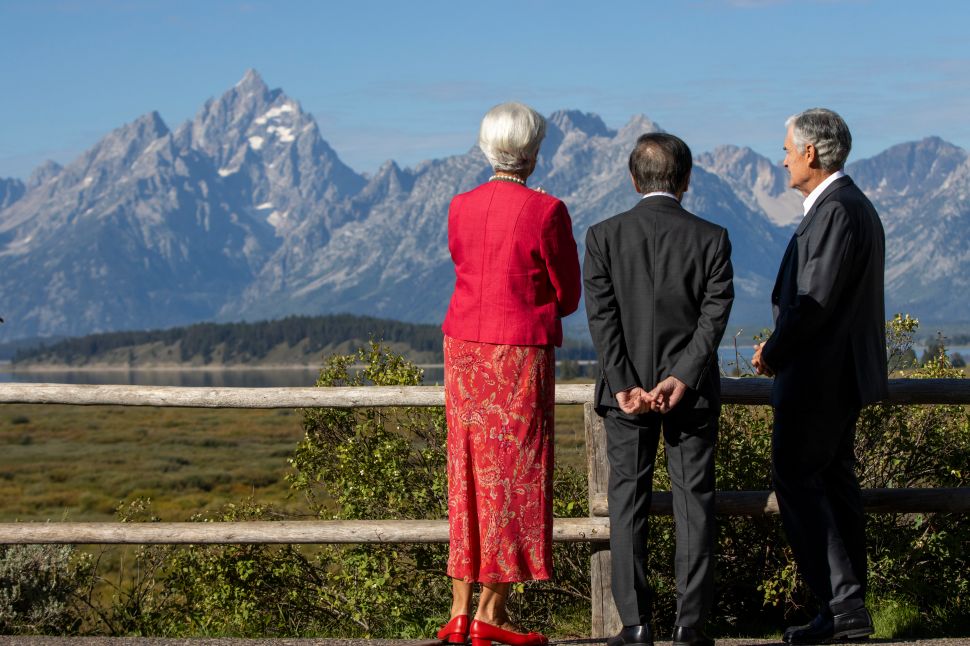
For 48 years, central bankers, academics and investors have gathered in the Rocky Mountains for the annual Jackson Hole Economic Policy Symposium. This year’s gathering in Northwest Wyoming is closely watched as Federal Reserve Chairman Kevin Warsh prepares to deliver his first Jackson Hole address after 65 consecutive months of inflation above the Fed’s 2 percent target. Yet, long before global financial leaders met to debate monetary policy, high-profile figures like President George H.W. Bush, Harrison Ford, and John D. Rockefeller Jr. helped put Jackson Hole on the map.
The symposium originated from a casual 1978 dinner conversation at Kansas City’s Crown Center among two American economists and government officials from Australia and New Zealand. Since then, it has evolved from analyzing agricultural policy to addressing global macroeconomic trends.
Each year, the host, the Federal Reserve Bank of Kansas City, sets a specific theme. This year’s topic, “Financial Innovation: Implications for Payments and Policy,” comes at a critical moment, as emerging payment systems like cryptocurrency continue to reshape financial markets and challenge existing regulatory frameworks.
The event moved from Kansas City to Jackson Hole in 1982 to accommodate then-Fed Chair Paul Volcker, an avid fly fisherman. That move was only possible thanks to John D. Rockefeller Jr., who covertly purchased and donated over 32,000 acres in the 1920s to help create Grand Teton National Park. The park eventually expanded to over 310,000 acres, encompassing mountain ranges, 200 miles of hiking trails, wildlife ecosystems and the long-time home of the symposium: Jackson Lake Lodge.
Going even further back, the region’s early footprint traces to pioneer Maggie Simpson. She settled in the area with her husband in 1893 and became postmaster, acquiring and parceling out 40 acres to help turn the small outpost into the town of Jackson. Her land established the community’s first hall, general store, hotel, stable and saloon, while her descendants later built the town’s first pharmacy and developed its initial city plan.
Encompassing seven towns across a 42-mile valley, Jackson Hole has hosted its share of notable moments. On June 13, 1989, President George H.W. Bush delivered a speech to 1,000 attendees laying the groundwork for his landmark 1990 Clean Air Act Amendments. In 1995, Bill and Hillary Clinton vacationed at Senator Jay Rockefeller’s local estate to escape Washington, D.C. The valley’s secluded mountain landscape has drawn not just political figures, but Hollywood stars like Julia Louis-Dreyfus, Sandra Bullock and Harrison Ford, who all purchased mountain retreats in the area.
Today, Jackson Hole also hosts annual art fairs, music festivals and traditions like Old West Days, a 10-day cultural celebration entering its 44th year. Tourism revenue has delivered local benefits beyond destination travel. Lodge taxes help fund public infrastructure, regional events and trailhead ambassador programs, while rising visitor counts have sparked community campaigns to preserve local wildlife and natural landscapes.
Bill Clinton (R) and First Lady Hillary Clinton appear at a ceremony at the Jackson Lake Lodge in the Grand Teton National Park in WY 26 August marking the 75th anniversary of woman’s sufferage in the US. President Clinton, First Lady Hillary Clinton, and their daughter Chelsea are vacationing for two weeks in the Jackson Hole area. ” width=”970″ height=”610″ data-caption=’Bill Clinton (R) and Hillary Clinton during their family vacation in the Jackson Hole area in 1995. <span class=”lazyload media-credit”>LUKE FRAZZA/AFP via Getty Images</span>’>
Against this peaceful mountain backdrop, the discussions inside Jackson Lake Lodge move global markets. In 2005—four years before the Great Recession—Raghuram Rajan, then chief economist of the International Monetary Fund, delivered a prescient paper titled “Has Financial Development Made the World Riskier?” He warned that, while financial innovation expanded the ability to share risk, it also heightened volatility, and urged central banks to use policy and market-friendly regulation to limit excessive risk-taking. Former Treasury Secretary Lawrence Summers dismissed the warning at the time as “largely misguided.”
During the virtual 2020 symposium, then-Fed Chair Jerome Powell unveiled a historic flexible inflation targeting framework, allowing inflation to run above 2 percent to support labor market recovery. Coupled with massive pandemic-era stimulus and severe supply chain shocks, consumer prices surged. The central bank formally abandoned that framework at last year’s gathering, signaling a return to traditional price-stability priorities.
While the Kansas City Fed does not formally track attendee demographics, representation at the symposium has gradually widened. Women made up an estimated 30 percent of attendees in 2022, a stark shift from the 1990s, when women “barely filled a table,” according to KPMG’s U.S. chief economist Diane Swonk. This broadening perspective matters at a summit where discussions shape real-world livelihoods. When Nobel laureate Claudia Goldin presented her 2025 paper “The Downside of Fertility,” it sparked intense debate on how policy should address falling birth rates.