
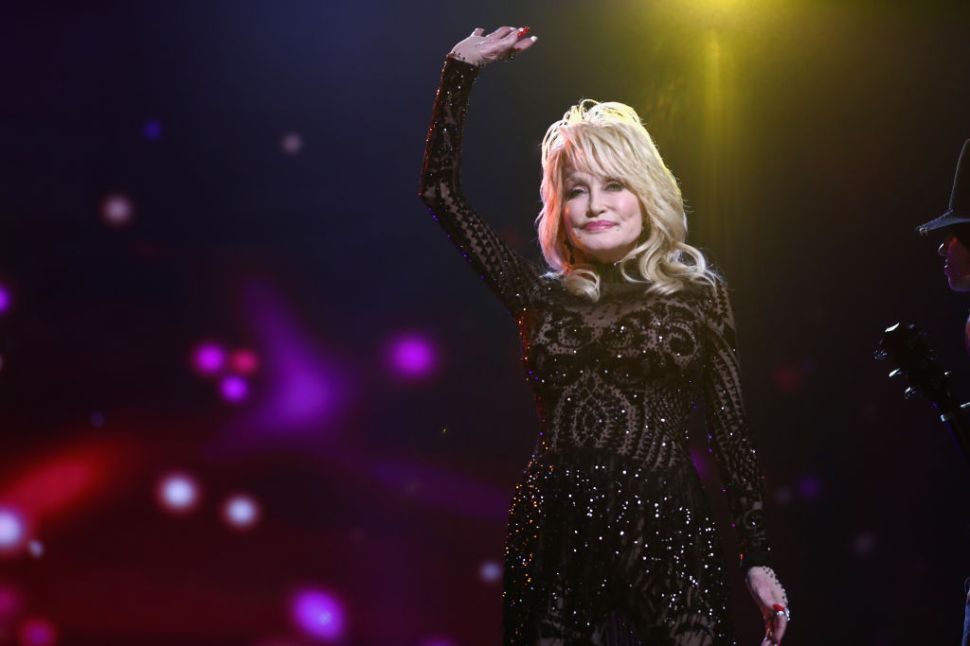
Dolly Parton – Inside” width=”970″ height=”647″ data-caption=’Throughout her life, she dedicated herself to using her money in a way that could do the most good for the most people. <span class=”lazyload media-credit”>Photo by Rich Fury/Getty Images for The Recording Academy</span>’>
Dolly Parton was never a billionaire because she never allowed herself to become one. The singer/songwriter/actress was too busy giving away money and offering opportunities to the people who needed her support. The “Queen of Country” knew something about being poor. Before writing her legendary songs, she would grow up in true poverty in Sevier County, Tennessee. Born in 1946, Dolly and her 11 siblings lived in a house without electricity and had running water only, as she would joke, “if you run ‘n’ get it.” She would later explain, “People hear me talk about eating squirrel and groundhogs, but in the mountains like that, you really didn’t have much of a choice. There were 12 of us kids.” Far from making her bitter, she credited her upbringing with giving her a sense of humor and resilience—the rags her mother sewed into a coat would inspire “The Coat of Many Colors.”
She practiced singing into a tin can and performed on local programs as a child. Then was featured at the Grand Ole Opry in 1959 when she was 13. Starting with “Joshua” in 1971, she would have 25 #1 songs on the U.S. Billboard Hot Country Songs chart. She reportedly wrote “Jolene” and “I Will Always Love You” on the same day, during a creative session in 1973. When Elvis wanted to record “I Will Always Love You” provided he could have 50 percent of the royalties, Dolly declined. It was later sung by Whitney Houston and became one of the most lucrative songs in history, with the royalties earning Dolly $10 million dollars in the 1990s alone.
And those royalties? Dolly poured them into developing an office complex in an overlooked Black community in Tennessee. She claimed, “this is the house that Whitney built.” This theme would thread through Parton’s life. She could have spent her time engaging in space tourism or basking in the adoration of her fans. No one would have begrudged her. Instead, she dedicated herself to using her money in a way that could do the most good for the most people.
Dolly explained, “I always thought that if I made it big or got successful at what I had started out to do, that I wanted to come back to my part of the country and do something great, something that would bring a lot of jobs into this area.” To that end, Pigeon Forge, not far from where Dolly spent her youth eating squirrel, is now a thriving tourist community, home to the Dollywood amusement park, which since its founding in 1986, has created 23,000 jobs and generated $1.8 billion for the area. Perhaps more remarkable though is that Dolly’s program Grow U paid for every Dollywood employee to go to college if they wished.
Two years later, in 1988, she instituted a buddy program in her hometown of Sevier County. She paired every 7th and 8th grader with someone else in their class and promised them that if they both graduated high school, she would give them each $500. If one of them dropped out, neither received anything. The high school graduation rate skyrocketed from 65 percent to 94 percent.
But her crowning philanthropic achievement may be The Imagination Library. Dolly Parton had always been an avid reader, telling Vanity Fair magazine that her idea of perfect happiness was “A big loaded baked potato and a good book with time to eat it and read it.” The Library provides a book a month for every child registered, from birth to five years old. It was not only because of Dolly’s personal passion, but also as a tribute to her father, who never learned how to read. Dolly believed “all children should grow up in a home full of books.” She saw to it that they did. At the time of her death, The Imagination Library had gifted 332,000,000 books to children. The family has asked for donations to the library in her memory. Fitting as, in 2019, she said that she would prefer to be remembered as “the book lady” rather than “the queen of country music.”
Dolly Parton’s songs and movies will be remembered. But her spirit may be treasured more. She understood that it wasn’t enough to simply make money. She had to spend it and spend it well. She achieved this purpose in her life, leaving a better place than she found it. And while it meant she was never a billionaire, it also meant that she left behind a legacy that is priceless.