
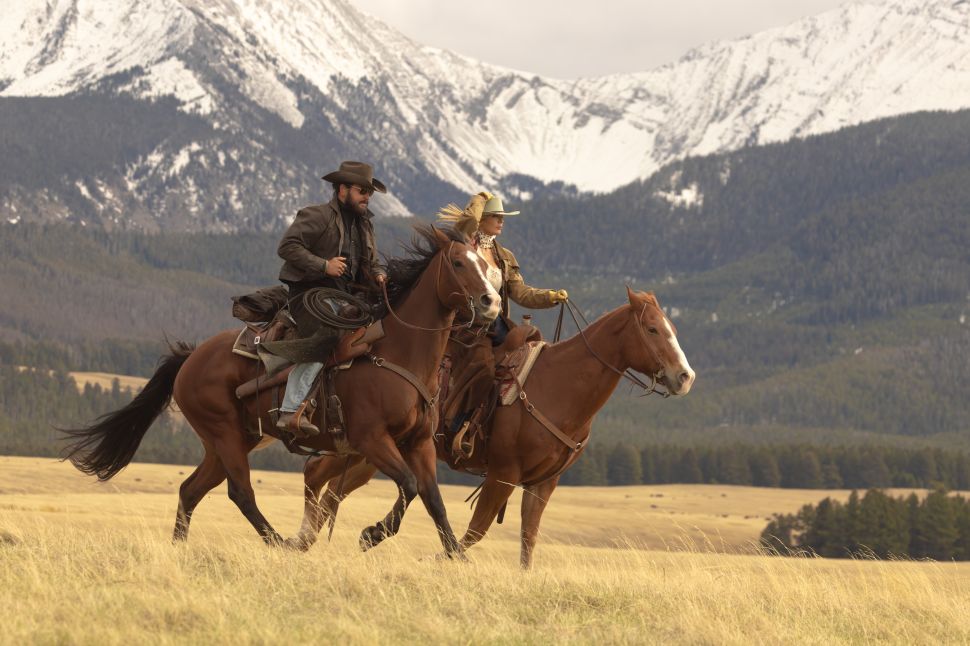
The West has always looked good on a screen, which is the only version of it that asks little effort from the viewer in return. Ranch life is chores with weather attached, and the climate does not negotiate. The work runs on knowledge that takes years and cannot be improvised, like when the river is fishable, or how a horse behaves. Television sold the picture to an audience whose own working day requires no physical knowledge at all, then luxury spent the next eight or so years learning to sell the knowledge without the chores.
John Wayne gave the screen West its square jaw. Little House on the Prairie put a family inside it, first in the 1970s NBC adaptation of the beloved Laura Ingalls Wilder books, and again in Netflix’s new version, which arrived this summer with the Osage story given space beside the Ingallses. For today’s luxury market, though, Yellowstone supplied the blueprint when it premiered in 2018 as a family succession drama dressed in black felt and worn leather, with land as the only asset worth killing for and houses lit like private clubs. The finale aired in 2024, but the appetite it cultivated kept growing. Nielsen’s final ranking of the 2025-26 television season placed Landman, Marshals and Dutton Ranch fourth through sixth, each averaging 19 million to 20 million viewers across platforms. Marshals, which turned Kayce Dutton into a Montana lawman, was the most-watched broadcast series in America.
The set decoration soon evolved into a shopping list. University of Montana researchers credited “Yellowstone” with drawing 2.1 million visitors to the state in 2021, including 1 million who said the show prompted their trip. Tourism and production associated with the series generated $730.1 million in spending. The Dutton wardrobe was the easiest part of the ranch to take home, and fashion got there before the finale did.
In January 2024, Pharrell Williams built a Louis Vuitton collection around the West with Dakota and Lakota artists. Two months later, Beyoncé’s “Cowboy Carter” made her the first Black woman to top Billboard’s country albums chart, pulling the mythology closer to the history that produced it. By October 2025, Vogue had Kendall Jenner and Gigi Hadid riding horses through Wyoming in flowing gowns. At the other end of the market, the trend showed up in Boot Barn’s books. The Western-wear chain closed fiscal 2026 with $2.25 billion in net sales, up 17.9 percent, after opening 80 stores. Another 70 are planned for fiscal 2027. One good boot carries most of the story.
Once the clothes were in the closet, hospitality sold a day inside the image. Montana drew roughly 4 percent fewer nonresident visitors in 2025, yet those travelers spent a record $5.64 billion, which works out to more per visitor than any year on record. Preliminary estimates put spending on outfitters and guides up 120 percent while lodging fell 11 percent. That combination is easy to read as a smaller, wealthier visitor pool, but Melissa Weddell, director of the University of Montana’s Institute for Tourism and Recreation Research, says that reading is too simple. Inflation did part of the work, and the rest is the same travelers choosing differently. “While inflation certainly accounts for part of the increase in spending, we’re also seeing visitors devote a larger share of their travel budgets to experiences rather than traditional purchases,” Weddell told Observer. A five-night stay becomes three, with the balance going to a day on the river. The guide gains a booking while the motel beside the highway gives up two nights. Montana keeps roughly the same wallet, opened at a different counter.
Hotels have rebuilt themselves around that choice. The former Snow King Resort reopened in May as the 203-room Trailborn Jackson Hole, with an adventure desk to start the day and a mineral spa waiting afterward. The 20-room Alpine House emerged this summer from an Elizabeth Roberts Architects overhaul in Pendleton textiles, its rooms modeled on family-run European lodges. It is a welcome reprieve from the antler-chandelier school of Western design.
Buena Vista, Colorado, built a more community-focused version around a wave. Surf Hotel sits beside a standing wave in the Arkansas River and South Main, the riverfront district that siblings and competitive kayakers Jed Selby and Katie Urban built on a former landfill before donating its trail to the town. Nearly every weekend from April through November now belongs to a wedding, with bookings stretching into 2028, Rob Scott, who oversees marketing for both, told Observer. In August, Field of Vision returned to nearby Meadow Creek, placing Buena Vista alongside Queens as one of the band’s only two U.S. stops of 2026.
Meanwhile, at Vermejo, the hotel comes with more than 550,000 acres. Ted Turner bought the northern New Mexico ranch from Pennzoil in 1996, then launched the public-facing Ted Turner Reserves hospitality venture in 2015. Guests now sleep in a 1900s stone mansion or one of the smaller cabins and cottages, spending their days fishing or riding with guides who also lead wildlife excursions across the restored land.
In Aspen, the Western fantasy begins as a shopping ritual. Customers may wait 45 minutes to enter Kemo Sabe, then find free drinks and dancing inside while hats are shaped and branded, owner Wendy Kunkle told Forbes. The appeal has traveled far beyond the mountain town. Abercrombie & Fitch chief product officer Corey Robinson first met Kunkle during a family vacation in Aspen.
<img decoding="async" class="lazyload size-full-width wp-image-1685474" src="data:image/gif;base64,R0lGODlhAQABAAAAACH5BAEKAAEALAAAAAABAAEAAAICTAEAOw==" data-src="https://observer.com/wp-content/uploads/sites/2/2026/07/BFA_46497_6589923.jpg?quality=80&w=970" alt="" width="970" height="647" data-caption='<p>Bella Hadid brought a full Western aesthetic—horse and chaps included—to downtown New York City for the <span class="lazyload iNqyIf" data-sfc-cp="" data-sfc-root="ep" data-complete="true" data-copy-service-computed-style="font-family: "Google Sans", Roboto, Arial, sans-serif; font-size: 16px; font-weight: 400; margin: 0px; text-decoration: none; border-bottom: 0px rgb(10, 10, 10);">Kemo Sabe<noscript><img decoding=”async” class=”lazyload size-full-width wp-image-1685474″ src=”https://observer.com/wp-content/uploads/sites/2/2026/07/BFA_46497_6589923.jpg?quality=80&w=970″ alt=”” width=”970″ height=”647″ data-caption=’ hadid brought a full western aesthetic and chaps included downtown new york city for the data-sfc-cp=”” data-sfc-root=”ep” data-complete=”true” data-copy-service-computed-style=”font-family: "Google Sans", Roboto, Arial, sans-serif; font-size: 16px; font-weight: 400; margin: 0px; text-decoration: none; border-bottom: 0px rgb(10, 10, 10);” sabe></span> pop-up. <span class=”media-credit”>Jason Lowrie/BFA.com</span>’>A few years later, that relationship helped produce Kemo Sabe’s first global retail collaboration in fall 2025, bringing a $50-to-$500 version of its Western dress to Abercrombie stores worldwide. Kunkle estimates that Kemo Sabe’s sales have risen 313 percent since 2019. Concierge company Cuvée folds that ritual into a private stay. At Star Mesa Grand, 35 acres and seven bedrooms come with a local team and private chef, while an Experience Curator can arrange an upstairs appointment at Kemo Sabe. Leaving Aspen with 12 cowboy hats sounds decidedly absurd, unless a Yellowstone-themed bachelorette calls for cowboy cosplay.
Long before Yellowstone made the private West prime-time entertainment, the Yellowstone Club had put the dream behind a gate near Big Sky. Today, 2,900 of its 15,200 acres are skiable, served by 21 chairlifts and a gondola with no lift lines. One member told the San Francisco Standard that fresh tracks can still be found on weekday afternoons, and staff will not let members carry their own skis. To ski its “Private Powder,” prospective members must buy property before applying, and membership is capped at 914. Tim and Edra Blixseth began developing the private ski-and-golf community in the late 1990s on timberland assembled near Big Sky. That first ownership era ended in scandal after more than $200 million from a Credit Suisse loan was disbursed to personal accounts and payoffs benefiting the now-divorced Blixseths, a sequence later detailed by a federal appeals court. The club filed for bankruptcy in 2008. CrossHarbor Capital Partners bought it for $115 million the following year and has since invested more than $1 billion.
The model is spreading on smaller footprints. Hoback Club opened in Teton Village in January with 25 residences and referral-only membership, while Southworth’s 26,000-square-foot Alpine Club, due in Telluride in summer 2027, has already sold out its initial membership categories. Crazy Mountain Ranch sells belonging without a deed. Philip Morris bought the 18,000-acre spread near Clyde Park in 1999 and spent 22 years flying loyal Marlboro customers there to inhabit the ad campaign. Lone Mountain Land Company, an affiliate of CrossHarbor, acquired it in 2021 and now operates it with Discovery Land Company as an invitation-only club offering lodging without residential lots. The cattle operation continues, as does Deadrock, an Old West town assembled from historic buildings moved in from around the region.
Discovery Land is also pursuing a residential version about 20 miles south of Steamboat Springs. The current Stagecoach Mountain Ranch proposal calls for 613 market-rate homes on roughly 6,100 acres served by a private ski mountain, along with 132 workforce units. Ninety-five would be reserved for Routt County residents. Routt County opened a second formal review in June, with hearings expected later in 2026. For now, the newest private mountain in the West remains an application on a county planner’s desk. Beyond membership, the acreage itself becomes the purchase. In December 2025, Stan Kroenke, owner of the Los Angeles Rams and Arsenal, bought more than 937,000 deeded acres of Singleton Ranches in New Mexico. It was the largest U.S. land purchase in more than a decade and made him the country’s largest private landowner, with 2.7 million acres. Singleton remains a working cattle operation.
Robert Redford on horseback” width=”970″ height=”755″ data-caption=’Robert Redford and Paul Newman in <em>Butch Cassidy and the Sundance Kid.</em> <span class=”lazyload media-credit”>Screen Archives/Getty Images</span>’>
Then there’s Robert Redford. In 1968, the year before Butch Cassidy and the Sundance Kid made him a Western star, the actor acquired Timp Haven and thousands of acres in Utah’s Provo Canyon, shaping what became Sundance Mountain Resort around a rule: “Develop a little, preserve a lot.” He founded the Sundance Institute in 1981, and the film festival it later took over turned nearby Park City into an international address before outgrowing the town’s theaters and affordable housing. The festival moves to Boulder in 2027, backed by up to $34 million in Colorado tax credits. By June 2026, dozens of Boulder homes were already listed above $5,000 a night for festival dates in a city with roughly 2,900 hotel rooms.
The current Western boom began with an audience looking for proof that life could still feel physical, a desire that luxury has answered with an increasingly elaborate rate card: first a room or a day on the river, now membership and control of the land. The thirst may outlast the current crop of shows, and the land certainly will—ideally with a trailhead or two left for people without a member referral.