
In 1871, a two-part article titled “The Wonders of the Yellowstone” was published in Scribner’s Monthly, a new magazine based in New York City. In it, Nathaniel P. Langford describes “great falls,” “springs of boiling mud” and “scorching jets” issuing from “craters and fissures” that he witnessed on an expedition. To East Coast urbanites, the account of volcanic landforms in the far West read like pure fantasy.
Langford’s piece was illustrated by Thomas Moran, based on field sketches from the expedition. His chance to see Yellowstone firsthand would soon come, however, thanks to railroad tycoon Jay Cooke, who was interested in promoting a tourist attraction to boost rail traffic. Cooke funded a lecture tour by Langford and recommended Moran as “an artist of Philadelphia of rare genius” for the next expedition, led by the nation’s chief geologist Ferdinand Vandeveer Hayden. The cost of Moran’s travels was covered by Scribner’s Monthly and Cooke, who would later receive 12 watercolors in exchange.
After quickly learning how to ride a horse, Moran joined Hayden’s party in July and journeyed into the Rocky Mountains of northwest Wyoming. The scenery in Yellowstone was more spectacular than he had imagined. Working alongside the photographer William Henry Jackson, Moran made a visual record of over 30 sites, rendering in luminous watercolor the breathtaking vistas and spectral hues of rocks and waters. According to Hayden, the Grand Canyon was “decorated with the most brilliant colors that the human eye ever saw” and Moran, who was “noted for his skill as a colorist, exclaimed with a kind of regretful enthusiasm that these beautiful tints were beyond the reach of human art.”
Back in Washington, D.C., Hayden lobbied for the preservation of Yellowstone, in concert with Cooke and Langford. He presented a report of his survey to senators, congressmen and Interior Department officials. Critically, Moran’s watercolors and Jackson’s black-and-white photographs helped convince Congress that the wondrous beauty of Yellowstone was worth protecting.
On March 1, 1872, President Ulysses S. Grant signed an act dedicating Yellowstone “as a public park or pleasuring-ground for the benefit and enjoyment of the people,” withdrawing it from “settlement, occupancy, or sale.” The legislation created not just America’s first national park, but the first of more than 6,000 around the world today.
The rise of Thomas “Yellowstone” Moran
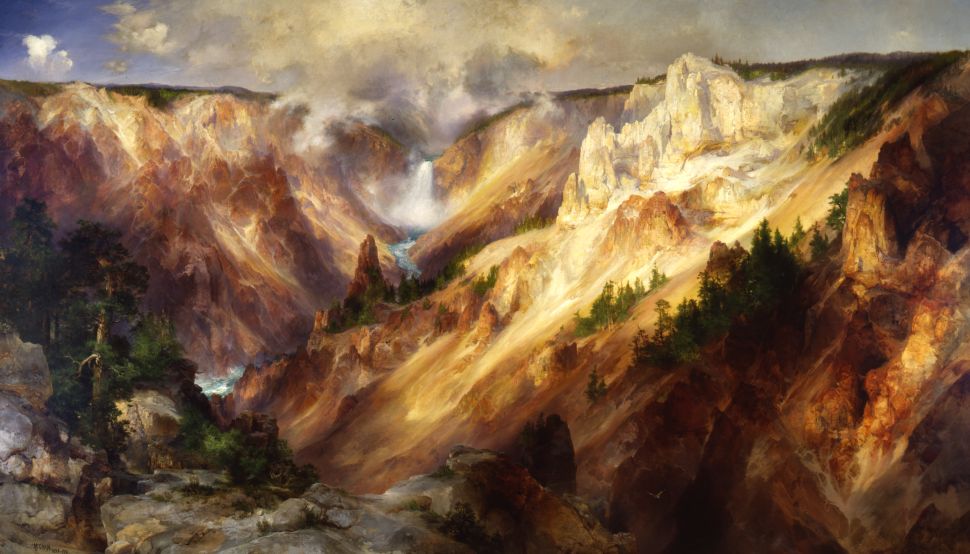
Yellowstone shot Moran to fame, such that he eventually signed his works with a TYM monogram, short for Thomas “Yellowstone” Moran. Shortly after establishing the park, Congress bought an oil painting by Moran for $10,000 and displayed it in the old Hall of Representatives. Titled The Grand Canyon of the Yellowstone (1872), the piece hangs today in the Interior Museum.
Moran’s Yellowstone landscapes placed him in direct competition with Albert Bierstadt, who had made his name painting Yosemite in the 1860s. By the end of the ’70s, their battle for government patronage resulted in a draw, with two paintings apiece hanging in the Capitol.
Historically, both painters belong to the Hudson River School—a New York City movement whose early subjects included the Catskill Mountains and the coast of Maine—as well as the Rocky Mountain School subset that ventured west. In a letter to Hayden, Moran wrote that “the business of a great painter should be the representation of great scenes in Nature. All the characteristics attach to the Yellowstone region, and if I fail to prove this, I fail to prove myself worthy the name of painter.”
Hudson River artists largely aligned with the philosophy of transcendentalists like Ralph Waldo Emerson and Henry David Thoreau, who believed that nature holds spiritual power. As is typical of the genre, Moran’s Grand Canyon is flooded by a divine light that dwarfs all living beings—the men and horses, the bear in the woods, the soaring bird of prey. Celebrating the natural wonders of God’s creation became a vital part of American identity. The patriotic hymn “America the Beautiful” (1895) was originally titled “Pikes Peak” after a summit in the Rockies.
Although Moran went on to paint other sites that became national parks, he returned to Yellowstone in 1892 with Jackson. Still captivated by the Grand Canyon, Moran made numerous sketches that led to a second version of The Grand Canyon of the Yellowstone (1901), now on view at the Smithsonian American Art Museum. Compared to the first, this painting is larger and more focused on the majestic, sweeping landscape—with not a human in sight.
The mixed legacy of national parks
The novelist and environmentalist Wallace Stegner famously wrote, “National parks are the best idea we ever had. Absolutely American, absolutely democratic, they reflect us at our best rather than our worst.” And yet, the reality is more complicated. “Protecting” a national park has often meant driving out the indigenous peoples who lived there for millennia. Dozens of tribes had a presence in the Yellowstone region before 1872. Particularly in the 19th Century, national parks were an expression of American expansionism and the belief in manifest destiny or the God-given right to the land that stretched from coast to coast.
Nature in the park sometimes ends up in a worse state than before. The gray wolf, seen as a dangerous predator and a “menace” to prey populations, was openly hunted, trapped and poisoned in Yellowstone. By the 1920s, wolves were effectively eradicated, triggering ecological collapse.
For Americans of immigrant stock, access to national parks wasn’t truly democratized until the advent of the family car. Early visitors were upper-class vacationers targeted by the rail industry, with marketing campaigns urging them to “See America First” and ride to the Rockies rather than sail to the Swiss Alps. In “protecting” Yellowstone from exploitation by miners and loggers, Cooke only sought to reserve profits for himself through tourism. For him, Langford and Hayden’s surveys might as well have been prospecting for gold; Moran’s paintings and Jackson’s photographs were basically imagery for advertising.
Still, for visitors today, including the 4.7 million that Yellowstone welcomed in 2025, national parks are a precious gateway for connecting with nature. And where there is a love for nature, there will surely be a love for art. Despite Trump’s recent disruptions to the National Park Service—fishing and hunting restrictions lifted, thousands of staff laid off, signs removed or rewritten, over $300 million diverted for D.C. projects—many federally funded artists-in-residence programs survive, and visitors continue to arrive with easels strapped atop their cars, ready to take in the sights and paint en plein air, just as Moran did 150 years ago.