
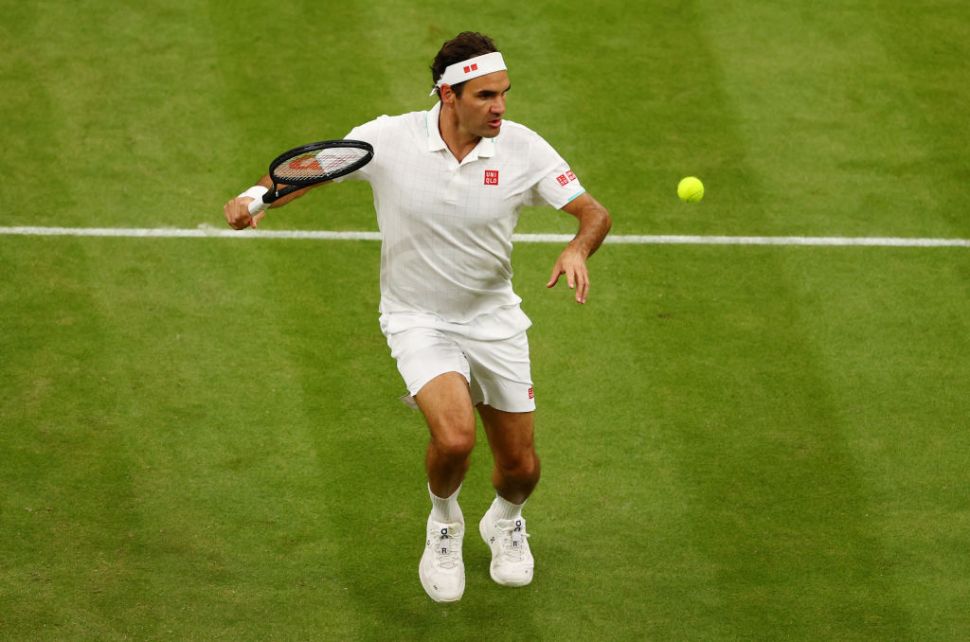
Roger Federer of Switzerland runs to return a shot in his Men’s Singles Fourth Round match against Lorenzo Sonego of Italy during Day Seven of The Championships – Wimbledon 2021 at All England Lawn Tennis and Croquet Club on July 05, 2021 in London, England. ” width=”970″ height=”642″ data-caption=’Roger Federer wearing a pair of On sneakers at Wimbledon 2021 in London. <span class=”lazyload media-credit”>Julian Finney/Getty Images</span>’>
Tennis legend Roger Federer earned nearly $131 million in prize money over his 24-year career. But one of his most lucrative moves came off the court. In 2019, he invested in On, the Swiss running-shoe company he joined as what the brand calls a “co‑entrepreneur.” On has never disclosed the terms, but previous reports said Federer invested roughly $50 million for an estimated 3 percent stake. At recent valuations, that position would be worth about $310 million.
It’s been a tough year for the sneaker company, however. Its share price is down nearly 40 percent in 2026 and plunged earlier this month after an alarming quarterly earnings report. Forbes estimated that Federer’s fortune fell by at least $52 million in a single day, briefly pushing him below the billionaire threshold.
On’s famously lightweight sneakers are still selling well and remain highly profitable. Second‑quarter sales rose 21.6 percent to $1.05 billion, while gross margin reached 65.4 percent. However, investors are worried about cooling demand in the Americas, slower wholesale growth, and a reduced full‑year forecast.
For Federer, a large share of his fortune now rests on whether On can keep pace with Wall Street’s expectations.
Federer was already one of the sports world’s most successful pitchmen. Forbes estimates that endorsements, appearances and other business ventures brought him roughly $1 billion during his playing career (before taxes and agents’ fees). After leaving Nike in 2018 for a reported 10‑year, $300 million apparel deal with Uniqlo, he found himself without a footwear sponsor. His wife, Mirka, wore On’s shoes, and Federer began noticing them everywhere in Switzerland.
On’s founders—former Ironman champion Olivier Bernhard and branding executives David Allemann and Caspar Coppetti—reached out. Federer joined not just as an investor but as a collaborator. According to On’s IPO filing, he spent “many days” in its Zurich lab working on both his namesake sneaker franchise and a high‑performance tennis shoe.
The first commercial result was The Roger Centre Court 0‑Series, a $250 lifestyle sneaker launched in 2020 as a limited run of 1,000 pairs. Later, the Roger Pro, a performance tennis shoe, was introduced, now priced at $220 and engineered for the lateral movements of competitive play.
On has since built a tennis roster spanning well‑known stars and younger prospects, including former world No. 1 Iga Świątek, U.S. Open semifinalist Ben Shelton and rising Brazilian player João Fonseca.
Since On’s 2021 IPO, annual sales have climbed about fourfold, reaching $3.7 billion by 2025. Over 90 percent of its revenue is from shoes. Its sneakers are particularly popular with younger consumers, thanks to patented technology and celebrity endorsements.
Customers under 34 now represent more than one‑third of On’s customer base, executives said on an earnings call this month, with the $170 Cloudtilt and other lifestyle footwear proving especially popular. Earlier this year, a footwear and apparel collection created with Zendaya and her longtime stylist Law Roach sold out faster than expected, with women under 34 accounting for 60 percent of buyers, according to the company.
On shoes are known for their “running on clouds” feel, enabled by the patented CloudTech cushioning—using hollow pods on the sole that compress during landing and lock firm for a springy push‑off. Part of On’s next act rests on LightSpray, a process in which robots create the upper portion of a shoe in about three minutes, largely eliminating the usual cutting, stitching and gluing. Production sites in Zurich and South Korea have increased On’s capacity thirtyfold this year. And demand has followed: co-founder and co-chairman Caspar Coppetti said the $280 LightSpray Cloudmonster 3 Hyper shoes sold out within hours in parts of Asia and generated nearly 20 percent of footwear sales during the opening week of On’s Boston store.
“We are deliberately engineering for the multi‑decade value of a premium brand,” co‑founder and co‑chairman David Allemann told investors on an earnings call this month.
On is expanding, too, recently opening stores in São Paulo, Copenhagen, and Stockholm, with Sydney next. But that growth comes amid leadership turnover. Marc Maurer left his co‑CEO role in 2025, while longtime financial chief Martin Hoffmann stepped down as CEO in May, returning Allemann and Coppetti to daily management. Their challenge is to keep On growing without diluting the premium image that made Federer’s investment so valuable.