
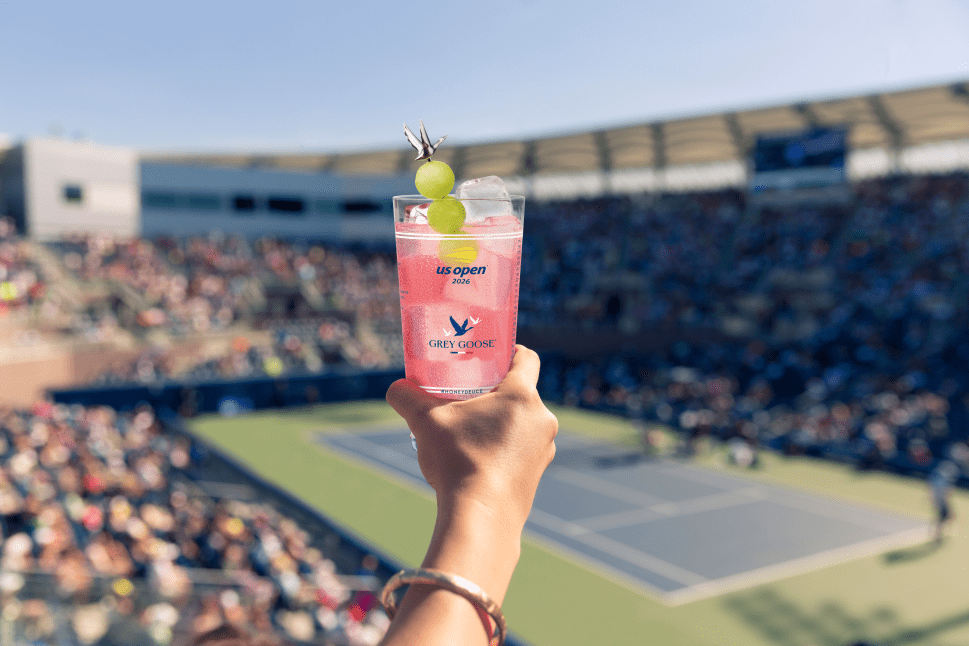
At the U.S. Open, Honey Deuces travel in packs. Tumblers bob along the promenade outside Arthur Ashe Stadium, each full of a pale-pink drink beneath a trio of green melon balls. By evening, the same cups ride the 7 train home in nested stacks, proof that a drink order can become a collecting habit before the night is over. For the uninitiated, the Honey Deuce is the tournament’s supremely photogenic official cocktail. Grey Goose and lemonade go over ice, followed by raspberry liqueur that settles near the bottom. The honeydew spheres stand in for tennis balls, while the name splices the fruit with “deuce,” the 40-all score when a player must win two consecutive points to take the game. It tastes like raspberry lemonade with enough vodka to make the walk between stadiums part of the entertainment.
The USTA sold 738,459 of them—priced at $23 each—in 2025, totaling $16.98 million—almost $7 million more than Carlos Alcaraz and Aryna Sabalenka received together for winning the singles titles. The cup survives the afternoon as take-home merchandise, and the garnish tells everyone across the concourse that its owner is probably off designated-driver duty. Flushing Meadows naturally encourages this sort of behavior: The U.S. Open is the last of tennis’s four annual Grand Slams and the only one held in New York, where planes bank toward LaGuardia above dance music and thousands of people treat the promenade as a second court. Wimbledon can keep its clipped lawns and Royal Box. Queens has a 23,000-seat arena where a night match can feel closer to prizefighting.
The tournament had spent decades growing into that personality. It left the private West Side Tennis Club in Forest Hills for the old World’s Fair grounds in 1978, opened Arthur Ashe Stadium in 1997, and took Billie Jean King’s name in 2006. By the time the Honey Deuce appeared the following summer, the American major had largely traded country-club manners for the scale and noise of a New York spectacle. On Sept. 9, 2007, Roger Federer defeated a 20-year-old Novak Djokovic in Djokovic’s first appearance in a Grand Slam final. Apple sold its millionth iPhone that same day, 74 days after the device went on sale. It was a fitting coincidence because the drink had sold itself by sight from the beginning. One person carrying it became the menu for whoever passed, and smartphones allowed that advertisement to leave Queens. Its color and garnish identified the drink immediately, while the year printed on the cup supplied proof of attendance. When Instagram arrived three years later, the Honey Deuce already looked like something people would covet as something of a status purchase.
After becoming an Open sponsor, Grey Goose hired Nick Mautone, a New York hospitality veteran who had managed Gotham Bar and Grill and spent seven years as managing partner at Gramercy Tavern, as its first brand ambassador. His assignment? Develop a house cocktail and beat the previous year’s sales of roughly 10,000 drinks. The idea arrived in 2006 as Mautone drove home to Hampton Bays after a Grey Goose meeting. With weekend guests coming, he stopped at a farm stand for striped bass and sweet corn, then added honeydew, blackberries and rosemary for dessert. His fruit salad drew on childhood summer lunches of melon with prosciutto and his mother’s sugared blackberries. As he worked a melon baller through the honeydew, the accumulating spheres began to look like tennis balls. The garnish was confirmed before the cocktail.
Mautone’s first version mixed fresh lemon juice with homemade rosemary-citrus syrup, seltzer and an expensive blackberry cordial. It belonged in a restaurant, where a bartender has several minutes and a proper sink. At Flushing Meadows, thousands of customers can reach the bars between sets, and nobody near the back of the line cares if the syrup was made in-house. The finished recipe used one and a quarter ounces of Grey Goose, three ounces of lemonade and half an ounce of Chambord. The raspberry liqueur went in last, staining the bottom pink. The melon stayed because it softened the final mouthful and advertised the drink to everyone walking in the opposite direction. Mautone remembers close to 30,000 selling during the first tournament.
The U.S. Open then gave people a reason to buy another every year. Danny Zausner, chief operating officer of the USTA Billie Jean King National Tennis Center, had seen Churchill Downs turn the Mint Julep glass into part of Derby weekend. The Open printed former champions on a clear plastic tumbler, updating it as new winners joined them. Used cups now sell on eBay for roughly $10 to $20.
That annual cup order now tells a California farm how much fruit to have ready in August. Baldor Specialty Foods begins planning in March or April, using the USTA’s tumbler purchase to forecast its order from Turlock Fruit Company. Founded in 1918 and still operated by the Smith family, Turlock leaves its King O’ the West honeydews on the vine long enough to develop the sweetness the drink requires. “We’re at the mercy of good weather,” Jared Walton, Baldor’s director of sales and national accounts, who has overseen its U.S. Open service for 18 years, tells Observer.
The melons reach Baldor’s South Bronx facility over roughly 15 deliveries, where each load is tested for sweetness and processed within two days. Machines can make chunks, but producing round, skewer-ready balls from delicate, curved fruit while preserving enough usable flesh still requires a small metal scoop and a human wrist. Baldor prepared 2.3 million balls by hand in 2025 and expects at least 2.4 million this year, enough for 800,000 cocktails. On peak days, more than 20 people work each shift around the clock and can turn out 250,000 balls. Employees rotate off the task on alternate days to spare their hands and forearms. Once service begins, trucks leave the Bronx at 5 a.m. each morning and finish unloading into the tennis center’s cold storage by 10:30 a.m. Baldor supplies plenty of other food to the caterer, Walton says, although “the balls do take up a large portion of the truck.”
The drink’s price has climbed with the order. A Honey Deuce cost $14 in 2012 and reached $23 by 2024. CNBC calculated that inflation would have brought it to $20.33 last year. The dated cup makes the remaining $2.67 portable, which is more than can be said for most stadium markups. And yet, sales still rose 32 percent in 2025. The Honey Deuce now outsells the combined total of the roughly 300,000 Pimm’s served at Wimbledon and the 125,000-plus Mint Juleps poured across Derby weekend. Other sponsors have taken notice. Seven of the Open’s 25 official partners were beverage companies last year; Moët & Chandon offered a $39 Watermelon Slice in a neon-green tennis-ball goblet, and Lavazza expanded its espresso martinis. Frances Tiafoe supplied the field report back in 2023: “Seventy percent of the fans are just loaded and just absolutely drunk.”
Grey Goose now promotes “Honey Deuce season” before the first serve and has placed the drink at more than 140 New York bars. Fans began treating it as “a ritual that’s integral to how they experience and share the U.S. Open, rather than simply something they ordered at the bar,” says Stacy Belter-Saltiel, Grey Goose’s senior brand director. A Grand Central pop-up served smaller versions to commuters last summer. During the 2024 men’s final, Taylor Swift reached for one beside Travis Kelce, prompting the Open’s social team to call it “the full U.S. Open experience” in a photograph that did not need to show the court. For 2026, The Ritz-Carlton New York, NoMad has included a Honey Deuce masterclass in a package starting at $15,000 a night, where guests learn to mix what began as a stadium concession in their residence, then take a car to Queens.
Fan Week begins Aug. 23, followed by the main draw from Aug. 30 through Sept. 13. Once the final ends, demand for perfect honeydew spheres largely disappears. “This melon ball cut is uniquely in demand for a specific time each year,” Walton says. Baldor’s Fresh Cuts team returns to mise en place and julienned carrots, and the garnish behind a $17 million cocktail spends the rest of the year as one of many among a fruit salad.