
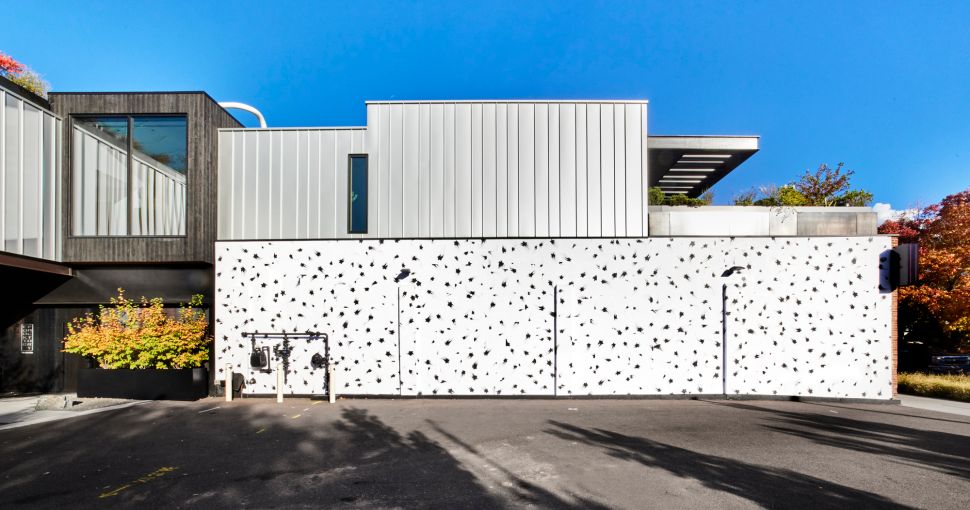
Gary Simmons created an exterior mural for Cookie Factory as part of the institutionâs commitment to commissioning new work developed specifically for Denver.” width=”970″ height=”511″ data-caption=’Installation view “Gary Simmons: Rush” at Cookie Factory Denver, 2025. <span class=”lazyload media-credit”>Photo: Third Dune © Gary Simmons Courtesy of the artist and Hauser & Wirth</span>’>
Arts foundations and private museums are frequently ego projects, well-intentioned but there to showcase the breadth of the founder’s collection and build a legacy around their name. Denver-based collector and real estate developer Amanda Precourt could have gone that route but wanted to take a different approach that placed art’s impact on her local community at the center. From her vision, Cookie Factory emerged—a free-to-the-public art space that launched in May 2025 and has since become a hub for the city’s creative community.
Housed in a former fortune cookie factory in the Baker neighborhood, Cookie Factory has a 5,000-square-foot gallery, a sculpture garden and video-screening rooms that host temporary exhibitions—mostly produced specifically for the venue—and an extensive public program. Precourt lives and displays her own collection on the residential floor above the galleries. “Rooted in place and embedded within a residential enclave, we operate on an intimate, human scale,” reads the space’s website, neatly summarizing its ethos.
When we meet Precourt at the St. Regis Aspen, it is clear that her highly sensitive and receptive nature has guided both her collecting and, later, the vision she developed for the space. Having just driven from Denver to attend the Aspen Museum Art Crush Gala, her blue eyes shine as she shares the story behind her ambitious adaptive-reuse project and community-focused art initiative.
Precourt, who is a real estate developer and designer by trade, discovered the factory after its roof had collapsed and the building had flooded—after more than 65 years, the owners simply wanted to sell. Paper fortunes were still floating in several inches of water among the old machinery, but she sensed the site’s potential and decided to follow her instincts. “When we pulled up to it, I literally got chills,” she tells Observer. “Sometimes it’s an imprinting. You feel energies or something.”
Precourt has always loved finding old buildings and adapting them for reuse while preserving their original identity. At the time, she had been casually looking for spaces where she and her husband, an artist, might create something art-related, but she did not yet have a clear sense of what such a project might look like. Discovering the factory immediately crystallized the vision in her mind: opening up the single-story structure to create an art space below with a residence above.
The project developed organically, but Precourt understood from the outset that it should be art-forward, noncommercial and oriented toward Denver rather than simply serving as a display space for her private collection. “I wanted to do something art-forward, but for the community,” she says, noting that through the long process of conversion and renovation, the building and her vision for it began to inform the way she collected.
Although she did not grow up in a particularly culturally minded family, art has been central to Precourt’s life since childhood. She recalls drawing and painting from a young age, and during adolescence, the practice became a tool for managing anxiety: “It is a way to reduce the external chaos by bringing in internal calm. I was always drawing and painting, and I drew and painted through college. I always felt art was something in my blood, although I never became a professional artist.”
Precourt began buying work by regional and local artists in her thirties while studying real estate finance, developing properties and designing houses. At the time, she primarily followed her own taste and did not initially identify as a collector. “I was not thinking ‘I’m building a collection,’” she explains. “I was collecting art and pieces of design just because I liked the aesthetic and the creative character in it.”
It was her close friend, art adviser Kim Gould, who encouraged her to collect more seriously. “She told me you need to collect art with me. You have a really good eye. You should go and start collecting on a larger scale,” Precourt recalls, admitting that she was initially intimidated, particularly when confronted with the dynamics of the art system. A turning point came during a trip to New York, when Precourt encountered Jeffrey Gibson’s punching bag, Know Your Magic Baby, at a gallery. The gallery initially agreed to sell it to her, but later reversed course because it was about to lose Gibson’s representation and wanted to prioritize other collectors. “The gallery was being difficult for me because I didn’t have that big collection; I was really a newbie.” She decided to ask Gould for help, and she was eventually able to acquire the piece, which became her first acquisition made with a clear intention to collect.
Over the following 12 years, the two traveled to fairs and developed the collection collaboratively. Gould offered expertise and guidance, while Precourt introduced her to artists she had not previously encountered. Even so, Precourt is quick to emphasize that her choices have been primarily driven by instinct, informed by her emotional connection with a piece over any market logic. “It was more like a collaborative and shared journey, where I received precious feedback,” Precourt asserted. “But I’ve always been following my own ‘internal muse.’ It is all based on emotional connection. It’s not about the markets to me. It’s about the way it makes me feel, and it’s about the connection I feel with the artist to something bigger and greater.”
Now that her collection has grown to more than 100 pieces, Precourt can identify recurring themes that were not initially evident. In college, she developed an interest in anthropology, archaeology and Indigenous cultures. “I really wanted to get a degree in anthropology with an emphasis on displaced cultures,” she shares. “I was always really, really into the Native American ruins and Native American art. I studied a lot when I was younger in my teens and 20s, and worked in the Asian art department at the Denver Art Museum.” Unsurprisingly, those interests began to shape her approach to collecting. “I’ve always been drawn to artists who have felt outside dominant systems and whose work addresses otherness.”
Another major theme for Precourt is mental health. In her late thirties, she checked herself into an inpatient psychiatric clinic for 15 weeks while suffering from depression. Those experiences later led her to co-found the Precourt Healing Center, an inpatient behavioral health facility in Edwards, with her late father, local businessman and philanthropist Jay Precourt.
Precourt is frequently drawn to artists whose work addresses similar states of mental wellness or “unwellness”—those who confront the kind of fear, anxiety, depression and feelings of otherness that she herself experienced for a long time. “A lot of these artists are questioning what the point is. Why are we here? It’s this kind of both existential and bigger cosmic questions that are inherent in many of the works in the collection.”
She sees art as offering a valuable entry point into alternative epistemologies and ontological systems, or simply different ways of seeing and approaching the reality around us. Artworks, she argues, can also serve as spiritual means of reengaging with alternative systems of knowledge and with questions about humanity’s relationship to nature, community and something greater than the individual.
One of the things Precourt values most is meeting artists and building personal relationships with them; she derives a lot of value from understanding the human being behind the work. She cites José Dávila, Gary Simmons, Theaster Gates, Jeffrey Gibson and Rashid Johnson among the artists she has particularly enjoyed getting to know, noting the humility she has encountered in many of them.
Through Cookie Factory, Precourt is bringing internationally renowned artists to Colorado, inviting them to become familiar with Denver, the mountains and local museums and encouraging them to create new work informed by the context in which the exhibition will take place. The human dimension that informs her collecting journey also informs the space’s programming: artists must not only make compelling work but also fit the institution’s collaborative culture and be willing to engage with Denver’s various communities. “We want to get along with the artists. We want to be friends. We want them to be part of the world. It needs to be a fit with our kind of internal culture,” Precourt explains.
She points to the institution’s latest exhibition, “Rush,” in which Gary Simmons engaged with Manifest Destiny, the Colorado Gold Rush, aspiration, failure and death, as a strong example. Simmons also drew on Charlie Chaplin’s film The Gold Rush, one of his favorite movies. “We want the conversations in the exhibition to be situated in the context of Denver and Colorado at large. We want them to do ideally new work that is inspired by Colorado and inspired by the space, and unless it’s in context with the show, but we ideally want it to be new work.”
Although Cookie Factory commissions new works directly, it does not automatically retain ownership of them, Precourt clarifies, though she always hopes to acquire at least one piece from each show. This modus operandi distinguishes Cookie Factory from most museums, which primarily present works that already exist.
Asked about Denver’s art ecosystem, Precourt acknowledges that the city has a strong institutional scene—including the Denver Art Museum, MCA Denver and the Clyfford Still Museum—but still lacks a more structured gallery system capable of supporting emerging artists and new production. She deliberately chose to fund Cookie Factory privately rather than immediately establish it as a fundraising nonprofit because she did not want to compete with existing institutions for the same resources. (Precourt is active on the board of the Denver Art Museum and has been a longtime donor to MCA Denver, which has given her close knowledge of institutional budgets and the pressures museums currently face.)
Her aim is to collaborate, break down silos and add something the city previously lacked: exhibitions by internationally recognized artists who have rarely or never worked in Denver, developed specifically in relation to the city and the state. Cookie Factory is located in Baker, a neighborhood with a strong population of artists and musicians. “It’s a kind of funky neighborhood, really art-forward and with a lot of creative energy,” she explains.
From the beginning, Precourt wanted the space to be something other than a traditional private museum, and she received enthusiastic support from the neighborhood even before construction began. Previous developers had failed to secure local backing, but Precourt petitioned residents, gained their support, pursued rezoning and then completed the permitting process. And because she followed through on her commitments, residents have continued to support the project. “The neighborhood has just shown up in that world to support me, to support us, and they keep coming back,” she says.
The opening drew approximately 2,500 people, while a first-anniversary celebration attracted about 900. Repeat attendance and steady neighborhood participation have convinced Precourt that the space can function as a genuine gathering point rather than a conventional museum. Over a year and a half of operations, Cookie Factory’s programming has also evolved in response to the community. Although the team initially planned to organize two exhibitions a year, it found that schedule too fast and began considering one six-month exhibition annually, accompanied by a series of activations.
These include music and dance performances, spoken word events, workshops, classes and collaborations with local artists and nonprofits. The Colorado Symphony has performed in the building, while other groups have used the galleries for interdisciplinary events. “We’re into this place for art in all forms,” Precourt says. “We’re evolving into a space that is really all about accessibility, and about bringing art to people that wouldn’t necessarily go to a museum before, and then also bringing museum goers to a space that is slightly askew from the normal museum model.”
Precourt, meanwhile, has continued to acquire art, though more selectively than before. Her present interests include emerging Indigenous art, Australian art, work connected to the African diaspora, collectible design and Indigenous jewelry from the Americas. Today, she prefers discovering work through artists, friends and connections rather than taking part in the art world’s nonstop social calendar and its exhausting fair circuit.
Gould’s sudden death a few years ago, followed by the deaths of Precourt’s parents, profoundly changed her relationship to collecting and to life more broadly. She stepped back to regroup and now evaluates acquisitions more deliberately, considering not only how a work strengthens the collection but also whether the artist might become part of the Cookie Factory community.
She already has a long-term plan for Cookie Factory: after her death, the building, residence and entire collection will pass to the Forge and Cookie Factory Foundation. The organization will be endowed and operated as a standalone museum in perpetuity to preserve the collection. Precourt currently has a core team of seven full-time staff members and is already developing the governance structure to ensure Cookie Factory can continue serving its community-focused mission after her death.
The next phase will also include curated presentations of rotating works from Precourt’s collection between exhibitions. However, she does not want these presentations to resemble conventional collection displays. Instead, she imagines a “living environment” combining art, furniture, design, lounges, bars, screenings, music and dance. “We’re creating a museum that can truly be a place to come and see your friends at any time,” she says, noting how a lounge created during Gary Simmons’ exhibition demonstrated the potential of this model: on some Wednesdays, roughly one hundred people came simply to gather, have a drink, watch films and inhabit the installation.
According to Precourt, “that’s the real accessibility.” She describes Cookie Factory as a container where people from different artistic disciplines, neighborhoods and socioeconomic backgrounds can encounter one another. By bringing trustees, musicians, bakers, dancers, students and local residents into the same space, she hopes to create relationships that would not otherwise form, strengthening Denver’s cultural ecosystem by fostering a spirit of open collaboration.
She remains deeply convinced of art’s role, in all its interconnected forms, in supporting mental wellness and making culture accessible. That is why she avoided naming the institution after herself or making it primarily about the financial value of her collection. “I feel like so many people in the art world talk about the financial value of the art, and I’m like, no. What about the emotional value? What about the social value? What about the cultural value?” she says. “I want to remove the financial value of the art and not make this a tax write-off. Instead, make it truly a gift to Denver. Art saved me in so many ways that I want to save others through art. So it’s like giving back.”