
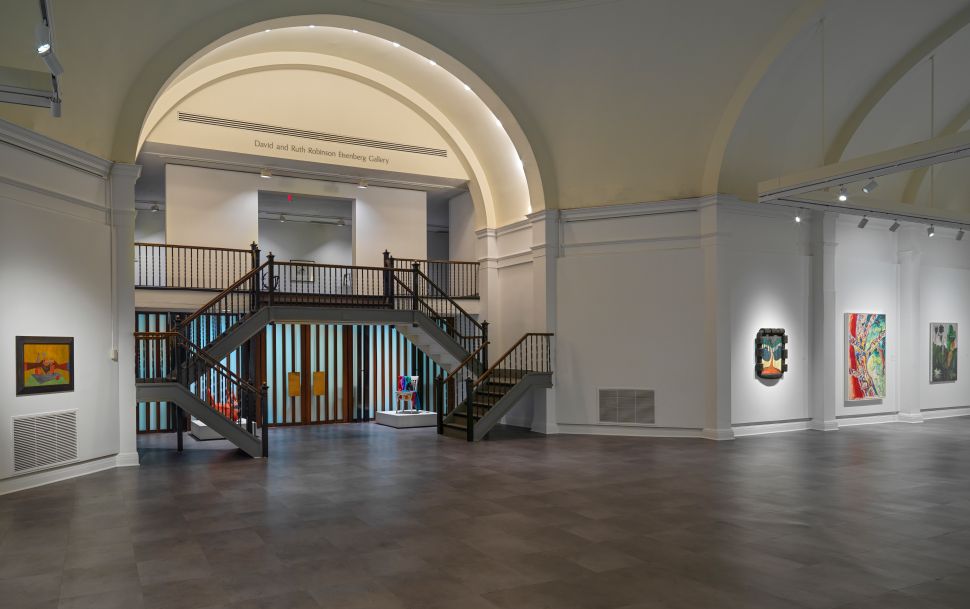
One of the most generous and forward-looking options available to collectors planning for the future of their collections is donating works to an institution, yet major museums are not always able—or willing—to accept such gifts. University and college museums, meanwhile, offer an accessible alternative that lets collectors have a tangible impact on the education and perspectives of future generations of students.
After years of collecting, Anne and Arthur Goldstein recently decided to donate 70 artworks to the Zimmerli Art Museum at Rutgers University in New Jersey, bringing the total number of works they have given the institution to 160. Announced in July, the major gift comprises works by leading contemporary names such as Tauba Auerbach, Darren Bader, Mark Bradford and Nicole Eisenman, as well as emerging artists including Ever Baldwin, Troy Lamarr Chew II and Lamar Peterson. Many of the works will be featured in “Mashup: New Acquisitions from the Zimmerli,” opening in February 2027.
Following the announcement, Observer spoke with the couple to learn more about the collecting journey that led to this major gift. The Goldsteins describe themselves as “self-taught collectors,” and when they started, they quipped, they didn’t even know who Edward Hopper was, and that was genuinely the case. At a gallery, they came across a stunning, simple watercolor depicting the landscape near their cottage on Cape Cod. “We recognized the scene immediately and wanted to buy it. I asked who the artist was and was met with a gallerist’s dirty look. As they whispered an unholy amount, I looked at Anne and said, ‘We’ve got homework to do.’”
Their first acquisition was a painting by Philip Pearlstein that still hangs in their living room. “It’s one of his iconic studio interiors. When we first saw it, we were overwhelmed by its power. We continue to be,” they said. After buying a few more paintings, they decided to focus initially on photography, recognizing early on that the medium offered the potential to build a strong collection at much more accessible prices. “Photography is how we learned to be adventurous. We quickly went from representational to conceptual pieces,” they said, and from there, moved toward even more conceptual and experimental aesthetics across media.
Curiosity, they said, has always been the primary force guiding their collection. “We like work that challenges us, surprises us, and stays with us long after we leave the gallery.” They have also always been particularly drawn to drawings and works on paper. “There’s an immediacy you can feel there,” they pointed out. “Drawing that both reflects the world now, but maybe also points to a future one.”
A turning point in their collecting journey was the purchase of Tacita Dean’s suite Russian Ending from 2001. “We got that quickly and confidently, and, after that acquisition, we never doubted our instincts again,” they said. “And as our confidence grew, we became more open. We were drawn to provocative work, artists with something to say.” (They later donated the group to the ICA Boston in 2015.)
The Goldsteins have distinguished themselves by collecting artists early and supporting underrepresented voices. They have always had a “voracious eye,” and they never stopped looking, followed recommendations, asked questions and spent time with people in the art world who shared their interests. “Navigating the scene at the beginning was hard, but we started going to galleries and museums every weekend and on every trip,” they acknowledged, recalling how some of the hotter, more established galleries shut them out, while younger or smaller galleries were often much more receptive. “We found a group of people; some even became lifelong friends. People started accepting us because we stayed true to our commitments, and we didn’t flip stuff.” Dorsey Waxter, Jay Gorney, Steven Henry, Michael Jenkins and James Danziger are among those who helped shape their collection. “Betty Cunningham told us to look for the toughest image because that’s the one that lasts.”
Building a collection as a couple can be a beautiful shared journey, though not always an easy one. The Goldsteins explained they tend to make decisions quickly, with each one both instinctive and grounded in mutual trust: “We collect because we love it, and, subconsciously, we always believed there would be a place for what we were doing in the future.”
Their gift to the Zimmerli is just one of many donations they have made to institutions across the country over the years. A gift in 2015 added 40 contemporary works on paper to the Tang Teaching Museum, and they have been active patrons of institutions including New York’s Museum of Modern Art and the Whitney, the San Francisco Museum of Modern Art, the Art Institute of Chicago, the Institute of Contemporary Art Boston and the Norton Museum of Art.
According to the Goldsteins, part of the responsibility of being a collector is planning for the afterlife of the works they acquire. “When you look at it that way, it’s not about the difficulty of parting, but an opening up of the work to everyone.” Any gift, they asserted, must first make sense within an institution’s collection. Conversations with curators, and the relationships built with them, have always been important to the couple. “Our core memories of the Zimmerli are with its curators,” they said. “Over the years, we’ve been fortunate to work closely with them, and through those relationships, we’ve come to see the museum as deeply committed to helping people discover artists other museums might overlook.”
As they began thinking about the future of their collection, the Zimmerli felt like not simply a place to house these works, but also a place that genuinely understood them and where they could be properly contextualized and appreciated. “What made the Zimmerli stand out was the staff’s excitement about this kind of collection—not just a handful of individual works, but a group of artists whose significance continues to unfold,” they said.
After learning that the Zimmerli had a strong collection of global Japonism and works by Japanese American artists, they had no doubt about where one of their favorites, Takeshi Kawashima’s New York M-33, ought to go. “It fit perfectly in this context. In the year this was painted, the artist was included in a landmark show at MoMA, ‘The New Japanese Painting and Sculpture (1966).’”
As museum acquisition budgets become increasingly constrained, private collectors have gained greater influence over what enters the public record. When asked whether this degree of power troubles them, the Goldsteins candidly acknowledged that this is how the system has always operated, since the Renaissance and probably even earlier. “The good art—the stuff that lasts—will always find its way into museums. Think of some of the artists; it could take 400 years!” For them, the real opportunity emerges when a public institution such as a museum can grow alongside collectors, with each supporting the other. It is less about imposing their preferences than asking museums about their collecting ambitions and offering assistance where possible.
While the donated works will form the centerpiece of the 2027 exhibition, the Goldsteins do not necessarily want to be involved in determining how they will be displayed, whether in terms of narrative, dialogue or curatorial priorities. “The easy part is buying the art. Making exhibitions is the real art,” they argued. “We think it’s important to stay out of a museum’s creative decisions, but the fun part is learning alongside them.” They trust the museum’s curatorial staff, led by chief curator Jeremiah William McCarthy, and discussed in advance how the gift might allow the collection to pose new questions. “Now that our art is in the museum, these conversations can unfold on the walls for the public.”
This latest major donation has the potential to further shape the Zimmerli’s collection and, with it, the kind of art its visitors—and particularly Rutgers students—will encounter. The Goldsteins were conscious of that possibility. “Like many collectors, we’ve reached a point where we’re thinking about the future of the collection and where these works can have the greatest impact. We want to place them with institutions that will embrace them and care for them but also share them,” they said. “We knew our collection would become part of the life of the museum and continue to be seen and appreciated by future generations.” After so many years of sustained support, making their largest gift of art felt like the natural next step in their relationship with the Zimmerli. “This gift reflects our journey of curiosity. It’s shaped by the hope that these works will spark a similar discovery for others.”