
The media attention generated by the Italian government’s acquisition in February of a rare Ecce Homo and Saint Jerome in Penitence panel by Renaissance master Antonello da Messina may have had unintended consequences. The state paid $14.9 million for the work through Sotheby’s—a rare move for the government—which likely brought renewed attention to the extraordinary economic value of works by the Renaissance master still held in Italian museums as part of the country’s priceless cultural heritage.
Around 9 p.m. on the night of Ferragosto, the August 15 national holiday that is essentially Italy’s Labor Day, a group of thieves took advantage of police attention being focused on the annual procession of La Vara, Messina’s huge and widely attended religious festival, to steal a group of masterpieces from MuMe, the Museo Regionale Interdisciplinare di Messina.
Bypassing the alarm systems, the thieves forced open a secure display case to remove the celebrated double-sided panel depicting the Madonna and Child giving a blessing, with a Franciscan friar in adoration on one side and Christ in Pietà on the other. Originally intended for private devotion and dated by scholars, on stylistic grounds, between 1465 and 1474, the panel was part of the Wilhelm Soldan collection since 1930. Its attribution to Antonello dates to 2003, the year the Sicilian Region acquired it at Christie’s.
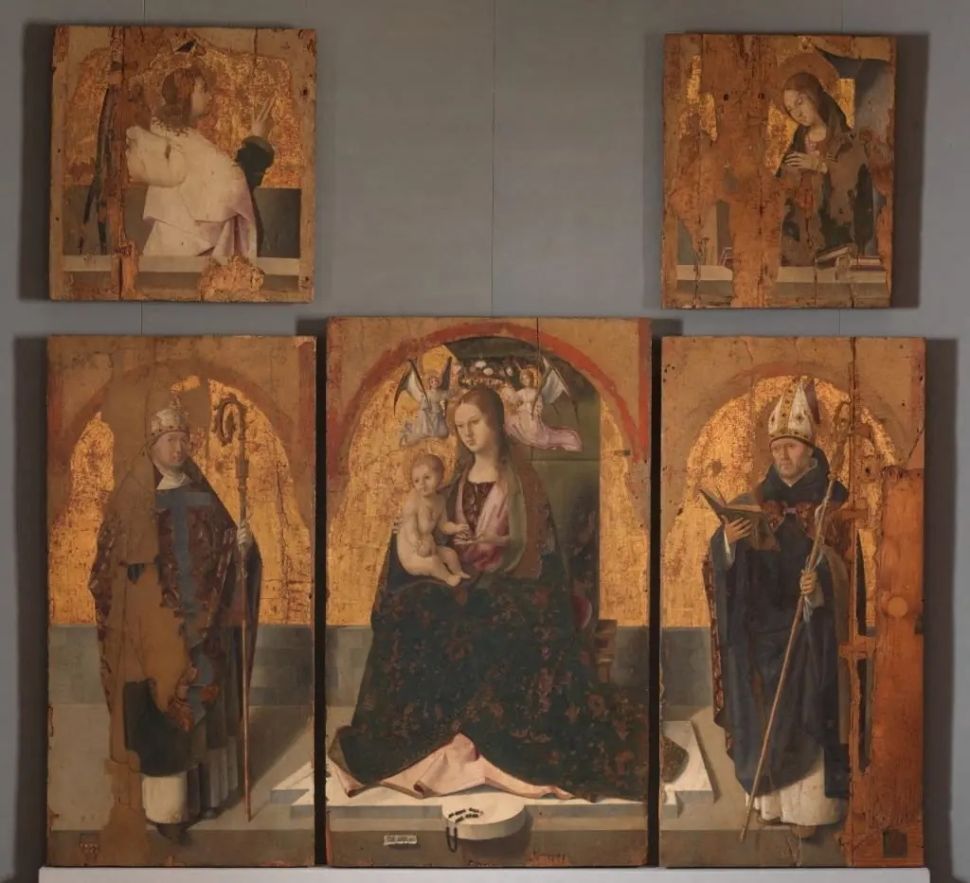
They also took three of the five surviving panels that made up an altarpiece known as the Polittico di San Gregorio. Originally composed of six panels created for the Monastero di San Gregorio, which was destroyed in the 1908 Messina earthquake, the altarpiece was the only work by the Sicilian painter that had never left his native city. Two additional pilfered paintings were abandoned outside the museum.
Surveillance footage, acquired by police, appears to show that a group of people carried out the theft in just two to three minutes, suggesting the operation had been carefully planned in advance. “It is an extremely serious and significant loss,” Marisa Mercurio, the director of the museum, said at the press conference. “They have stolen works of enormous cultural, artistic and symbolic importance, not only for Messina but for Sicily as a whole. We hope they are recovered very soon.”
The thieves will likely quickly discover the limits of the market they may be targeting. Works of this level and notoriety are almost impossible to resell openly, particularly at the seven-figure prices they might aim for, once their provenance is so irreparably tainted. That is especially true today, amid heightened scrutiny and due diligence requirements across the industry, especially for Old Masters, and Italy’s strict rules governing the export of cultural property. Outside the black market or a theft commissioned to order, there are very few places such works can realistically go.
“These were works that had survived the earthquake, destruction and five centuries of history. To see them taken from the public in this way makes the loss impossible to measure in purely economic terms,” Mercurio added. The museum was immediately closed to the public to allow investigators and forensic teams to carry out their work, including determining whether the choice of date was part of a deliberate logistical strategy. According to the state news agency ANSA, investigators are considering the possibility that the theft was carried out on commission for an art dealer.
The theft follows a series of high-profile art heists over the past year. More than a dozen major art heists have been recorded since January 2025, prompting the International Council of Museums to team up with Interpol. Among them was the October 2025 raid in which thieves spent less than eight minutes stealing jewels worth more than $100 million from the Louvre’s Apollo Gallery, a heist whose fallout eventually pushed out the museum’s director.
On Friday, Italian police recovered three paintings by French masters Paul Cézanne, Pierre-Auguste Renoir and Henri Matisse that were stolen earlier this year from the Magnani Rocca Foundation, a private museum near Parma, with the works together valued at roughly $10 million. Meanwhile, Brazilian police recovered eight prints by Henri Matisse on Thursday that had been stolen from the Mário de Andrade Library in São Paulo. The works, from the artist’s celebrated Jazz series, were among 13 pieces taken in the robbery, which also included five works by Brazilian modernist Cândido Portinari.
Taken together, the cases raise a difficult question about whether the increasingly public visibility of art as an asset class—and the constant headlines around auction records, trophy acquisitions and multimillion-dollar valuations—is also making cultural property more legible as a target, particularly when smaller museums are underfunded and underprepared to provide the level of security and care required for works of such value.