
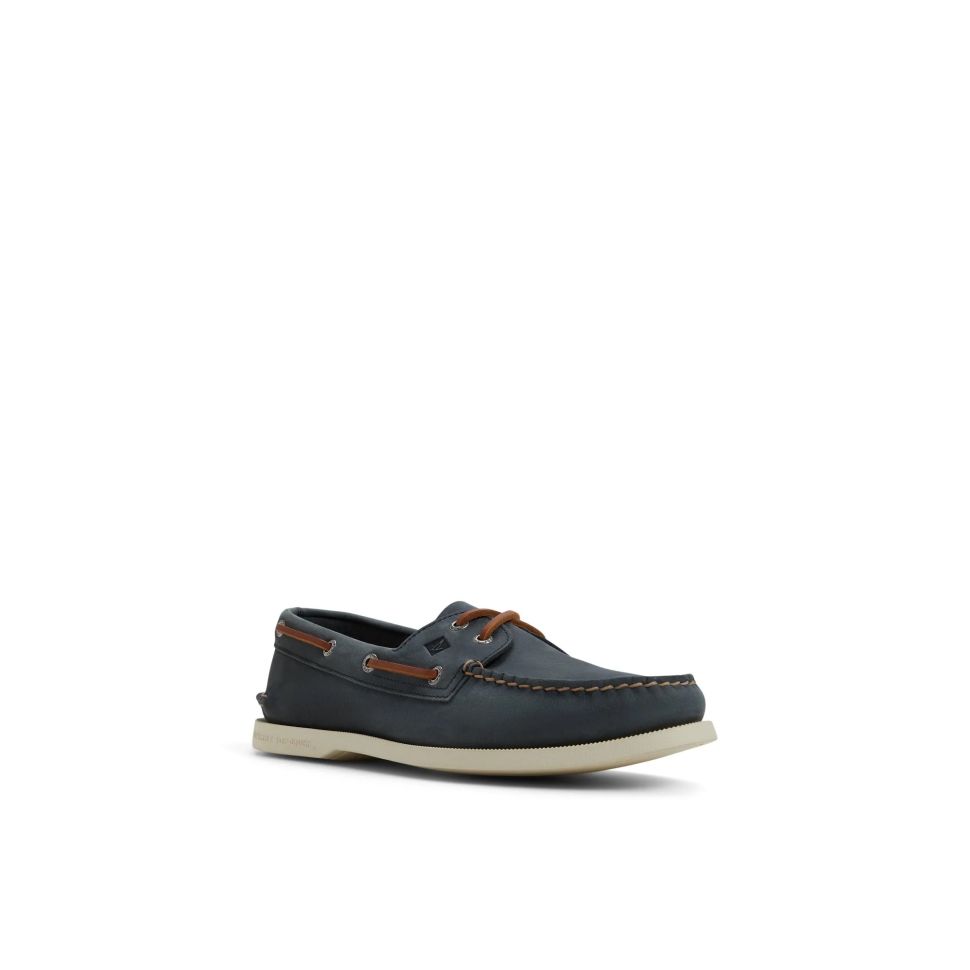
In the winter of 1935, a Connecticut sailor named Paul Sperry watched his cocker spaniel cross a sheet of ice without slipping and decided the dog knew something he didn’t. Sperry had spent years falling down on the wet deck of his schooner, once clear into the Long Island Sound, and no sole on the market gripped a thing once the spray came over the rail. So he flipped the dog over, studied the cracked pads of its paws, and went at a piece of rubber with a knife until he’d carved the same fine network of cuts into it. The grooves channeled water and bit in every direction. He had invented siping, the boat shoe, and a century-old debate about who gets to wear it.
Every part of the shoe that now looks like style began as a fix. The hand-sewn moccasin upper flexed with a working foot. The rawhide lacing pulled it snug when the boat heeled over. Leather, tanned to take salt water, held its shape through a soaking, and the white siped sole, the dog’s contribution, bit into wet wood without scuffing it. None of it was a matter of taste. Sperry sold the first pairs by mail to the Cruising Club of America, and by 1939, the U.S. Navy had made the Top-Sider regulation issue, strapping it to the feet of sailors who’d never seen the inside of a yacht club. For its first quarter-century, the boat shoe was exactly what it advertised: a tool for not dying on a wet deck.
Then it came ashore, and the troublemaking started. By the 1960s, the shoe had drifted off the working docks and onto the lawns of Newport, Rhode Island, the house slipper of a moneyed New England at play. Prep schools took it up, then the colleges those schools fed, and in 1980, Lisa Birnbach’s Official Preppy Handbook put a Top-Sider on the cover and made the subtext text. “The first thing they check,” it advised, “is your shoes.” Ralph Lauren and the rest spun a mythology around the silhouette. Nantucket. The Vineyard. A sloop the wearer may or may not have verifiably owned. The shoe built to keep fishermen upright had become a costume for weekenders not just trying to fit in, but nearly developing an on-island dress code.
That costume curdled fast. By the 2010s, the boat shoe had been drafted into the most maligned uniform in American men’s style in pastel shorts—Nantucket Reds among them—a popped collar, sunglasses leashed to a neoprene cord, a pair of Sperrys worn defiantly nowhere near salt water. It became shorthand for a type: fraternal, finance-tracked, faintly fragrant of warm light beer. Fashion, embarrassed to be seen with it, pushed the whole thing overboard. For most of a decade, the boat shoe was something you wore in college and explained away after.
Then, improbably, it came back, and the rescue party was led by Miuccia Prada. Miu Miu’s spring 2024 runway sent the boat shoe out flattened and faintly absurd, styled with swim briefs and Clubmaster glasses, and the rest of fashion fell in behind it fast, from Prada to Bally to Loewe. What the houses executed was a deft edit. Set a classic Sperry or Sebago beside the new minimalist versions and it jumps out: Where the former wears its function out loud—white sole, contrast stitching, brass eyelets, a knot of rawhide lace—labels like John Lobb and the Japanese line Auralee have filed every one of those tells off by hiding eyelets, minimizing the lacing, keeping the leather left soft and unlined until the deck shoe fully slouches into something closer to a louche moccasin. Essentially, they kept the shape and deleted the evidence of the job.
To say the updates were effective is an understatement. The retail tracker Circana clocked boat shoe sales up 24 percent in the first quarter of 2025, the category’s first growth in a decade, and Jennifer Lawrence wore a pair of The Row’s to dinner in case anyone missed the memo. Even the heritage names read the room. Sperry, sold off to Authentic Brands Group in early 2024, has spent the revival collaborating its way back into good standing: a suede Authentic Original with Todd Snyder, a shell cordovan version with Brooks Brothers built by hand in Maine and capped at fewer than 100 pairs. A shoe pronounced dead a decade ago was, suddenly, the most talked-about silhouette in the room.
So how does a man wear the thing in 2026 without time-traveling back to the frat house? Like any signature piece in your wardrobe, don’t let the look become a costume. The boat shoe works now precisely because it’s been pried loose from its preppy roots, worn with loose denim instead of slim chinos, with a rumpled linen suit at a coastal wedding, with tailored trousers that have no business near a marina. Sockless is still the move, though bare leather and a damp foot make a miserable pairing, so a no-show sock saves both the smell and the insole. Keep them out of the office, where they look distractingly off-duty, and away from anything black tie. And the old joke holds, with affection now where there used to be scorn: the boat shoe has never been less likely to see a boat. Ninety years on, Sperry’s dog was right. The grip was always the easy part. The hard part was knowing exactly where to stand.
Get the Look (Whether or Not You Own a Boat)
Sperry Authentic Original 2-Eye Boat Shoe
This is the one that started it, barely changed since 1935 with its water-resistant leather, rawhide laces and razor-cut sole. Choose from over two dozen colorways, wear them into the ground, and proudly let the salt and the scuffs handle the styling.
Sperry Boat Shoe.
Sperry
Prada Suede Boat Shoe
Prada’s contribution to the revival is the genre rendered in suede on a pale gum sole, the moc seam hand-stitched and the only visible note a small lettering stamp at the lace. It’s the runway boat shoe you could wear to dinner.
Prada Suede Boat Shoe.
Prada
Auralee Soft Leather Deck Shoes
The cult Tokyo label builds these from New Zealand baby calf, finished by hand until the leather all but melts onto the foot. This is the deck shoe stripped to pure line and feel, zero contrasting stitching or hardware, just the silhouette and a fit that gives like a second skin.
Auralee Boat Shoe.
Auralee
Clarks Godney Boat Shoe
Clarks runs its Wallabee instincts through a deck shoe here, stitching a British-tan leather upper to a low crepe sole, so you get the moc-toe heritage on a softer, springier tread than the usual gum bottom.
Clarks Godney Boat Shoe.
Clarks
Sebago Classic Portland Dockside
Sebago has been turning out the Docksides since 1970, and it’s still the European prep’s boat shoe of choice—full-grain leather, a hand-sewn moc seam, those non-corroding brass eyelets, and a crisp white sole.
Sebago Dockside.
Sebago
Morjas The Boat Shoe
This Scandinavian upstart hand-stitches this one in Italy and leaves it unlined so it lets your feet breathe through August. Set on a tonal rubber sole that mutes the nauticality, if you will, it takes wide-leg trousers as happily as tailored shorts.
Morjas Boat Shoe.
Morjas
Paraboot Barth
The Barth is the French rebuttal to the “bateau” shoe, cut in the 1970s for the Navy’s submariners and built to outlast them. It’s hand-sewn in soft deer leather on a Blake-stitched gum sole, which means a pair can get resoled and rebuilt rather than swiftly replaced.
Paraboot Barth.
Paraboot
Ancient Greek Sandals Pliario T-Moro
Here’s proof the silhouette has gone fully Mediterranean: handmade in Greece in crosta suede, laced with a leather cord knotted the way the label’s creative director learned from her father.
Ancient Greek Sandals.
Ancient Greek Sandals