Summer winds down, and American fashion goes back to school. Windows fill with navy blazers, barn coats, Oxford shirts and rep ties, the durable kit of domestic prep and proof that a young country can have an old closet. Brooks Brothers opened in 1818, before Queen Victoria took the British throne. Woolrich began producing woolen fabric in Pennsylvania in 1830. Their clothes started as useful goods and became shorthand for a life, which may be the most American fashion story of all.
European houses grew around ateliers and private fittings, but America built its industry on reach. Stateside, the department store and mail-order catalog imposed different demands. A coat had to look desirable and work hard, then come in enough sizes to reach a customer hundreds of miles from Seventh Avenue. Ready-to-wear made taste reproducible, while sportswear gave the same jacket a place at the office and dinner.
The dynasties that emerged from that system are real, though they seldom resemble several generations of designers sharing one studio. Here, succession usually means a professional chief executive manages the company while the family retains authority through private ownership, super-voting shares, board seats or a trust. A founder’s child may still appear in the campaign, yet still hold no power inside the business. The real test is who can choose directors, appoint the chief executive and approve a sale. The companies below show how American fashion families kept control as their labels grew far beyond the generation that built them.
Ralph Lauren
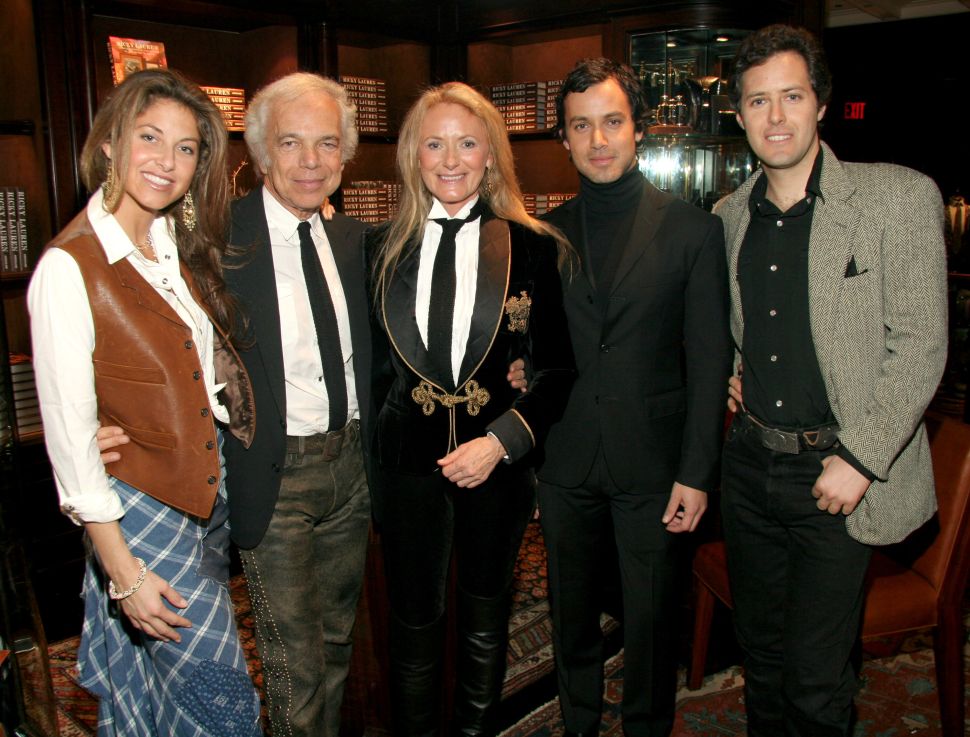
What began with neckties in 1967, giving American prep a budget and a backstory, would eventually become a public company whose founder, now 86, remains executive chairman and chief creative officer. The succession plan is considerably more practical. Patrice Louvet has managed the daily business as president and chief executive since 2017, leaving Ralph to direct collections and campaigns. Ralph’s younger son, David Lauren, joined in 2000, became a director in 2013 and is now vice chairman and chief branding and innovation officer. Ralph and Ricky’s daughter, Dylan, built Dylan’s Candy Bar. Their eldest son, Andrew, produces films. Only David works inside the company, but all three siblings have a formal role in the family’s voting block. Ralph controls 85.5 percent of the voting power, according to the 2026 proxy statement, while David, Dylan and Andrew also manage a family LLC holding 2.84 million super-voting shares, and at least two must approve any action.
Dylan Lauren, Ralph Lauren, Ricky Lauren, Andrew Lauren and David Lauren.
Hal Horowitz
Carhartt
Hamilton Carhartt started the Detroit company in 1889 with two sewing machines and five employees. Carhartt has since spent more than a century making clothing for jobs that ruin lesser clothes. According to company lore, the founder refined his bib overalls after speaking with railroad workers. The brown duck jacket eventually traveled beyond the job site, adopted first by hip-hop and skate culture, then by designers, without losing the customers who need its pockets day to day. Ownership stayed with Hamilton’s descendants: His great-grandson, Mark Valade, led the company from 1998 and now serves as executive chairman.
Mark Valade.
John Carl D’Annibale /Albany Times Union
Estée Lauder
Estée Lauder understood the persuasive power of a free sample from the start. She and Joseph Lauder founded the business in 1946, selling skin-care products in New York before their son Leonard took the company into department stores around the world. The company developed Clinique in-house and acquired MAC, Aveda, Bobbi Brown and Jo Malone London. Leonard remained involved until his death in June 2025. The family still controls roughly 84 percent of the voting power through shares covered by its stockholders’ agreement. William P. Lauder, Estée’s grandson, chairs the board. His cousin, Jane, left her executive position at the end of 2024 but remains a director. Jane’s sister, Aerin Lauder, continues as an ambassador and director of creative special projects. Aerin’s husband, Eric Zinterhofer, joined the board in 2025 as one of Ronald Lauder’s two family designees.
Leonard Lauder, Estee Lauder, Evelyn Lauder, and Gary Lauder.
Tony Palmieri/WWD/Penske Media
Chrome Hearts
Richard Stark co-founded Chrome Hearts in 1988, turning biker hardware and black leather into Hollywood luxury. Laurie Lynn Stark later joined him in building a privately held business with shops around the world. Much of its work still happens inside an L.A. complex spread across three city blocks. GQ reported that Richard, Laurie Lynn and their children, Jesse Jo, Frankie Belle and Kristian, approve company decisions together. Jesse Jo designs for Chrome Hearts and led its collaboration with Mikimoto. Frankie Belle’s swimwear company, Dipped in Blue, operates in partnership with the family business. Kristian has worked on Chrome Hearts’ real estate footprint in St. Barth and spoken since adolescence about eventually taking over the company. For now, the handoff is happening through shared decisions and distinct operating roles, with all five Starks still involved.
Frankie Belle, Richard Stark, Laurie Lynn Stark, Jesse Jo Stark.
Madison Voelkel/BFA.com
Elie Tahari
In 1980s corporate America, Elie Tahari made the sharp jacket part of the working woman’s uniform. After a childhood that included time in an Israeli orphanage, he arrived in New York and built his name on polished separates that moved easily from a desk to dinner. The company celebrated its 50th anniversary in 2024. The following year, Tahari appointed his son, Jeremey, as chief executive and creative director, the clearest handoff in this group. Jeremey began working with his father at 16, and later founded the streetwear label Anti and spent time in real estate before returning to the company. Elie remains chairman and continues to design the luxury Elie Tahari Collection.
Jeremey Tahari and Elie Tahari with CFDA CEO Steven Kolb.
Zach Hilty/BFA.com
New Balance
New Balance, founded by William J. Riley in 1906, was already 66 years old when Jim Davis bought it on the day of the 1972 Boston Marathon. He paid $100,000 for a six-person arch-support business producing roughly 30 pairs of shoes a day. Jim and his wife, Anne, built it into one of the world’s largest privately held athletic brands. New Balance reported $9.2 billion in 2025 sales, its fifth consecutive year of double-digit growth. Forbes estimates that the Davis family owns 95 percent. Control remains simple because the company is private and the family owns nearly all of it. Joe Preston has served as CEO since 2018. Chris Davis, Jim and Anne’s son, is global brand president and chief marketing officer—he once joked in an interview that New Balance felt like the favorite child in the Davis household.
Jim Davis.
Tom Landers/The Boston Globe
L.L.Bean
Long before the duck boot became a campus uniform, it was a rather spectacular product failure. The leather uppers separated from the rubber bottoms on 90 of the first 100 pairs of Maine Hunting Shoes. In an impressive show of customer service, Leon Leonwood Bean refunded every buyer and corrected the construction. Then he mailed the catalog again. The repaired boot became the brand’s signature product, and the company remains privately owned by a fourth generation of the family. While a nonfamily executive now handles daily management, Shawn Gorman, the founder’s great-grandson, chairs the board.
Shawn Gorman, chairman of L.L. Bean.
Shawn Patrick Ouellette/Portland Press Herald
Patagonia
Few brands did more than Patagonia to move technical outdoor clothing into daily life and put its environmental cost into the sales conversation. Its ownership plan is equally unorthodox. In 2022, Yvon Chouinard and his family transferred every voting share, representing 2 percent of the company, to the Patagonia Purpose Trust. The other 98 percent went to the Holdfast Collective as nonvoting stock. Patagonia remains a for-profit company. Profits not reinvested in the business are directed toward environmental work, while the Purpose Trust can approve board appointments and changes to the company’s charter. Yvon and Malinda Chouinard sit on the board with their children, Claire and Fletcher. Claire became board chair in March 2026, succeeding Charles Conn. Fletcher remains a director, as do both parents.
Yvon Chouinard with wife Malinda Pennoyer, son Fletcher and daughter Claire.
Ed Lallo