Believe it or not, Dairy Queen did not invent its signature Blizzard. The company lifted the idea—frozen custard whipped so stiff it is served upside down to prove it will not fall out—from a Route 66 custard stand in St. Louis called Ted Drewes, which has been in the same family since 1929. The stand is still there. So is the recipe, sweetened with honey since wartime rationing and never shown to anyone outside the bloodline.
Many foods Americans now treat as common property have similarly exact points of origin. The hamburger has an address in New Haven. The cheesesteak has one in South Philadelphia. Oysters Rockefeller emerged from a New Orleans dining room in 1899. In Tucson, family lore traces the chimichanga to a burrito dropped into a fryer. Each began with a particular cook in a particular kitchen. The country consumes the descendants by the ton and rarely remembers who made the first one.
Statistically, most of these places should have shuttered by now. Restaurants fail faster than almost any other business, and the few that survive tend to get bought, franchised or folded into hospitality groups steered by people who never met the founder. A restaurant kept in one family, three, four, even five generations on, has turned down the offer that reaches every success—cash out, and let the name become a brand. The 15 below are some of the ones that said no. The neon and the recipes are original. So, remarkably, are the families.
Historic Family-Owned Restaurants
Louis’ Lunch
261 Crown Street, New Haven, Connecticut 06511
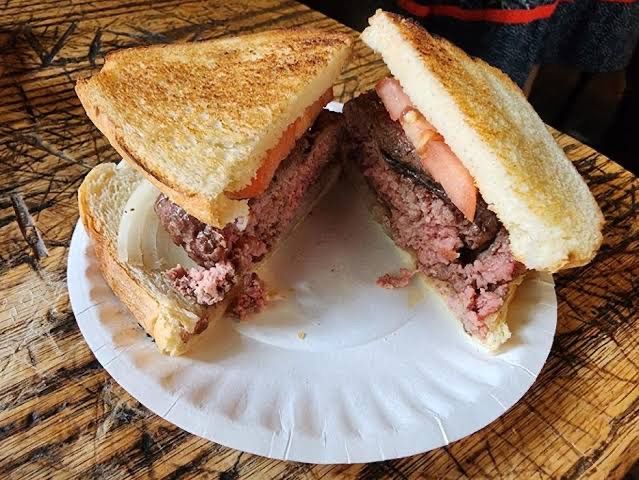
Four generations of Lassens have run this cramped brick lunchroom near Yale since 1895, and the Library of Congress credits founder Louis Lassen with serving the first hamburger here around 1900. The burgers still come off cast-iron vertical broilers from 1898, ground fresh and served on toast—never a bun, and under no circumstances with ketchup. Great-grandson Jeff Lassen will happily explain why.
Louis’ Lunch.
Louis’ Lunch
Peter Luger Steak House
178 Broadway, Brooklyn, New York 11211
The Luger family launched this Williamsburg steakhouse in 1887; by 1950 the founder’s heirs had let it slide and auctioned it off. The lone bidder was Sol Forman, a metalware manufacturer and 25-year regular from across the street, who bought the restaurant and its building for the price of the real estate—and four generations of his family have held it since. The menu is essentially one dish: dry-aged USDA Prime porterhouse, carved tableside under a pour of the melted butter the staff calls “vitamins.” The cash-only dining room, top-rated in the city since 1984, doubled in 2009 as the site of a lieutenant governor’s secret swearing-in.
Peter Luger Steak House.
Liz Clayman
Pat’s King of Steaks
1237 E. Passyunk Avenue, Philadelphia, Pennsylvania 19147
Pat Olivieri was a hot dog vendor in 1930 when he grilled some beef for his own lunch, sold a bite to a curious cabbie and accidentally invented the cheesesteak. Four generations later, the Olivieri family runs the original corner stand around the clock, directly across the street from archrival Geno’s, and still expects you to order correctly (“whiz wit,” if you want Cheez Whiz and onions). During wartime rationing, Pat spread a rumor that his sandwiches contained horse meat, then offered $10,000 to anyone who could prove it—business boomed.
Pat’s King of Steaks.
Pat’s King of Steaks
Antoine’s
713 St. Louis Street, New Orleans, Louisiana 70130
Opened in 1840 by Antoine Alciatore and now run by his fifth-generation descendants, Antoine’s is the oldest continuously family-owned restaurant in the country. It is the birthplace of Oysters Rockefeller (the recipe remains a family secret), served across 15 themed dining rooms that double as a museum of New Orleans society. Franklin Roosevelt and Pope John Paul II both dined here, and Oliver Stone shot part of JFK in the mirrored main room, where Kevin Costner is greeted onscreen by a real Alciatore descendant working as maître d’.
Antoine’s.
Antoine’s
The Columbia Restaurant
2117 E. 7th Avenue, Tampa, Florida 33605
The Hernandez-Gonzmart family has run this Ybor City landmark since 1905, growing it from a corner café for cigar workers into the largest Spanish restaurant in the world, occupying an entire city block. Now in its fifth generation, it is Florida’s oldest restaurant, known for the 1905 Salad tossed tableside, Cuban sandwiches and nightly flamenco. The dining rooms seat 1,700 beneath hand-painted tile and stained glass.
The Columbia Restaurant.
The Columbia Restaurant
Doe’s Eat Place
502 Nelson Street, Greenville, Mississippi 38701
Dominick “Big Doe” Signa turned his family’s Delta grocery into a honky-tonk and then, in 1941, into a restaurant serving hand-cut steaks and his wife Mamie’s hot tamales—a pairing that put the Mississippi Delta on the culinary map. Three generations of Signas run it, and diners still enter through the working kitchen, past the broiler where porterhouses the size of hubcaps come off the fire. In 2007, it became Mississippi’s first restaurant to win a James Beard America’s Classics Award.
Doe’s Eat Place.
Doe’s Eat Place
The Bright Star
304 19th Street North, Bessemer, Alabama 35020
Alabama’s oldest restaurant opened in 1907; it has been in the Greek Koikos family since 1925, when brothers Bill and Pete bought a stake from founder Tom Bonduris. Three generations on, it serves Greek-style snapper and beef tenderloin, seafood gumbo and meringue pies several inches tall, beneath murals a European artist reportedly traded for room and board. Among its celebrity fans is Sandra Bullock, who brought her father here for Father’s Day back in 2019.
The Bright Star.
The Bright Star
The Berghoff
17 W. Adams Street, Chicago, Illinois 60603
Herman Berghoff started selling his Dortmunder beer with free sandwiches at the 1893 World’s Fair, then opened this Loop institution in 1898; his great-grandson, Pete, runs it today. The German menu—wiener schnitzel, sauerbraten, creamed spinach and the famous house root beer—has barely changed, and the bar still displays Chicago’s Liquor License No. 1, issued the very day Prohibition ended. The bar itself admitted men only until 1969, when Gloria Steinem and members of the National Organization for Women arrived and demanded to be served.
The Berghoff.
The Berghoff
Ted Drewes Frozen Custard
6726 Chippewa Street, St. Louis, Missouri 63109
Ted Drewes Sr., a champion tennis player, opened his first custard stand in 1929. The fourth generation now runs the Route 66 shop using a recipe from the 1930s, with honey retained from the years of wartime sugar rationing. The signature is the “concrete,” a custard shake so dense it is handed over upside down to prove it won’t fall out—a gimmick so effective that Dairy Queen copied it for the Blizzard. Come December, the parking lot turns into a Christmas tree lot.
Ted Drewes Frozen Custard.
Ted Drewes Frozen Custard
American Coney Island
114 W. Lafayette Blvd., Detroit, Michigan 48226
Greek immigrant Gust Keros started with a downtown pushcart and opened American Coney Island in 1917, topping natural-casing franks with a secret-recipe beanless chili to feed Detroit’s autoworkers. His granddaughter, Grace Keros—the third generation and first woman to own it—runs the place, right next door to Lafayette Coney Island, the rival his own brother opened after a falling-out. Ask for ketchup and, in keeping with a century of local doctrine, you’ll be handed the bottle to do the damage yourself.
American Coney Island.
American Coney Island
El Charro Café
311 N. Court Avenue, Tucson, Arizona 85701
El Charro has occupied the same downtown house since 1922, when Monica Flin—one of Tucson’s first businesswomen—turned her stonemason father’s home into what is now the oldest Mexican restaurant in America run continuously by the same family. The Sonoran specialty is carne seca, beef sun-dried in a rooftop cage, and Flin is widely credited with inventing the chimichanga after accidentally dropping a burrito into the fryer. In the 1940s, she reportedly sipped martinis from teacups and played cards on the patio with John Wayne, in town shooting Westerns; today, her grandniece, Carlotta Flores, keeps the kitchen running.
El Charro Café.
El Charro Café
The Fort
19192 Colorado Highway 8, Morrison, Colorado 80465
Denver adman Sam Arnold built this adobe replica of an 1830s fur-trading post as a family home in 1963, then finished the ground floor as a restaurant; his daughter, Holly Arnold Kinney, runs it now. Billed as “new foods of the Old West,” it serves more bison than any independent restaurant in the country, alongside elk, quail and roasted bone marrow that the pioneers called “prairie butter.” When Denver hosted the 1997 Summit of the Eight, Boris Yeltsin was reportedly so taken with the bison that he wanted to import live buffalo to Siberia.
The Fort.
Visit Denver
Musso & Frank Grill
6667 Hollywood Blvd., Los Angeles, California 90028
Hollywood’s oldest restaurant opened in 1919, and the Mosso family has owned it since 1927—four generations now, with John Mosso’s great-grandson Mark Echeverria working the floor. The red-jacketed waiters, the martinis and the century-old chophouse menu are unchanged, which is why the “Chaplin booth” remains the most-requested table in the house. F. Scott Fitzgerald proofread novels in these booths; Taylor Swift even name-checked the place on her 2025 album.
Musso and Frank Grill.
Musso and Frank Grill
Canlis
2576 Aurora Avenue N, Seattle, Washington 98109
Peter Canlis—the son of a Greek father and a Lebanese mother—opened this glass-and-cedar landmark above Lake Union in 1950 and is credited with all but inventing Pacific Northwest fine dining. Three generations later, the Canlis family runs it, tosses the signature Canlis Salad (from Peter’s Lebanese mother’s recipe) tableside, and sets one of the most decorated tables in the country—Food & Wine ranked it the second-best restaurant in America in 2025. During the pandemic, the family kept its entire staff employed by turning the dining room into a drive-through burger window and, briefly, a Swiss-themed yurt village.
Canlis.
Canlis
Black’s Barbecue
215 N. Main Street, Lockhart, Texas 78644
Cattle rancher Edgar Black Sr. opened a Lockhart meat market in 1932 and started smoking his unsold cuts. The Black family has run it as the oldest barbecue joint in Texas under continuous family ownership ever since. In the self-declared barbecue capital of the state, it serves post-oak-smoked brisket seasoned with nothing but salt and pepper, sliced to order onto butcher paper, plus giant beef ribs and a sausage recipe going back some 80 years. The brick pit that third-generation pitmaster Kent Black works in was built by his father in 1949, and holds 500 pounds of meat at a time.
Black’s Barbecue.
Black’s Barbecue