The art at Chez Fifi, David and Joshua Foulquier’s bistro tucked into an Upper East Side townhouse was not curated in the conventional sense but rather inherited. The brothers, cofounders of the We All Gotta Eat group, named the restaurant for their mother—Firouzeh “Fifi” Foulquier—a stylish Iranian refugee who arrived in New York in the 1970s and settled just a few blocks from where it now stands. Though its menu is shaped by French and Basque influences, the ambiance is all Fifi. According to Joshua Foulquier, the candles on the tables were hers. The pillows on the banquettes were hers. Chez Fifi’s playlist comes from a box labeled “dinner party CDs” that he found under his mother’s bed after she passed away in 2018; it plays every night, untouched. And on the wall are works by Pablo Picasso, Alexander Calder, Joan Miró and other artists that she collected over decades.
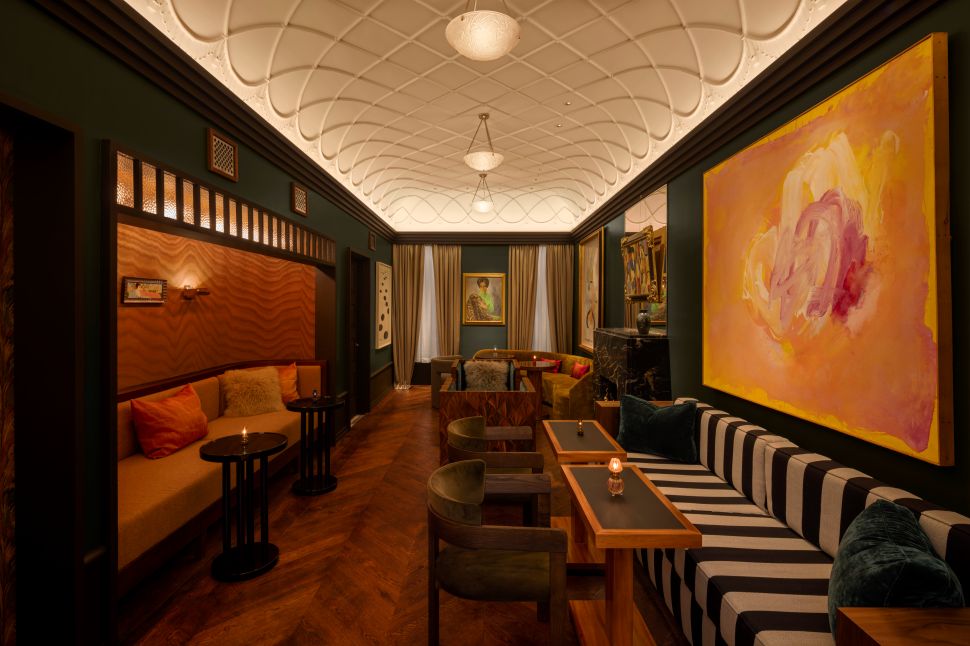
“In the salon upstairs, behind the black-and-white upholstered couch, is a Cleve Gray painting,” Foulquier told Observer. Gray was a New York-based painter who studied with all of the great AbEx artists of the Postwar period. “He was friends with Mark Rothko, Barnett Newman and Willem de Kooning—that whole crew of New York Jewish painters.” Fifi bought the painting not long after arriving in New York, straight off a gallery wall where it hung beside a de Kooning of the same size, made the same year and priced identically at $2,000. She chose the Gray. “It really defines my mom in ways that words or photos don’t, in a lot of different ways,” he added. “She never regretted it. We never regretted it. It hung over our dining room table for my whole life, and before that, for her life as a young adult who was a refugee and made it to New York City.”
Elsewhere in the salon is a Joan Miró lithograph, reframed in an oversize vintage frame Foulquier’s mother found collecting dust at the Marché aux Puces in Paris and knew, instantly, that it belonged with the work. “It’s absolutely spectacular… she loved the musicality of it,” he said. Foulquier, who is colorblind, walked us through the work’s palette with the same ebullience with which he described his mother. “They are all the vibrant colors that really define my mom. Growing up, roses of all colors were always in the house—pink roses, white roses, red roses, yellow roses—and she just loved those colors, and all of her art and all of her jewelry and all the clothes she wore reflected that.”
Foulquier studied art business at NYU before pivoting into hospitality, and also collects, mostly Calder gouaches. Across from the Miró lithograph is an Calder gouache that Foulquier acquired as a teenager, after finding two Calder-esque works listed as fakes at a small auction house in Alabama. He bought them anyway, for next to nothing, simply because he liked them. A month later, Sandy Calder, the artist’s grandson, reached out to tell him that one of the works had hung in his grandfather’s own bedroom for 20 years before a patron acquired it in the 1970s and the family lost track of it. His own tastes, he said, run more academic than his mother’s, with more portraiture and landscapes where she gravitated toward images of pure color and joy, but his approach to collecting is all Fifi: “I buy things that I like to be around.”
A Ludwig Bemelmans dog portrait, auctioned at Doyle and bid on from a stool at—providentially—Bemelmans Bar at the Carlyle, turned out to be a near-exact likeness of Baguette, Fifi’s treasured maltipoo, who carried her through her illness and now lives with Foulquier. Above the bar hangs a framed original sketch by the tattoo artist Daniel Zender, commissioned to render Foulquier’s mother in the style of Henri Matisse, her favorite artist and one whose work she sadly never owned. (It became the restaurant’s logo.) And tucked between two windows in the back of the salon is a striking portrait of Foulquier’s grandmother, a Sophia Loren-esque woman who, by his account, spent her life pulling attention toward herself and, fittingly, now does so once more.
These and other works were arranged in the space, said Foulquier, with no particular design logic. “They hung themselves, really… They fit perfectly in the space exactly as the space was.” He was quick to add that no amount of explanation can do the art, or Fifi herself, justice. The restaurant itself, he suggested, says more about his mother than he can. “She was just warm, welcoming, loving—she would hug you and hold you just a second longer than you expected, and give you that little extra love. That’s my mom, and that’s how I want her to be remembered.”