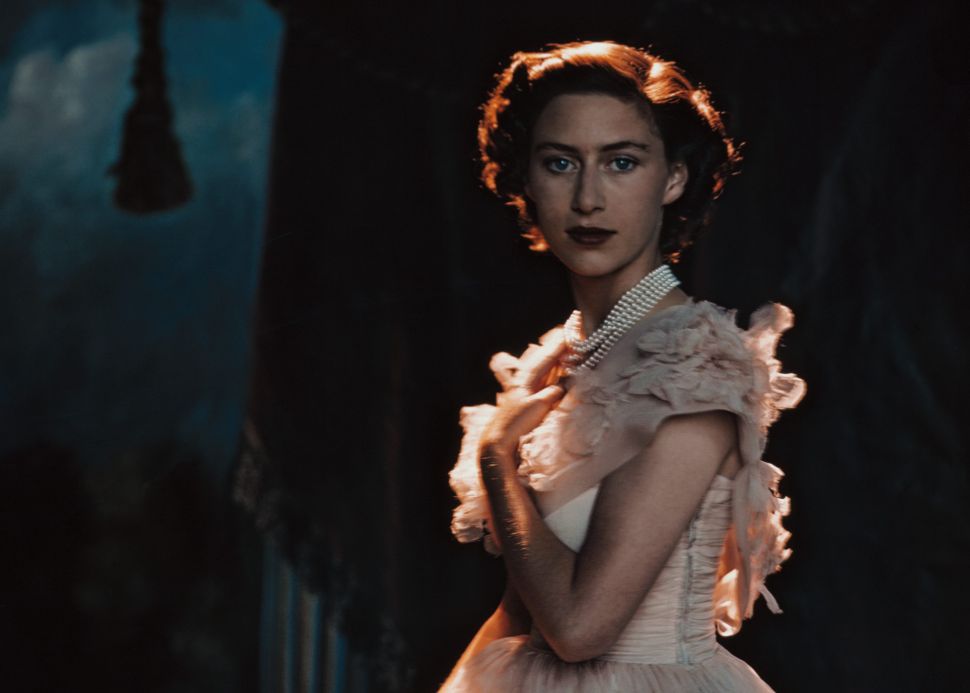
Princess Margaret of England in 1949.” width=”970″ height=”693″ data-caption=’Princess Margaret of England in 1949. <span class=”lazyload media-credit”>Bettmann Archive/Getty Images</span>’>
When Princess Margaret wanted to marry the divorced Royal Air Force pilot David Townsend in 1952, the British Crown should have known enough to let her do it. In 1936, King Edward VIII, shortly into his reign, proposed marrying the twice-divorced American, Wallis Simpson. The Church of England (of which the monarch is the Supreme Governor) felt that a woman who had been twice divorced was not a suitable candidate for marriage. This position was probably not helped by rumors that Wallis Simpson had seduced Edward through witchy charms and a judicious application of what was then called “the Baltimore grip” and what we now call “kegels.”
In refusing to allow the marriage, the Crown hoped Edward would find a more appropriate partner. This did not happen. Whatever allure she had, Edward was so in love that, rather than leave Wallis, he chose to abdicate what Winston Churchill called “the greatest throne in history.” And while Noel Coward quipped that this meant “there should be a statue of Wallis Simpson on every village green in the land” because she saved the country from being ruled by weak-willed, Nazi sympathizing Edward, it did seem to show that refusing to let people marry whom they loved didn’t result in good outcomes for the Monarchy.
Which brings us to Princess Margaret and Peter Townsend. Townsend was born in 1914. He became a distinguished Royal Air Force pilot, shooting down the first German bomber plane on English soil during World War II. He would later be shot down over Kent himself. Following the war, he was appointed King George Vi’s equerry. Though Americans sometimes mistake equerries for bodyguards—as they are military officers trusted with accompanying members of the Royal Family on public engagements—their duties pertain more to organizing schedules and overseeing ceremonial events like Trooping of the Color. To this day, they are also known for being, for whatever reason, extremely hot.
Princess Margaret, the younger daughter of King George VI, absolutely concurred with this opinion when she met Townsend in 1947 at the age of 17. Her sister Elizabeth informed her, “Bad luck, he’s married.”
However, he would not be married for long. Townsend’s duties kept him extremely busy, and his wife, Rosemary Pawle, whom he married in 1941, “spent lonely holidays painting landscapes,” with their two boys and the nanny. She fell in love with another man, John de László (a son of a painter), whom she married two months after her 1952 divorce from Townsend. The assistant registrar of the Sydney archdiocese claimed, “There is a strong feeling in England that it is discreditable for a member of the Royal Family to be involved in any way in a divorce question. That feeling has been increased by the unhappy experience of Edward VIII.”
This feels somewhat ironic given that, first, Edward did not happily decide to marry a virgin, and second, that the Church of England was established because King Henry Viii really wanted to divorce his wife and marry Anne Boleyn. In the Anglican Church, divorce ought to be a sacrament.
The agreement the Crown reached was that Princess Margaret could marry Peter Townsend, but doing so would require her to “give up the privileges of life as a Royal Princess to become the wife of a man in moderate circumstances.” The Queen Mother worried about where they would live, which prompted Prince Phillip to quip that “it is still possible, even in this day and age, to buy a house.”
Giving up the privileges of royal life was, clearly, a considerable sacrifice. Around this time, for example, rather than attending the glittering coronation of Queen Elizabeth II in 1953, former King Edward VIII was left watching it on television in his self-imposed exile in France.
On October 31, 1955, Princess Margaret announced, “I would like it to be known that I have decided not to marry Group Captain Peter Townsend.” Townsend would say, in 1978, that he understood her decision. “I was hardly enough to compensate for these very serious, admittedly material, losses that the princess would have to suffer. She would have been stripped of practically everything.”
Peter Townsend was sent off to Brussels as an air attaché from 1953 to 1956 and then went into exile. In 1959, it was reported that he and Margaret continued to write to each other regularly. According to the Daily News, “Close friends say that the romance has never cooled.” That same year, Townsend married a tobacco heiress, the 20-year-old Belgian Marie-Luce Jamagne. One year later, Princess Margaret married the photographer Antony Armstrong- Jones. He was the first commoner in 400 years to marry a British Royal. Margaret claimed, “I received a letter from Peter [Townsend] in the morning, and that evening I decided to marry Tony. I didn’t really want to marry at all. Why did I? Because he asked me!”
Getting married on the rebound is, if not always, at least generally, a terrible idea. In 1960, shortly after their marriage, Antony had a child with his mistress, Camilla Fry. But it wasn’t all terrible. For a wedding gift, Margaret was promised by Colin Tennant, the owner of the small Caribbean island of Mustique, a plot of land where the couple had honeymooned. In 1960, it was still relatively undeveloped, and the couple had to bathe using buckets of water hung from trees and eat canned preserves. Antony despised it and referred to it only as “Mustaq.” He never returned. But Margaret found a peace there that often eluded her in royal life.
By 1968, construction had begun on a Mustique villa which would be known as Les Jolies Eaux. The five-bedroom villa was completed in 1972, with two swimming pools and six bathrooms—no more bathing under buckets. Margaret began visiting there regularly in the winter months and would spend the nights drinking and playing cards with her guests and the dozen or so other families that lived on the island.
It was there that Margaret would be spotted with Roddy Llewellyn, a 26-year-old gardener, in 1976. The couple was photographed by News of the World frolicking in the ocean, a scandal that would lead to the end of her marriage. For all the fear about Margaret marrying a divorced man, she and Armstrong-Jones would divorce in 1978. They’d be the first British royal couple to do so in 400 years.
But her love affair with Mustique endured. According to Madrid’s El País, “Margaret was happier than ever during the long seasons that she spent in Mustique. There she found her haven of peace, an escape from the frigid streets of London.” Today, the home she spent so much time in is available to vacationers looking for their own respite. Hopefully, they have better luck in love than Margaret ever did.
But perhaps the real lesson of Margaret’s life isn’t about love at all. She was born into an inheritance she never got to negotiate the terms of—an institution that took Townsend from her, dictated who she could marry and how, and left her, at 25, choosing between a man and a title she’d never even wanted in the first place. The Crown was never hers to keep or discard. Mustique was. It was small, undeveloped, and came with buckets instead of plumbing—but it was the one inheritance nobody handed her with conditions attached, and it was the one she actually got to build.