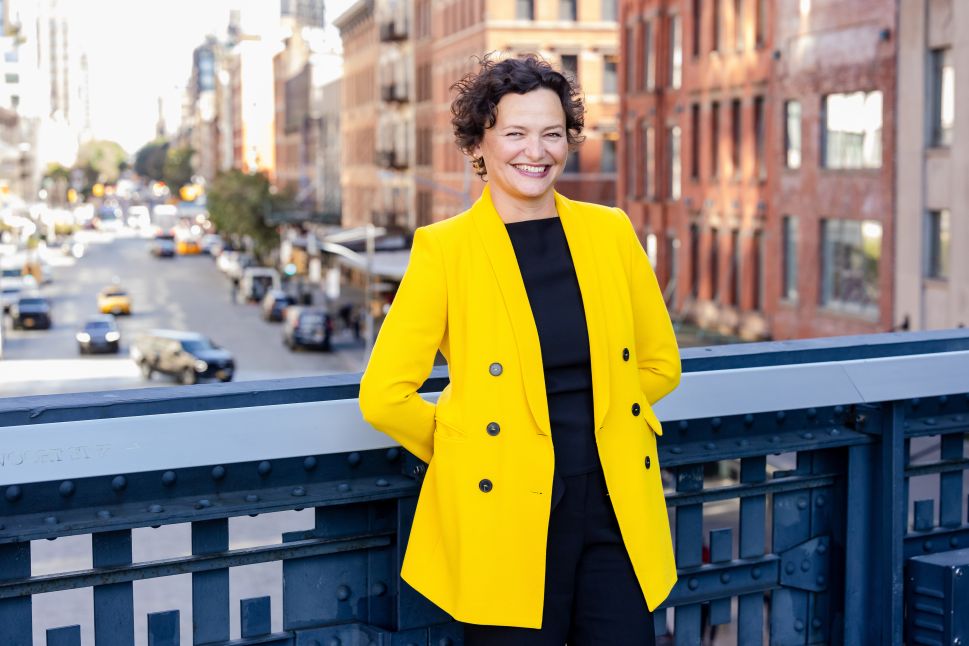
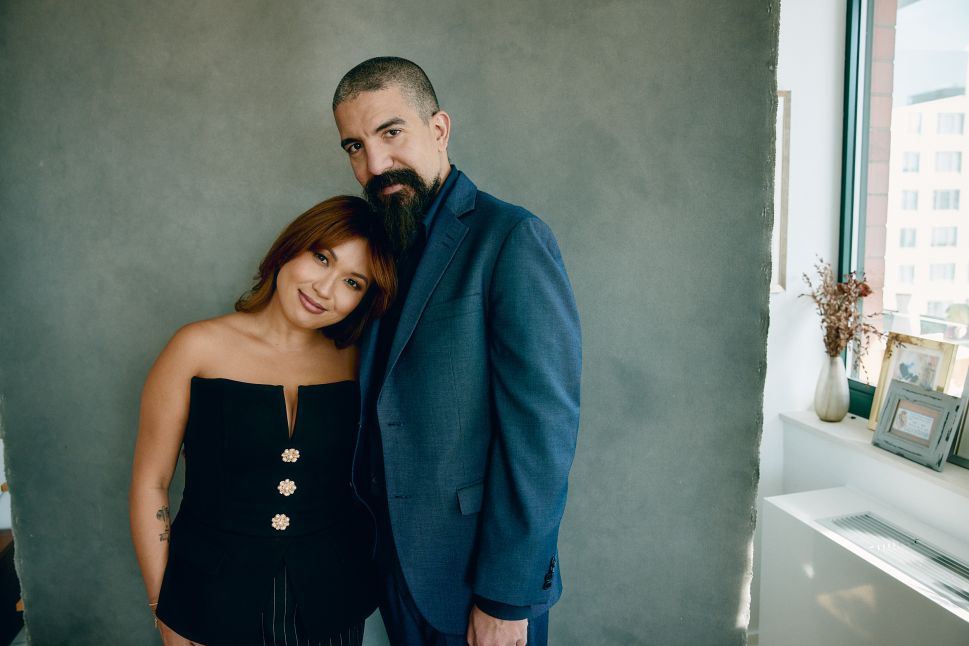
Kate Lee in a black strapless outfit rests her head against Clovis Lima Jr., who wears a blue suit, as they pose together beside a gray wall and a sunlit apartment window.” width=”970″ height=”647″ data-caption=’Kate Lee and Clovis Lima Jr. <span class=”lazyload media-credit”>Photo Zenith Richards.</span>’>
The new generation of art collectors wants to go beyond the ownership of artwork to have a deeper impact on artists’ careers while feeling like they are part of a story and helping to foster a community built around creative exchange and shared passions. It’s an approach that transcends acquisition to embrace an ecosystem of values, meanings and human relationships that they believe collecting should encompass. Kate Lee and Clovis Lima Jr., founders of the new 603 Arts Foundation, belong to this group. Lee is originally from the Philippines and Lima Jr. is from Brazil, two countries that, despite their distance, share much as a result of parallel and, at times, intersecting colonial histories, but also centuries of global exchange through the galleons, which led to a blending of traditions spanning cuisine, craftsmanship, culture and spirituality. Art from both countries, despite their extremely vibrant and long-established markets, has only recently begun gaining broader international attention. Amplifying these connected voices while celebrating the cultural roots that continue to inspire them is at the core of 603 Arts Foundation’s mission and the vision that guides Lee and Lima Jr.’s collecting.
Latin America and Asia are among the fastest-growing regions in the global art market, but artists from these regions remain significantly underrepresented, making up just 3 percent and 9 percent of the art displayed in major U.S. museums, respectively—a persistent gap between market growth and institutional visibility. 603 Arts Foundation is the first nonprofit dedicated to supporting emerging artists across Asia and Latin America with exhibition support, institutional partnerships, collecting, public programming and, eventually, residency and visa support. On August 8, it opened its inaugural exhibition, “The Cataclysm of Binary Star Systems,” hosted by Nunu Fine Art in New York with work by artists from nine countries, several of whom are exhibiting in the U.S. for the first time.
Born in the Philippines, Lee moved to New Zealand with her family as a child, as her parents sought new professional opportunities. When she was 13, they moved again so her mother could accept a position at the University of Chicago. Lee completed high school, college and graduate school in Chicago, initially studying immunology, on track to become a doctor. Notably, she did not grow up in a family of collectors. (Even now, her mother sometimes asks why she is buying art instead of a house or a car.) “We did not have inherited wealth with which to buy art,” she tells Observer, yet her family valued museum visits, and Chicago offered plenty of opportunities to engage with art.
Before the pandemic, Lee researched HIV vaccines, dengue and other tropical diseases. She later moved to New York to work at a genetic-testing startup, where she served as a bridge between engineers and scientific teams. That role led to approximately 11 years working in technology across several industries, including in product strategy and messaging at Meta until a large round of layoffs in 2026. By then, she had already become disillusioned with the company’s intensifying emphasis on A.I. metrics and employee monitoring and had decided not to sacrifice her health to the job after experiencing burnout. She was looking for more purpose, for something more meaningful: “After years in technology, I felt I was seeing the same people over and over and wanted to do something else.”
That was when art entered Lee’s life through a friend, Anne Parke, an art adviser who was organizing gallery walks and other events. A restaurant presentation where a gallery brought artworks into an informal social setting “was the moment when I realized I could enter a gallery and that acquiring art was not completely beyond me,” she admits.
Her first purchase was a work by Chicago artist Neal Vandenbergh, whose science-fiction imagery appealed to her longstanding interest in futuristic, mystical and technological themes. “It reminded me of the covers of secretive science-fiction cult books. I loved it immediately,” she recalls. Lee initially viewed the acquisition as decoration, but that first purchase removed the psychological barrier to making another. “Once you buy the first work, it unlocks something. You realize, ‘I can do this, so I can do it again.’”
Exhibitions were an educational entry point. “They create a space where people can encounter the art directly, talk with gallerists, understand an artist’s practice and follow a curatorial narrative,” according to Lee. Salons in particular—intimate gatherings around art—offered a more comfortable way to engage with a world that had once appeared inaccessible to her.
Lee met Lima Jr. in London, where Meta relocated her after a period in Seattle. Trained as a designer in Brazil, Lima Jr. was working as a front-end engineer for the company and they ended up on the same team.
When Observer visited the couple’s Midtown Manhattan apartment, there were clear threads binding their shared collection together, even as that collection reflected their different tastes and upbringings. Given Lee’s scientific background, she is often drawn to work involving technology and science fiction, as well as astrology, spirituality and mysticism. This is clear in the altar-like arrangement of a group of works on one of the cabinets: sculptural snake candleholders by Anastasia Komar and a sculpture by Laura Benson are paired with paintings by Chris Oh, Jennifer Carvalho, Ben Cowan and Marc Armitano Domingo. Among them also hangs a small Miró aquatint—a playful illustration from a poetry book and the only work Lee acquired at auction.
Works in her office and in the couple’s bedroom exemplify similar themes, styles and directions, including a densely symbolic work on paper by Filipinx artist Maia Cruz Palileo, a darker scene by Maggie Ellis and an ethereal, portal-like, luminous work by Amorelle Jacox.
Lima Jr., meanwhile, is clearly influenced by the aesthetics he absorbed during his upbringing in Brazil, with a strong attraction to minimal, geometric abstract compositions that still feature vibrant colors, revealing his exposure to the country’s long-dominant aesthetics of Tropicália as much as Neo-Concretism. Lima Jr. grew up near Salvador, later moving to the city for university before living in São Paulo for a period. Although his family did not collect art, his education and work in design brought him into contact with Brazilian modern and contemporary works and creators.
Their first joint acquisition was a work by Rubem Valentim, whose position in Brazilian art became central to Lima Jr.’s reflections on cultural extraction and historical visibility. “When I was studying, I encountered some of those other artists first and only discovered Rubem Valentim later,” he shares, explaining how artists from Salvador became better known abroad than in their own region. Valentim, for instance, was collected internationally while remaining unfamiliar to many people locally. Ultimately, Lima Jr. sees the collection as a means of reconnecting with Brazil and supporting histories and artists that have not received adequate recognition. Collecting is also a way to preserve and deepen that connection while contributing to the visibility of creators from his country.
Lee is quick to admit that her collecting changed significantly when they moved in together, as they realized that their home contained no works connected to either the Philippines or Brazil. “We started thinking more consciously about art from the Philippines, Southeast Asia, Brazil and Latin America,” Lee says. The couple became particularly interested in the historical and cultural resonances between the two regions, including colonial histories, Catholic syncretism, craft, symbolism, spirituality and matriarchal traditions. Although their backgrounds were different, Lee found that certain cultural ideas required little explanation between them. “There are many cultural elements that we share between Brazil and the Philippines, especially forms of religious syncretism connecting Indigenous traditions with Catholicism,” she argues. “In Brazil, different religious systems are often layered together. Afro-Brazilian deities can also be associated with Catholic saints or Jesus Christ,” Lima Jr. confirms. The same kind of strategy exists in the Philippines. “Syncretism can function as a way of resisting cultural erasure by allowing older systems to survive inside an imposed religion.”
These parallels extend into food, language and trade. Lee recounts how her mother once presented siriguela to her partner as a distinctly Filipino fruit, only for Lima Jr. to recognize it as closely associated with his region of Brazil. The coincidence led them to ask how plants, ingredients and cultural practices traveled between Latin America and Southeast Asia. Collecting became a shared project through which to trace those affinities. “Even though Clovis and I had very different upbringings, there were things we did not have to explain to each other. That was very meaningful,” Lee says. “It has been a very enjoyable project to do together.”
Their research repeatedly returns to the Manila-Acapulco galleon trade and the wider colonial networks connecting Asia, Mexico, Brazil, Europe and the Pacific. Although a single exhibition cannot fully reveal overlooked histories or embody centuries of cultural exchange, artistic practices can make forgotten connections visible and prompt younger audiences to contextualize their own identities within a wider global history.
603 Arts Foundation grew out of a desire to make their personal project larger into something more impactful. “We were already collecting for ourselves, and then I thought it would be more interesting to make it something beyond us,” Lee explains. If they could organize exhibitions featuring works from their collection and include other artists they admired, their thinking went, they could bring more people into the experience and give those artists greater visibility in art hubs like New York.
What grew out of the idea was a collecting foundation through which the couple could continue acquiring artworks while also providing exhibition and production support. For instance, 603 Arts Foundation contributed to the production of works included in “Greater New York” at MoMA PS1, and Lee and Lima Jr. are part of the New Museum’s Friends of the Triennial. The couple is also extremely active across the city’s other institutions: Lee is part of the Acquisitions Committee for the Bronx Museum of the Arts and is a member of the Guggenheim Curators Circle and the Frick Young Fellows. Both are members of the Met Apollo Circle, Whitney Contemporary Patrons and the MoMA Young Patrons Council.
Lee found the role she could play at the Bronx Museum especially meaningful because acquisitions directly affect what a specific local community encounters. “The Bronx is such a specific community,” she says. “If you have an opportunity to help determine which artists the community can encounter, that is significant.” She wants to see greater representation of Filipino artists while ensuring that proposed works maintain a meaningful relationship to the Bronx or New York.
Their participation in patron groups has become more selective over time. After initially joining several programs to understand their models, they concluded that meaningful patronage requires choosing a smaller number of artists and institutions and supporting them consistently. The foundation has also contributed to institutional exhibition production and is exploring a potential collaboration with Free Arts involving educational or internship opportunities.
Having the foundation has already changed the way they approach art fairs, and any trip: they now have a focus. “It shifted from shopping for myself toward researching artists and galleries for the foundation,” Lee acknowledges. “We are becoming more strategic about where we travel and which art-world hubs we visit.” The couple identified SP-Arte as an important future destination for understanding Brazil’s art ecosystem, and it is now firmly in their plans. While visiting Paris last year for Art Basel, they also found Asia NOW to be a valuable experience for the foundation’s Asian focus.
“Every time we return to Brazil or the Philippines, we now have a mission: to see particular places, meet artists and deepen our understanding,” Lee continues. “Traveling for art can take us far out of the way, but it is fulfilling because Clovis often brings historical context to Brazilian artists, and I can do the same as I rebuild connections in the Philippines.”
This organic exchange, they recognize, is extremely important and brings so much to both their collecting and their relationships: they do not need an adviser simply telling them which Brazilian or Filipino artist they are supposed to collect. They can exchange histories and introduce each other to different sides of the work.
Running the foundation has required Lee and Lima Jr. to learn, as they go, all the practical infrastructure behind it, from insurance and registration to exhibition logistics. The current show was clearly a major test, as they had to navigate complex logistics while importing works from Brazil and Asia. “Right now, it is a learning period,” Lima Jr. acknowledges. “We are discovering how difficult it is to move works from different countries, how long the process takes and how to solve problems when artists ship without professional support.” This made them understand firsthand the obstacles preventing artists from those countries from gaining broader international visibility. “After dealing with customs and shipping, I understand part of the problem,” Lee says, referring to works they were trying to ship from Brazil. “If a gallery wants to take a chance on an artist, the logistics can be intimidating.”
Residencies have therefore become central to the couple’s thinking about the future of 603 Arts Foundation. Rather than shipping fragile or oversized works internationally, artists could travel to New York, produce locally and develop relationships with galleries, curators and communities. Lee also sees residencies as a practical response to the obstacles facing artists from Southeast Asia and Latin America. Tariffs, shipping costs, export requirements and visa barriers can make international exposure difficult. A residency can allow an artist to produce locally, bring family members when necessary and establish relationships within a new cultural context, while building the kind of international network that, in a city like New York, can prove immensely valuable over time.
The couple is also beginning to build relationships with galleries, collectors, fair organizers and institutions in both regions. Brazilian galleries have often been generous with practical knowledge, including trusted shipping contacts, once they understand that 603 Arts Foundation can offer their artists visibility in New York.
Lee and Lima Jr. do not currently intend to create an independent residency infrastructure. They are more interested in partnering with organizations that already provide accommodation, studios, programming and visa support, while also exploring potential partnerships with spaces in São Paulo or Manila. Visa support is especially important. “Many artists from the Philippines and Brazil face significant barriers, so we are researching residency programs that can sponsor or support visas,” Lima Jr. points out. He believes that a residency should give artists enough time and independence to encounter New York from their own perspectives. “Each artist will have a different perspective and a different way of connecting with people. The role of the foundation should be to facilitate the opportunity, not dictate the entire experience.”
As Lee emphasizes, they want to prioritize artists who have not yet received sufficient institutional or gallery representation. “That is probably the foundation’s third, less visible pillar: helping artists gain visibility and, where possible, connecting them with galleries or other opportunities,” she says. In some cases, the foundation may help connect artists with galleries, curators or new audiences. “That is where I see the foundation potentially expanding: not only collecting and exhibition support, but also residencies, visibility and the practical infrastructure that helps artists enter new contexts.”
For their inaugural exhibition, Lee and Lima Jr.’s expectations remain intentionally modest. Their immediate priorities are to complete the project successfully, understand the mechanics of international exhibition production and introduce the foundation’s mission to audiences. A second exhibition is already in the works for the following year, again combining emerging artists with figures from regions that remain underrepresented in New York. “This is the best we can do right now, but it should also be the least ambitious version of what we eventually become,” Lima Jr. says.