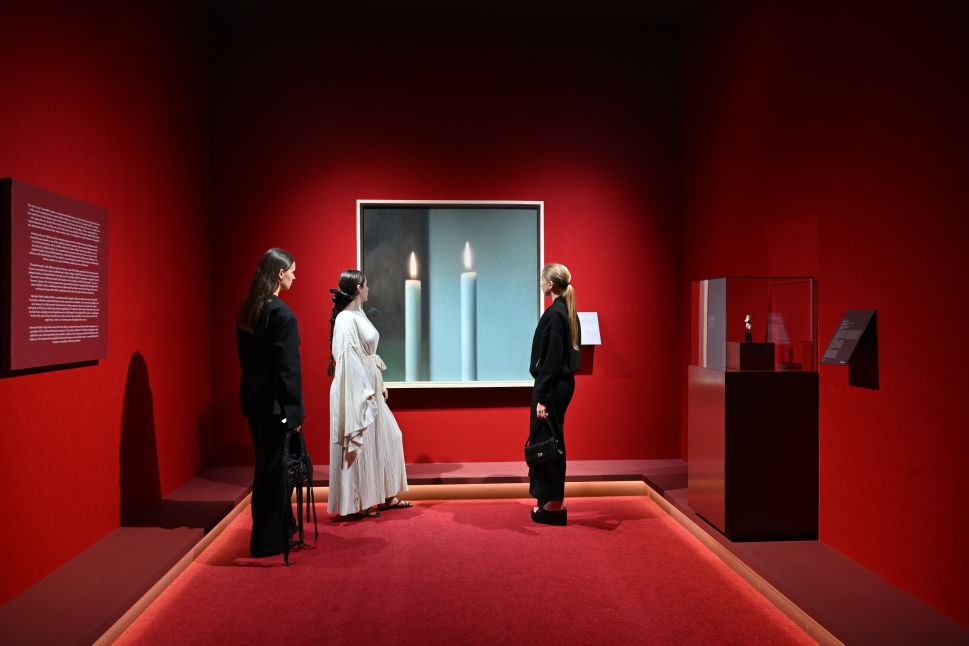
A few weeks ago, I attended a private launch hosted by the storied British perfume house Penhaligon’s to celebrate the 10th anniversary of its “Portraits Collection.” In the slower summer season, I can sometimes venture into other lifestyle events, and I suppose the fact that it was taking place at the artsy Chelsea Hotel was enough for the invitation to be extended to me as an art reporter. What I thought would be some kind of artist collaboration, I was imagining an actual commissioned photo series celebrating “a decade of unforgettable characters, exceptional fragrance, and impeccably bad behavior” as they pitched it, turned out to be a luxurious private cocktail party, with artisans engraving guests’ names live onto limited-edition perfume bottles. The brand could easily have hosted it in a Soho pop-up. Instead, it chose an artsy, intimate venue, a contained, curated crowd and artistry and craftsmanship as a formula for exclusivity.
The BCG-Altagamma survey found that 65 percent of luxury consumers today feel overwhelmed by brands’ overcommunication and lack of personalization, resulting in growing fatigue and progressive disengagement. What they now value in response is a tailored interaction built around context, taste and lifestyle. “Clients are showing a clear preference for privacy, discretion, and controlled environments. Having access to private, intimate spaces is not just about comfort—it has become a subtle expression of status in itself,” a Hermès retail activation expert Li interviewed confirmed. The key here is how these salons privés and invitation-only experiences turn private shopping into a deeper expression of intimacy and belonging.
In an era when everything can be so easily emulated, simulated and reproduced by A.I. and when the boundaries between the real and the fictional are increasingly blurred, top buyers, particularly younger ones, are looking for meaningful in-person experiences defined by privileged and non-replicable insights, as well as human connection and understanding.
The new luxury is undergoing a deliberate redistribution, scaling back the proliferation of boutiques and flagships to offer more dedicated private experiences with one expert, one craftsman and one collection. Deep personalization and profound human connection, making the client feel special, seen, listened to, understood and remembered, are what luxury brands are returning to, as top clients seek authorship rather than mere personalization: an experience built around precisely who they are. Referring specifically to Asian buyers, Li describes how access itself is being redefined today: no longer simply entry to places others cannot reach, but “access that is intellectual and relational—to knowledge, to context, and to the people who preserve it.”
Going a step further in deepening ties with top clients is key. Gen Z and millennials, HNWIs and the upper-middle class increasingly seek meaningful, culturally relevant experiences that offer proximity to the brand, as well as historical and artistic discovery, strong design narratives and associated social engagement. They value memorable interactions, relationships and purchases that reflect their lifestyles and identities.
“Luxury is no longer just about expensive things,” says another hospitality executive discussing modern strategies in Shenzhen in another Jing Daily article. “Luxury should bring emotional value or real-life value to people.”
In-depth access to stories, human connections and a mission or purpose worth supporting, once shared through conversation, has long been central to the art business. This was true in the old model of patrons directly supporting artists’ visions and styles because they were fascinated not only by their mastery but also by their personalities, to the point that artists were invited to live with them. But it has also been true since the emergence of the first art dealers, who later evolved into gallerists. What legendary figures from Paul Durand-Ruel and Joseph Duveen to Leo Castelli, Ileana Sonnabend and Sidney Janis, and, more recently, Larry Gagosian, Marian Goodman and Paula Cooper, all have in common are distinctive visions accompanied by strong personalities capable of creating a circle around themselves, sustaining it and supporting the artists they chose to champion.
These reflections somehow resonate with Tim Schneider’s recent Gray Market commentary on “updating the Experience Economy.” The operative question for art sellers trying to reach young clients, he argued, is no longer, “How do I sell art objects to people who are mainly interested in paying for memorable, positive experiences?” It is more like, “How do I make buying art objects feel like part of a memorable, positive experience?”
As Schneider noted, this is not so different from the question some dealers have been asking themselves for decades. Some of the most successful galleries since at least the middle of the 20th Century have built their businesses around creating a lively, exciting scene. “In those cases, collectors who bought from them weren’t just acquiring objects; they were supporting the entire social and cultural ecosystems that influenced the production of those objects,” he wrote, describing this as buying souvenirs of immersive experiences.
I would add that collecting from and supporting a gallery is also more like buying membership in one of the secretive, experiential, events-driven clubs that are becoming so popular today, particularly in large cities. According to Knight Frank, more private members’ clubs opened between 2020 and 2024 than in the three decades after London’s Groucho Club debuted in 1985, while Soho House’s membership reached roughly 270,000 in 2025. App-enabled membership communities and social clubs for events and meetups are also proliferating: Meet5, an app that organizes offline group activities for adults over 40, raised approximately €8 million, or $9 million, in 2025 for its U.S. expansion, while Parlor Social Club now hosts roughly 100 events monthly in New York City and has, in just a year, scaled its operations into major metro areas including Los Angeles, Miami, Chicago and Houston.
Art galleries and art spaces have, in fact, always offered this dimension: a social circle and a social scene in which people can participate in different capacities. In this sense, they should naturally respond to the longing for belonging, purpose and community-oriented commitment that younger collectors and patrons repeatedly cite in interviews today as one of their principal motivations for engaging with the art world.
Clearly, not every gallery can embark on the kind of cross-industry expansion developed by Manuela and Iwan Wirth, whose multilevel empire spans galleries, a publishing house, art-filled restaurants, hotels and bars already perfectly designed to integrate art dealing into the experience and destination economies. Nor can every gallery enter the fandom and “kidulting” space through cute artist-designed collectibles, accessories and clothing, as well as accessible editions, as Perrotin has done with stores that, particularly in Asia, operate somewhere between art, lifestyle and cool concept retail.
Still, some gallerists, even when operating at the middle and lower levels of the market, are already exploring new, or old-new, strategies to rebuild the perception of not only a unique but also a meaningfully engaging experience around their programs, their artists and their own distinct visions. Take, for instance, the London gallery Gathering, whose name already suggests an approach and mission that value human connections, with the works and with the people gathered around them, at their core. “I strongly believe in human contact. People who buy artworks for many thousands of dollars want to feel a connection with me,” Alex Flick, the gallery’s founder, told Observer. He noted that, although he might have very competent sales directors and rely on them, most galleries bear their founder’s name. “They are also buying into the trust they have in me.”
Three years ago, Flick opened a seasonal gallery in Ibiza to engage with clients at a more relaxed pace while creating a new seasonal destination for the community it had built around itself. He sees the Ibiza gallery’s most important function as that of a long-term relationship platform for creating and nurturing sustained, informal contact with collectors. “It is still a long-term investment. I use Ibiza as a platform to continue the relationships I have with collectors, not necessarily for them to buy here. We are not selling consumer goods. You do not buy an artwork the way you buy a pair of underwear once a year. There is a significant relationship between collectors and me.”
For Flick, in the gallery business, the clientele is only as strong as the relationships one can maintain. “Having face time with them, being close to them, going out for dinner or spending an evening together keeps the dialogue alive.” At some point, those people will buy, he adds, but that might happen only later at the gallery in London, at his Frieze booth or at another place where he is exhibiting. His sales have increased over the last three years, though not in any record-breaking fashion, he acknowledges. The Ibiza gallery does allow Flick to maintain a revenue stream when everything in Europe’s megacities shuts down for the summer.
Gathering’s dual presence in London and Ibiza gives the gallery flexibility, while the caliber of summer visitors to its island space, he argues, often exceeds what it sees in London on an ordinary day.
Looking at the future of the contemporary art market, and the gallery business in particular, Flick finds it impossible to ignore that something is going wrong. To him, the art world, and gallerists in particular, should reckon with the shift toward a different kind of connection or a different way of experiencing art, a shift toward more experiential forms of engagement. This can be frustrating, he admits, particularly when speaking from a context like Ibiza, where people can spend tens of thousands of dollars on beach clubs, dinners and nightlife, things enjoyed in the moment and then gone. “I think, if you skip that beach club for one day, you could buy an artwork. At the absolute worst, you will have a beautiful object in your home for as long as you want to keep it. We are confronted with a highly hedonistic and immediate demand for enjoyment and experience. Those experiences no longer happen in isolation; they are shared through phones and social media. They are buying it because they can show people they are there, which makes others desire that lifestyle. There is an ever-increasing currency attached to personality and lifestyle.”
Still, if museum blockbusters routinely sell out, he argues, we have proof that broad audiences remain eager to experience art. Yet many of those same people do not realize that they can enter commercial galleries for free. Ironically, the traditional gallery business is largely responsible for having created this barrier by cultivating exclusivity and intimidation for so long. “I know other gallerists who like that elitism and the idea of ‘us and them.’ They like people to be intimidated. But the landscape is changing, and we need to move beyond that, as the collectors who traditionally sustained the Castelli model are dwindling in number. Something has to shift,” Flick argues.
One way Gathering has been able to break down many of these barriers is by building a program that overlaps with different ways of encountering art, often extending beyond the isolated object toward performance, music and social situations. “There is a house-party-inspired element to it,” Flick jokes. Christelle Oyiri, one of the gallery’s top artists, recently had a major show at the Tate, followed by a solo presentation at Frieze in October. Her practice encompasses both visual art and a substantial career as a DJ, bringing different audiences and cultural forms together. “Her DJ career is at least as significant as her art career, and now that her art career is accelerating, the intersection is very interesting.”
At the same time, galleries are starting to understand the importance of refocusing on their artists, who, despite how often the industry forgets, remain at the very core of any gallery business. They are making sure that artists themselves feel part of something: part of a vision and a community in which they can believe, something any organization should understand as important when it comes to human resources.
With this thinking, GRIMM Gallery launched a new artist residency this summer at Château Val Croissant, an 18th-century estate in Provence, hosting as many as five artists and their families at once, alongside invited writers, curators and other cultural practitioners. Part of GRIMM’s broader 20th-anniversary expansion, the initiative comes as the gallery prepares to move into a larger Amsterdam flagship in September 2026, following the relocation of its London operation to Duke Street in St. James’s last year. The new South of France initiative aims to create a gathering platform that acknowledges and fosters the community the gallery has built over the years, maintaining an artist-centered strategy that has been largely responsible for its sustainable growth.
The artist-first approach came naturally, Jorg Grimm told Observer, as the gallery works with most of its artists from the start of their careers. “The market comes later since there isn’t one, at first,” he admits, recalling how he discovered some of his top artists today through the Rijksakademie and De Ateliers, two major postgraduate programs where international artists pass through for two-year stays. That is where Grimm discovered Claudia Martínez Garay and Arturo Kameya, two artists who are now well established in the biennial circuit, as well as Louise Giovanelli, whom he first met while she was at the Städelschule. Others come to the program through word of mouth, curated shows and recommendations, he adds. Artists are often the best at suggesting other artists through whom the gallery can expand its roster, or, more precisely, its community.
For Grimm, institutional support reflects recognition of the gallery’s role in shaping careers. “There is strong mutual loyalty,” he acknowledges. At the same time, he admits, truly managing someone’s career also means finding partner galleries to co-represent the artist when the time is right. While other galleries host collectors’ dinners, GRIMM is known for hosting artists’ dinners that celebrate their work and foster a sense of belonging and connection. Additionally, GRIMM is one of the few galleries to share profits with its artists if a work comes up for resale. “A lot of collectors appreciate this and consign secondary works to us on the premise the artist also benefits properly,” Grimm says.
The South of France residency is an extension of this ethos. His goal was to create a place where multiple artists could stay at the same time, bring their families and remain flexible about timing, the possibility of visiting and returning, which is not always the case. Beyond its proximity to many museums and foundations in the South of France, the property offers a chance to slow down, Grimm adds. At the same time, the location offers collectors, as well as curators and writers, a way to connect with the gallery and its artists on a different level. “I believe facilitating experiences like this will become more and more valued.”
Now, it is particularly among younger galleries that we are seeing a return to more personal, community-based formats and events. Salons, studio visits, gallery dinners, private parties and other activations that keep people engaged with a gallery not only when a potential transaction occurs but also through something larger and more meaningful are proliferating across the main art centers. Dealers are returning to cultivating a solid base of people who can support the gallery consistently over time, rather than constantly chasing new buyers through an endless succession of art fairs around the world.
Since founding JOHS in 2021, Elisabeth Johs has always run the gallery from her own home. The gallery began in a renovated 1970s modernist house in Mexico City that functioned simultaneously as her home, exhibition space and artist residency. “Rather than separating life from art, I wanted to create an environment where artists could live, work, and exhibit under one roof, fostering slower, more meaningful encounters between artists, collectors, and the wider community,” she tells Observer.
Today, JOHS operates from her loft on Crosby Street in Soho, continuing this domestic model. “Instead of the traditional white cube, the gallery exists within a lived-in environment where artworks are experienced alongside books, furniture, design, and everyday life,” Johs argues. The intimacy of the space naturally encourages conversation, she notes, allowing each visitor to engage with the work in a personal way rather than moving anonymously through a commercial gallery.
This approach also draws inspiration from the history of Soho itself. “Many of the galleries that shaped New York’s contemporary art scene in the 1970s and 1980s began in artists’ lofts and apartments, where exhibitions, conversations, and shared meals often happened in the same room,” Johs observes. “I love reconnecting with that spirit of experimentation and hospitality.”
Beyond exhibitions, JOHS regularly hosts intimate dinners, artist talks, salons and gatherings that bring together collectors, artists, designers, architects and creatives across disciplines. “For me, the gallery is not simply a place to display art, it is my home and as I blur the lines between home and gallery I make space to build relationships, exchange ideas, and create a sense of belonging.”
JarvisArt, another young venture by longtime advisor and former Arsenal Contemporary director Lindsay Jarvis, has also opened a more private second-floor space, prioritizing the cultivation of direct connections and relationships rather than pursuing the fair circus. Monthly activations in its space, buzzy openings followed by dinners and parties, and a program of often sold-out shows have created a vibrant community of people who gravitate toward the gallery.
“I think the core of gallery work has always been personal, long-term relationships with artists and clients,” Jarvis told Observer. “For me, it’s about spending time in person and talking on the phone regularly, which is how trust is created and good ideas often develop. It’s rewarding to place a work after a client has viewed it in person and becomes very excited.”
During the pandemic, he admits, this might have changed, with more interactions taking place online, but Jarvis now sees a clear desire to return to in-person engagement. The last few years have also brought greater reflection on the cyclical nature of the art market, he notes, as a seasoned insider who, as an advisor, has closely followed the ups and downs of the ultra-contemporary in particular. As a result, Jarvis argues, galleries are refocusing on the central components of success: strong relationships with their local artists and clients: “These relationships can often provide more fruitful collaboration over a longer period of time.” The formula seems to have worked so far: both recent shows, the New York debut solo show of Greek, London-based Konstantina Krikzoni in May and the current exhibition, which stages a playful intergenerational dialogue on the contemporary idyll and “Primitive Romanticist” between emerging painter Ana Cristina and 20th-century works by Louis Eilshemius, sold out.
Nunu Fine Art has similarly long prioritized building engagement within the local communities surrounding its Taipei and New York locations rather than falling into the trap of the relentless international art-world calendar. “Forming deep relationships and lasting community ties centered around artists’ creativity have always been key to my work as a dealer,” founder Nunu Hung tells Observer. She grew up in Taiwan, a country that highly values interpersonal relationships, she explains. “When I opened my first gallery in Taipei, connecting patrons to the work of international artists began with establishing relationships based on curiosity and education and then slowly developed by introducing them to work that was unfamiliar and ultimately rewarding.”
When she opened her New York gallery in 2023, Hung brought that community-centered approach with her. For Hung, each exhibition and its programming extend well beyond the opening reception, encompassing artist walkthroughs as well as performances by local writers, poets, musicians and other creatives who interpret and augment the work on view. “These events unite artists with new and established audiences for their work and bring together people from many backgrounds based on their shared interest in art and ideas,” Hung says. The gallery has also expanded to support other forms of creativity and cultural production, as with its periodic “Writers Stage,” where, in the spirit of a literary salon, she invites novelists, poets and playwrights to share recent work or new pieces written in response to the exhibition.
While Hung still fervently believes in the kind of global connections represented by art fairs, her first hope remains to provide an accessible avenue for interested visitors from local communities and inspire greater engagement with the arts.
Marsha Plotnitsky, founder of The Merchant House in Amsterdam, also decided to invest in making the gallery itself the destination, creating a model centered on repeat local engagement rather than periodic international visibility that dissipates resources and energy within the international fair system. The gallery’s philosophy intentionally extends well beyond exhibitions, developing a program of performative and participatory dinners that are open not only to collectors but also to the wider public. “These are not networking events or VIP hospitality but carefully structured evenings where guests genuinely curious about art first encounter artworks without interpretation before participating in conversations that transform dinner into an extension of the exhibition itself,” Plotnitsky told Observer.
This diverse, multilevel program has become one of the gallery’s most effective audience-building tools, encouraging visitors to return repeatedly and creating a sustained cultural community around the space that engages all their senses.
As Schneider noted in his article, the key to building sustainable growth for galleries today is the ability to create an ongoing “immersive experience,” which, he says, really means a “scene,” that makes everyone who encounters it feel that they deserve to be there, regardless of their background, while at the same time offering the authenticity of something they can access and to which they can belong. I would add that such a scene also needs to offer each client a contribution perceived as meaningful: a form of personal symbolic storytelling and an individual human journey.
What if, then, the gallery system is not actually broken or beyond repair, but simply needs to return to its roots as a structure based on authentic and distinctive human exchanges among thinkers, creatives and passionate people?
At a time when people, particularly younger generations, are increasingly seeking originality, authenticity and meaning, luxury is returning to a form of “private exclusivity” rooted in irreplaceable and irreproducible human connection, the kind once created through the encounter between product, maker and buyer in a haute couture atelier, a master artisan’s workshop or the kitchen of a private chef.
In this context, the art world may already contain, within its original foundations, many of the answers it needs to shape its next chapter differently. That would mean returning to the heart of the business: the artists, the art and the human connections formed through them. The necessary “scaling down” could, therefore, be more about restoring closer relationships and more intimate gatherings, valuing conversation over the relentless pursuit of global visibility.
Ultimately, what appears broken, in art as in the broader luxury industry, may be less the business itself than the empire-building model that prioritized scale, constant expansion and the endless circuit of fairs over cultural and human depth. Reclaiming that depth is precisely what could restore art’s irreducible value, what has made it unlike any other product and, for much of human history, effectively priceless.
More in Arts