Artist Julian Schnabel’s five-decade career has pivoted around using repurposed materials, from wax to velvet, as fresh surfaces; his most recent subversion is handling a paintbrush elongated by a stick. His work is currently on view in the south of France at the resplendent Château La Coste, which has 40 al fresco installations and sculptures scattered across the 500-acre site, plus five indoor galleries.
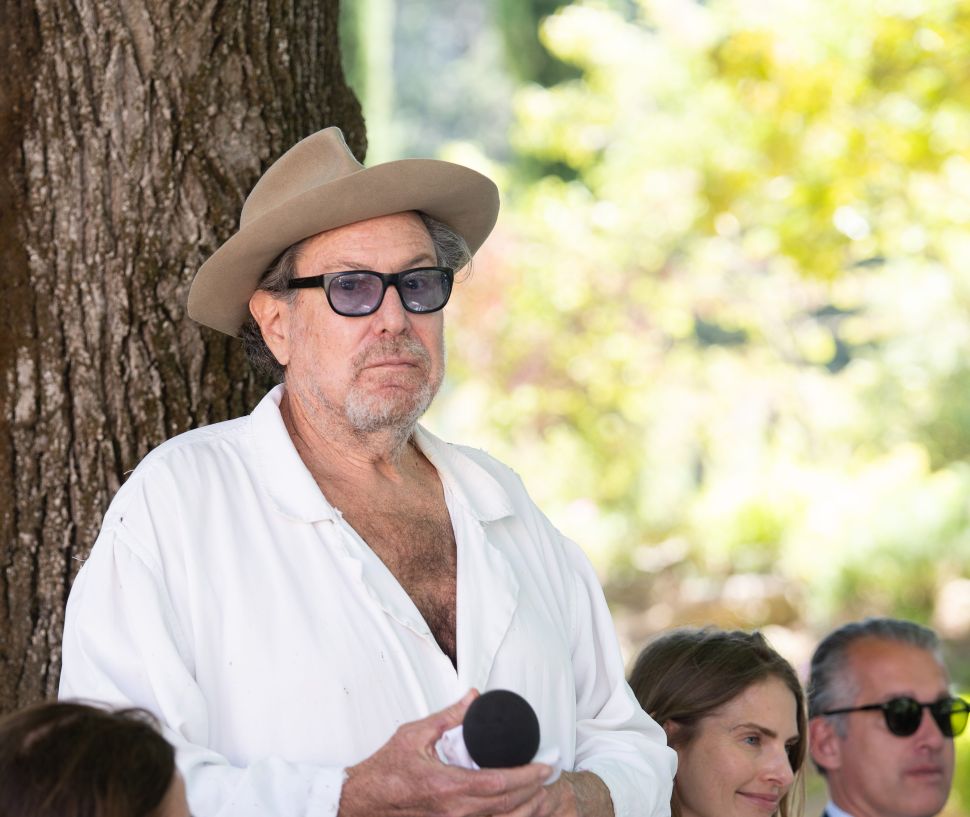
At Galerie des Ancien Chais is a sampling of nine monumental works drawn from across Schnabel’s career. A painting from 1975 is the earliest in the show; the use of a boxing ring floor for The Edge of Victory (1987) reflects how he was constantly flipping what can or should be used as an art surface. His most recent work is a Plate Painting that stars himself from 2023, showcasing a dapper hat, his signature glasses and a striped robe. The edit was chosen with curator Donatien Grau, head of contemporary programs at Musée du Louvre; the two worked together on a Musée d’Orsay show in 2018, “Orsay vu par Julian Schnabel,” in which the artist selected works from the prestigious collection alongside his own productions.
In the neighboring Bastide Gallery, is a cluster of Umbrella Pines, also shown this spring at Pace, that resonate with the French estate’s cypresses, stone pines, olive trees and oaks. His ongoing Plate Paintings series, which he began in the 1970s fashioned from shattered dishware, takes inspiration from Antonio Gaudí’s mosaics throughout Barcelona.
Observer spoke via video with the artist, who was in his Hamptons home in between a surfing session and a massage.
Where am I catching you?
You’re in my kitchen in Montauk. [He moves the screen around.] These drawings were made in 1978. That one says “for Piero Manzoni, for Lou Reed: ‘I’m gonna stop wastin’ my time. Somebody else would have broken both of her arms.’” That’s a Henry Fox Talbot photograph, one of the first photographs ever.
Oh wow!
Jorge Galindo made this. This is an old collage from the ’90s. I’m walking into the living room.
Is every room filled with art?
Yeah, all the rooms. That’s from 1980. And that’s from 1636.
What range!
[He walks outside.] That’s a sculpture of mine called Ahab. There’s another one here called Idiota that I made in Spain in 1988. It’s bronze… I’ll sit here in the garden.
In the press materials, the nine paintings are described as “the most loved.” What determines the hierarchy of “most loved” among your creations?
I think that’s Donatien saying that, and he’s seeing if I’m agreeing with him.
Do you?
I think that each of these paintings is emblematic of a particular moment. They encapsulate something, they represent a group of paintings. For example, Untitled (Los Patos del Buen Retiro III), the one that says “Nip” on it… I made five paintings that were that size; there were four painted on some light-colored tarps that belonged to the Reina Sofía. So that stands as a representative of that. “Los Patos del Buen Retiro” means the ducks in the Buen Retiro, the lake in the middle of the park in Madrid. I fell in that lake, kind of depressed. I went out on a rowboat and fell off the rowboat and watched the lake come between me and my glasses, and then thought, well. When I gave this course to the Círculo de Bellas Artes, I told these kids that, at one time, my only friends were the Patos del Buen Retiro, the ducks in the pond.
The Untitled (Sister of Ozymandias) is painted on a sail, and I made another painting called Ozymandias, and other groups of paintings on sails, like the [abstract] Jane Birkin paintings on felucca sails from Egypt. So that painting represents that body of work, in a way. Then I made Last Big Girl with No Eyes: a painting that I first showed at Larry Gagosian. Robert Rosenblum wrote the catalog text: “Schnabel’s Violent America.” There were four that were that size.
I made a group of pictures that are painted on canvas that have resin on them. I was in Giovanni Volpe’s palace in Venice years ago; he had paintings of procurators that were members of his family from the 18th century, people with these red vests on. I just thought they needed a little white. So I started to make my own antique paintings, and painted the white on top of them.
You have two paintings in that show that have resin on them. One is of José Ramón Antero, where he looks like a priest; there’s a little white right triangle in the corner. José Ramón Antero was called Pi-nueve because he had a long nose, Pinocchio is Pino Ocho, he was Pino Nueve. I did not name him that; the local people did. I did not call him that to his face. You have to go to Spain to find somebody with a nose like that.
For the Christ painting, I tied my friend Victor Hugo Demo to a cross in my studio in San Sebastián and painted him. Then there’s Jack the Bellboy. That’s from 1975. I didn’t want to paint on canvas that you could buy in an art supply store with a stretcher that was predetermined by somebody else. So when I bought that, I modified it, and I covered it with joint compound and Rhoplex, and made these lumps on it, and changed the edges, and cut holes in it, and that was the beginning of me making a receiver for whatever things I believe would end up in a painting, or should be in a painting, or could be in a painting. Jack the Bellboy was sort of a surrogate for me in a way. In a sense, that’s a self-portrait.
And then there’s a self-portrait with the plate painting that’s from 2023. I once said anything could be the subject of a painting: a smudge of dirt, a painting of your own painting. I mean, Van Gogh used to paint paintings of his own paintings.
Then The Edge of Victory is the one with the big white marks on it and the gaffer’s tape, and that was painted on the [floor of the] boxing ring of the Gramercy Gym where Mike Tyson trained; Floyd Patterson also. I once let Jamie Nares use my studio on 23rd Street for free, and I guess to return the gift, he found these tarps that they were going to throw out of the gym on 14th Street, and he brought them to me. So I made three paintings. One was called Muhammad Ali, one was Descent from the Cross, and The Edge of Victory. I glued the gaffer’s tape down, and then painted those white marks on it.
I think I talked about each painting that was in that show just now.
Do you feel like this selection distills your career or your approach?
The point of being able to have the experience there is not about me; it’s about you, and us, communing with these different variables that might open up a path to some place in your consciousness, that becomes a part of your reality that you carry with you when you walk out of there. Maybe Donatien’s role in this is him trying to bring people closer to my sensibility, or to show what my work is about. How do you mediate somebody else’s work and try to make the public see what you’re seeing because you think it’s of value?
That’s a good question. How?
If we dissect each person’s intention here, you’ve got Paddy [McKillen, owner of Château La Coste] that has this property. He wants to show what art is, or what art can be, right? And then Donatien selects this place because of the context of what Paddy’s doing, and then he’s melding that with what you would call my career, or whoever I’m supposed to be as an artist or whatever.
Could you speak more about the exchange between you and Donatien? How does that conversation beget the distillation that we were just talking about?
How did you feel when you walked into the room?
The scale felt striking, it was humbling to be around those paintings because they have such enormous presence.
It’s like being in church.
Yes.
The church of your insides, your own church. [Designer] Azzedine Alaïa years ago said to me, there’s this young guy that loves your work. I want you to meet him and let him into your studio, and that was Donatien. He had already written a book about Proust. And then we became friends. Later he worked at the Musée d’Orsay, and they had never had a show of a living artist there before. I was going to work on my film At Eternity’s Gate, and I was looking around at the paintings in the museum. He asked Laurence des Cars to have an exhibition where we could show some of the paintings that I was looking at, affected by. They started to say, “Oh, you can’t have this one because it has to be in this spot,” or “it’s earmarked for another exhibition.” I said, “You can’t say it’s ‘vu par Julian Schnabel’ if they’re not the paintings that I selected, so I’m not doing it.” Laurence des Cars talked to the different curators, and they let me use the paintings that I selected. Did you see that show?
I did.
I don’t only do one thing. One guy came to my show at Château La Coste and he said, “Which one of these paintings is yours?” I said “they’re all mine.” The breadth or the possibilities of what painting can be… I had no idea what my paintings were going to look like when I was beginning, or what being a painter meant, but I guess as you live your life and you go through these different moments, you say, “Oh, I see a painting there. I see a painting in that. I see a group of paintings in that. I see a plethora of possibilities here.”
Obviously there are bodies of work that are not in that show also. But I think that it’s a pretty concise embodiment of the different possibilities of what one person can do, and my attitude towards image-making or mark-making or making something, even though a lot of things that I made are not in. Donatien was trying to frame it and contextualize it. And I think it was a healthy marriage.
Tell me about the work in the other gallery.
I wanted to show something that was also recent; I made them while I was waiting for the Venice Film Festival to tell me if our film was going to be shown, because it was invited to be in competition the year before, and I turned it down for other reasons, but they let me submit it again. They gave me the “Glory to the Filmmaker Award,” and we showed the film. But I didn’t know that that was going to happen.
While I was waiting, anxious about it, I was painting these umbrella pine trees that surrounded the house in Ansedonia that we rented. They’re also similar to the trees by the Villa Borghese, and I was just looking at the scaffolding of those branches. Those drawings I painted on 18th-century maps of Italy that I had blown up from little maps, because they weren’t that size. I could do that while I was waiting, in terms of the film.
And then when I came back to Montauk, I painted those plate paintings on the floor, which is unusual. I had the brushes taped to sticks, and I was pressing on the paper, and the bristles would look like pine needles. I mix the paint wet on the brush as I’m dipping it into the different pots of paint, so it makes that kind of color where the light of the Naples yellow hits the green or the umber.
That’s a very different thing to be doing than, say, me putting lumps on the canvas, making Jack the Bellboy in 1975. But it’s the same brain or the same impulse to discover ways of applying paint to a material. If you call art a “practice,” you’re practicing, and you’re practicing your stroke, the same way a surfer would perfect their way of riding a wave.
It’s the gesture of it. There’s a palimpsest of things that exist. We didn’t invent anything. There’s no personal language: there’s just a personal selection of language. What is it to make a painting? Why is that a painting? Let’s talk about The Edge of Victory. Somebody else might look at that and say, “Well, that’s not a painting… Where’s all the things that I thought were supposed to be in a painting?” What this is saying is: well, maybe this is what a painting can be.
What was your own process of deconstructing what a painting could be, of realizing that there were more possibilities than just a formatted canvas?
If you put on a sweater and it’s itchy, you take it off. I was looking at the different things that were presented to me as art. I’m thinking about what was being shown at the Whitney Museum when I first came back to New York in the ’70s, and I was thinking about what I was seeing when I was in art school in Houston, or what the teachers were doing. It didn’t really do anything for me. I wanted to make something, but I needed something that was particular to me. And you stumble upon things, and you don’t even know, really, what you’re looking for.
I wanted to be an artist. I didn’t know what that meant. And as I’m older, it’s about the commitment that you have to doing that. You have no idea what it’s going to be or what you’re going to do. I was talking with my friend; I said… What was the quote? “I didn’t know what it was until I did.” And it’s about leaning towards a divine light and maybe it’s going to hit you.
Have you always felt this way?
I made a painting, and there was a nurse’s hat. I used to go to Max’s Kansas City, and after one night of drinking, these two artists who were about 10 years older than me came over to the studio and looked at it, and they said, “I don’t think you’d need the nurse’s hat in that painting.” I listened to them, and I cut the hat out of it, and I ruined the painting… Most older artists are going to try to get you to conform to the standards that you’re out to destroy anyway. Obviously, that was a good lesson because it didn’t stop me from putting broken dishes on my painting. Why did I do that? I did that out of desperation. I was looking for another painting that I had never seen before. I think that’s the goal. How do you make a painting that is particular to you? When you start looking at other people’s work, you see their references, and either they have elevated them or taken them to some other place, or they’re just repeating something that somebody else has already settled for and claimed for themselves because they lived it. No substitute for that.
Speaking of different generations: do you feel intrigued by what newer generations are doing today? Do you follow what’s happening?
No I don’t, and I’m not.
Why not?
I mean, I’d like to be surprised. It’s not just a generational thing. I think it’s just about people, and luckily, because people know who I am, or artists know who I am, they try to connect with me. I can recognize when I think people have something special.