The Greek island of Chios is not, in itself, an easy place to get to. From Athens, the options are a propeller plane (not for the nervous flyers among us) or a ferry; to get to this year’s edition of DEO Projects there, a further journey is required, far north of the island’s famous mastic villages, to the quieter northwestern part of the island. This is Amani, a region shaped by generations of emigration to the United States, Germany and Australia, still processing the catastrophic wildfires of August 2025, and now, this summer, home to an international group exhibition that would turn heads in any capital city.
Chios is not glamorous; it resembles the Greece of my childhood summers far more than the parties and beach clubs of Mykonos or the postcard blue domes and whitewashed hillsides of Santorini: paper tablecloths in tavernas, the sound of cicadas, small streets giving way to squares that come alive with food and dancing come the panigiri (traditional Greek village festival). The island is famous for its mastic, the resin harvested from lentisk trees in the south and used in everything from liqueur to chewing gum, and for a history layered with Byzantine, Genoese and Ottoman traces, shaped by migration and trade and its position in the northeastern Aegean, just a few miles from Turkey. It resists, as Akis Kokkinos, the founder and curator of DEO, puts it, “the stereotypical image of the Greek island.”
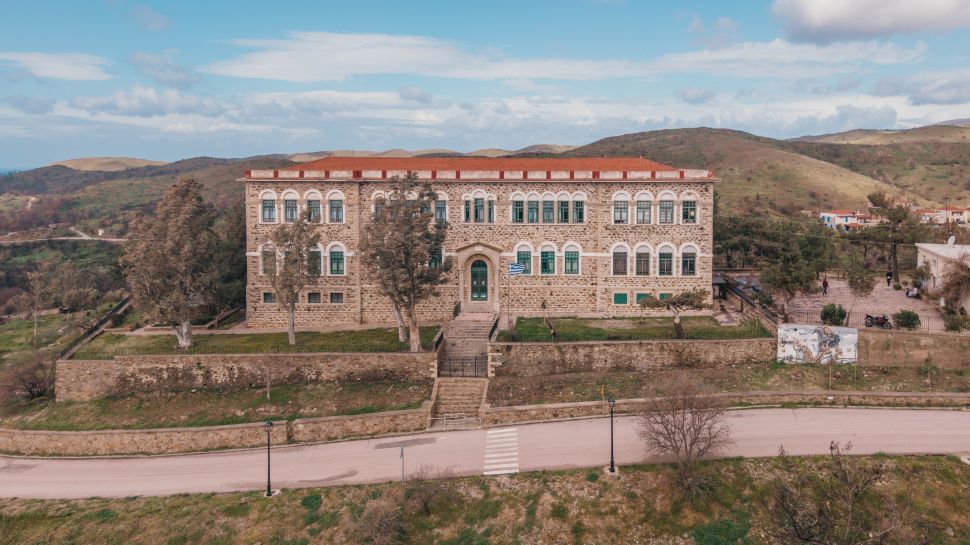
DEO, now in its sixth year as the island’s sole contemporary art organization, has made a practice of occupying unexpected locations across Chios each summer, moving between very different landscapes and communities rather than settling in one place or one kind of venue. This year’s choice carries particular weight: the School of Volissos narrowly escaped the major wildfire last August. It is also the last public school still operating across the entire Municipal Unit of Amani, a building “entrusted with future generations while itself living under the threat of decline,” as Kokkinos describes it. The exhibition’s title, “Letter to an Ailing Father,” takes the school’s predicament as both setting and metaphor: the ailing father is not only a biological figure but any structure that has promised protection and failed to provide it, a political system, a state, a patriarchal institution, a form of governance that relinquishes its responsibilities of care. “We’re living through a moment shaped by wars, environmental collapse and profound uncertainty,” Kokkinos told Observer. “There are many fathers who appear unable, or unwilling, to care for the futures they helped create.”
“Letter to an Ailing Father“
Artists: Various
Venue: The Volissos School
Address: Chios 821 03, Greece
Through: August 30, 2026
That this conversation is happening here, in a stone school building that survived a wildfire, rather than in a Basel fair booth or a white-walled gallery, is itself a curatorial statement about where serious thinking belongs. Around a hundred people pass through the school each day during the exhibition, among them many who attended it as children. Evita Kyriazi, who curates DEO’s public program and grew up on Chios herself, told Observer that visitors regularly become emotional on returning: “I see it again now with different eyes,” she has heard people say. One visitor pointed to a photograph still hanging on a classroom wall and identified her great-grandfather, who had donated the land on which the school was built. “This sharing of memory,” Kyriazi said, “is what matters most: it is the connective tissue of a community.” The art world has developed its own version of the privacy economy, a circuit of events where the serious thinking happens away from the main stages, where the absence of a waiting list for dinner reservations functions as a kind of quality signal. Kokkinos is careful not to overclaim. “I don’t think remoteness automatically produces better thinking,” he told Observer, “just as I don’t believe major art centers are incapable of depth.” What Chios offers, he says, is a different rhythm: fewer competing demands, fewer openings to rush between, fewer expectations to perform. “It creates room for slower conversations, genuine curiosity and the possibility of changing your mind.”
Part of what makes that possible is something particular to Chios itself. The island has long had deep ties to the Greek shipping industry and some of DEO’s most committed patrons come from shipping families, yet wealth here does not announce itself loudly. Kokkinos describes finding yourself in a taverna beside one of Greece’s leading shipping figures without realizing it; people return to the island for childhood memories and family histories, not to be seen. That social leveling is something DEO actively cultivates. “During an opening weekend you’ll find artists talking to farmers, collectors sharing a table with local families, editors walking through the exhibition alongside schoolchildren and visitors who may never have entered a gallery before,” Kokkinos told Observer. “Contemporary art becomes the common ground rather than the marker of difference.” That this year’s roster includes Cindy Sherman, Danh Võ and John Gerrard alongside emerging artists from Bangladesh, Cyprus and Greece, all showing in a village school, says something about what DEO has built over six years.
The exhibition opens with Nasan Tur’s Life and Death (2023), a 75-minute film in which German hunters describe, in close-up and without showing their faces, the narratives they use to justify killing. Visitors watch from the school’s stage, an unexpectedly charged spatial choice that puts you simultaneously in the position of an audience and something closer to a jury. Tur’s shorter In My Pants (2015) shows the artist urinating into his trousers, without hesitation or apology, an act of deliberate regression that, in a school setting, scrambles the usual dynamics of authority and vulnerability with uncomfortable precision.
The show builds through a series of responses to precarity, inherited and environmental. John Gerrard’s Smoke Tree I and Smoke Tree IV (both 2006) are real-time 3D simulations of a lone oak tree perpetually emitting thick black smoke, meditative objects that lodge a persistent question about systems we have come to depend on and what happens when they begin to fail. Vasilis Papageorgiou, who spent time in Amani researching his commission, presents I Come from the Depths of the Earth (I, II, III) (2026): three hotel minibars containing cast brass imprints of the ground surface from sites in Amani scarred by fires and threatened by extraction, simultaneously deadpan and disturbing, raising pointed questions about who decides what is worth preserving and what gets left to disappear. Cindy Sherman’s Untitled #174 (1987), from her Disasters series, is installed in the school laboratory, where it constructs a dystopian landscape of decomposing organic matter and viscous fluid that, in a room carrying traces of actual environmental catastrophe, has an added charge.
The theme of precarity, and the failure of structures and institutions to serve the communities they were built for, extends beyond the Aegean. Md Fazla Rabbi Fatiq’s Mirage (2022-2023), a series of 24 photographs of abandoned and unfinished bridges across Bangladesh, infrastructures intended to connect communities, left to lie instead in canals and fields, often due to misuse of public funds, hang without fanfare, but somehow adamantly. These are broken promises made concrete, documented with a photographer’s eye for abstraction, the series resonating with the exhibition’s context of recent disaster and distance from the seat of power.
Among the most affecting works are those that locate resilience in material knowledge and folk tradition, the kind of situated understanding that the art world, in its more itinerant modes, tends to overlook. Paky Vlassopoulou’s KOMONI (2026), whose title refers to the communal practice of cultivating land together, weaves together the story of Thomas Tsolakis, Volissos’s last living saddler and folklore collector, with archival traces from an abandoned house up the hill. The installation uses fire-resistant clay and beeswax infused with mastic, materials that echo the landscape’s recent traumas and its older practices of healing. Lito Kattou’s Whisperer series (2026) places hybrid figures, part woman, part migratory bird, around the school, each carrying handmade local textiles on their backs as they move, preserving folkloric memory across time and geography. The textiles were loaned by the women’s association Friends of the Chian Village, a detail that keeps the work tethered to something particular and real rather than purely symbolic.
Arda Asena, a descendant of a family displaced from Greece to Turkey in the 1923 population exchange, brings hand-woven jacquard tapestries made from photographs taken in Amani, each image digitally translated into a weaving pattern before being worked on the loom. In this process, some details disappear and others emerge, the imagery shifting from documentary to abstraction, carrying both what has been preserved and what has inevitably been lost. The connection between the words “textile” and “text,” both derived from the Latin texere, to weave, feels less like a curatorial footnote than a genuine organizing principle for the show. The public program deepens it further: Kyriazi has organized weaving workshops in collaboration with a local women’s association founded in 1956, the same year women were granted the right to vote in national elections in Greece. The association’s original purpose was to teach girls domestic skills associated with traditional feminine roles. It now functions as a custodian of folk art on the island, and its presence here opens a dialogue about what those traditions meant then and what they might mean now. “A weaving practice can simultaneously be a form of heritage, a lived experience, a social practice, and a contemporary artistic language,” Kyriazi told Observer. “The richness comes from holding all these layers together.”
Eleni Odysseos’s new paintings on raw silk and jute, suspended so that visitors walk between them, draw on the story of Saint Markella, an 18-year-old from Volissos murdered by her father after resisting his assault. She was declared a martyr of the Orthodox Church and her blood is said to reappear each year on the rocks at the site of her death. Working with raw silk and jute, Odysseos dissolves the boundary between the human body and the island’s geology, the body becoming landscape, the landscape bearing the traces of violence done to bodies within it. Byzantine iconography and local legend sit alongside geological and floral imagery in compositions that feel less like paintings than like acts of remembrance, honoring healing traditions that have persisted across generations and cultures. Moving through the suspended panels, which form something like a cocoon, myth and geology blur into each other in ways that can feel almost physically uncomfortable.
The public program, which runs throughout the exhibition’s duration and includes talks, musical performances and children’s workshops, extends this work into the surrounding community. Kyriazi notes that in rural settings, many people feel a distance from visual art, a sense that “I don’t know anything about it.” Through more familiar entry points, she says, the program aims to reduce that hesitation and open pathways toward the exhibition itself. There is something fitting about that in a school: the building was designed for exactly this kind of threshold-crossing.
No work in the exhibition carries that weight of transmission more powerfully than Danh Võ’s J. Théophane Vénard Letter (2009-), which is also perhaps the show’s most devastating work. It is based on the final letter written by a French missionary to his father, shortly before his execution in Vietnam in 1861. Rather than reproduce it himself, Võ asked his own father, Phung Võ, to copy the letter in calligraphy, despite being unable to read French, and his father continues to copy it each time the work is exhibited or acquired. The piece will remain unfinished until he can no longer hold a pen. It is a work about inheritance and colonialism and the intimacy of a relationship conducted through an act of patient, loving transcription that will one day simply stop.
The exhibition closes with Shezad Dawood’s Invisible Threads (2026), a commission of eight canvases accompanied by a musical composition. Dawood was fascinated, Kokkinos explained, by the altered soundscapes left behind after the wildfires, the silence where birdsong had been, and the paintings draw on local Chiot folklore, including the myth of the Sunless King, who never emerged into daylight, and on the ancient sanctuary of Apollo Phanaios, historically associated with light and revelation. The musical score, composed by Adam Rudolph and performed by an ensemble of ten musicians, carries sounds of the island and something of its grief. It is an elegy that refuses to conclude, a meditation on what survives devastation, and in a village school at the edge of Europe, far from anywhere with a waiting list for dinner reservations, it turns out there is no better place to sit with that question.