
With culinary tourism on the rise, bucket-list dining has continued to dominate travel itineraries in the most established gastronomic cities. But while any amateur foodie can experience the usual Michelin-starred restaurants of Paris, Healdsburg and Tokyo, several of the world’s most unique fine-dining restaurants demand more than a hard-to-get reservation. At these ultra-remote restaurants, inaccessibility is about more than an elusive dinner slot—it’s about actually managing to physically access the eatery.
While remoteness can be rather inconvenient, these isolated restaurants make dining feel like both an accomplishment and an adventure, all in one. Some can exclusively be reached by boat, while others are only found at the end of a two-day hike, building anticipation with every step (or nautical mile).
Most importantly, this isolation creates an authentic connection to the land that is otherwise difficult to find in our overly connected world, whether that is atop a snow-capped mountain in Austria or on a secluded coral outcrop in Zanzibar. These culinary establishments defy norms, allowing guests to indulge in the rare privilege of having untouched nature as the ultimate backdrop. From a floating structure on top of one of Norway’s largest fjords to an atrium-like eatery that sits within Spain’s Timanfaya volcanic fields, these remote restaurants show that the most unlikely setting can result in the most unforgettable meal.
The Remote Restaurants in the World Worth the Trek
Huset
SJ, Vei 300, Longyearbyen 9170, Svalbard & Jan Mayen
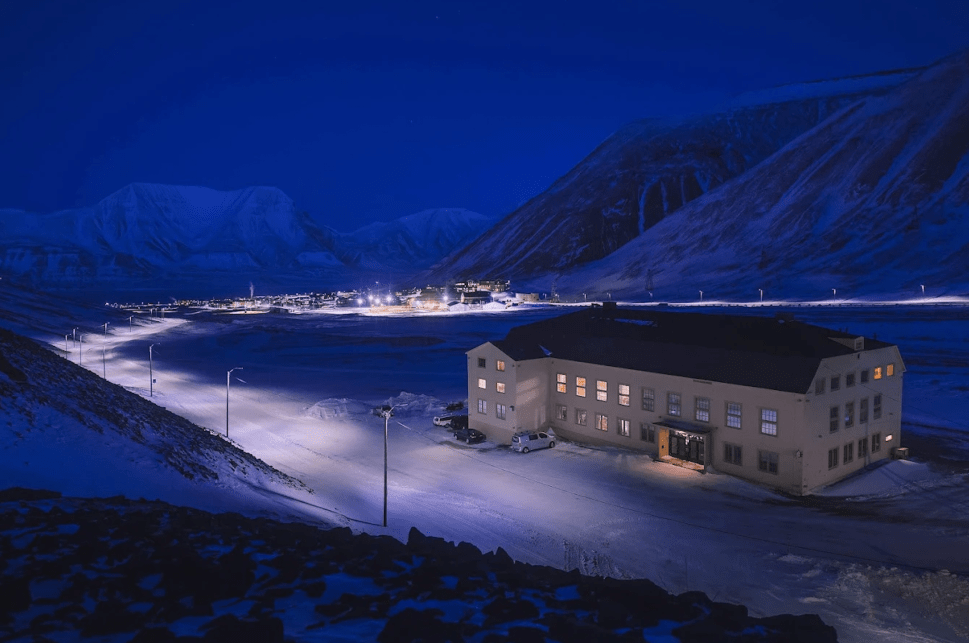
As the northernmost restaurant in the world, Huset offers a bucket-list dining experience just 800 miles from the North Pole; it’s the closest you can get to dinner with Saint Nick himself. Surrounded by glaciers and frozen fjords, the restaurant is pretty much in the middle of polar bear territory, right on the outskirts of the Arctic wilderness. Huset opened as a community hub with a cafe, cinema, church and school in Longyearbyen in 1951. In the 1980s, the focus shifted to fine dining, and it has remained there since. An extensive wine cellar complements the 14-course Nordic menu, which spotlights local delicacies such as reindeer and rock ptarmigan.
Huset Restaurant.
Huset Restaurant
The Old Forge
Inverie, Mallaig PH41 4PL, United Kingdom
Inverie is a tiny village tucked away on Scotland’s Knoydart Peninsula, and the crown jewel of this remote town is a community-owned pub called The Old Forge. There are no roads in or out—the only way to get your hands on a well-deserved pint is to embark on an 18-mile hike or an eight-mile boat trip. With a population of just 130 people, don’t expect a bustling city center or touristy Main Street; people come here for the pub. It’s important to book your reservation in advance, and while the menu changes seasonally, consistent staples include the signature Knoydart wild venison and Cullen skink, a traditional Scottish soup made with smoked haddock, leeks and potato.
The Old Forge.
The Old Forge
Mil Centro
Vía a Moray, Maras 08655, Perú
Dining at Mil Centro takes guests to the heart of Peru’s Sacred Valley, right next door to the Incan ruins and agricultural terraces of Moray. The restaurant celebrates the Indigenous roots and ancestral history of the land, creating a more impactful experience for patrons. The eight-course tasting menus blend a love of food with a passion for Andean culture, using seasonal, native ingredients grown at a high altitude. The standard tasting highlights traditional meats like alpaca and lamb, while the vegetarian option spotlights fresh produce from Mil Centro’s impressive network of more than 300 producers and artisans. If the meal alone is not enough to quench your thirst for knowledge, there are three other accompanying adventures you can book, ranging from a meeting with the local K’acllaraccay community to a tour of the Kollparay and Qollqa Mate facilities before sitting down for dinner.
Mil Centro.
Mil Centro
Ithaa Undersea Restaurant
Rangali Island, 20077, Maldives
Ithaa Undersea Restaurant gives guests the chance to dine among the fish in a glass cocoon 16 feet below the surface of the Indian Ocean. Located at the Conrad Maldives Rangali Island hotel, it’s only accessible via a speedboat or seaplane transfer. After walking along a lengthy jetty to a thatched-roof structure, diners are instructed to descend 33 steps to the 14-seat subterranean restaurant, which is open to non-hotel guests, as well. An intimate lunch or dinner service is enhanced by the immersive turquoise waters and a flurry of sea creatures, ranging from gliding reef sharks and stingrays to green sea turtles and schools of angelfish. Curved walls make you feel as though you’re part of the open water and completely detached from the nearby shore as you’re treated to a multicourse menu featuring fresh scallops, truffle-topped beef tartare and Maldivian lobster.
Ithaa Undersea Restaurant.
Conrad Maldives Rangali Island
Ice Q Restaurant
Bergstation Gaislachkoglbahn, Dorfstraße 115, 6450 Sölden, Austria
Ice Q Restaurant is perched 10,000 feet above sea level on the summit of Austria’s Gaislachkogl Mountain. Reaching the sky-high dining room requires two gondola trips, and though that might sound like quite the commitment, the journey is a key part of the dining experience. Admiring the panoramic views of Sölden’s unspoiled scenery guarantees an unforgettable start to your meal. From the outside, Ice Q Restaurant looks like a glass cube built into the natural landscape, and the surrounding alpine environment is just as beautiful in summer as in winter. The setting is so cinematic that it was even used as a filming location in the 2015 James Bond movie Spectre. Those wanting one of the best seats in the house should book the €160 Chef’s Table. This midday reservation guarantees a window-side table and includes a welcome glass of Champagne, followed by a curated four-course lunch.
Ice Q Restaurant.
Ice Q Restaurant
The Rock Restaurant Zanzibar
Pingwe, Michamvi, Tanzania
Defined by the tides, The Rock Restaurant Zanzibar appears to float atop the surface of the Indian Ocean, but in reality, it sits on a small coral outcrop that formerly housed a fisherman’s post. If the tide is high, patrons must take a rickety wooden boat over the islet, but during low tide, a shallow lagoon appears, and guests are able to wade across—so long as they don’t mind getting a little damp. The establishment feels more like a landmark than a restaurant, completely isolated from the mainland and enclosed in aquamarine-colored waters that are often clear enough to see right through to the rocky floor. Seafood is, unsurprisingly, the focus of the menu here, with standout dishes including the stewed rock lobster, fish carpaccio and squid-ink ricotta spheres.
The Rock Restaurant Zanzibar.
The Rock Restaurant Zanzibar
El Diablo Restaurant
Montaña del Fuego, Carretera general Yaiza-Tinajo s/n, 35570, Diseminado Islote Hilario, 1, 35560 Tinajo, Las Palmas, Spain
El Diablo is an otherworldly dining experience in the middle of Lanzarote’s Timanfaya National Park. The circular restaurant features a wall of floor-to-ceiling windows that look out onto the vast, sandy and red-rock landscape of the park’s massive lava field. El Diablo’s most extraordinary highlight, however, is the kitchen’s use of natural geothermal heat to cook an array of meats and veggies. Rather than working with fire or electricity, chefs place an iron grate over a volcanic pit that releases intense heat, with temperatures ranging from 800 to 1,000 degrees Fahrenheit. It is one of the most geologically unique places to dine, immersing guests in a backdrop of ash-covered mountains and crimson craters. Expect Spanish classics like chicken croquettes and grilled chorizo alongside smoked chicken thighs, shrimp skewers and entrecôte.
Iris
Salmon Eye, 5470 Rosendal, Norway
Hidden away inside a floating, fish-eye-shaped structure in Norway’s Hardangerfjord, Iris feels straight out of The Menu. Guests take a boat ride from Rosendal and embark on a short tour of the fjord before sitting down to dine. Earlier in 2026, however, Iris moved to an invite-only format to emphasize its impact on ocean activism while developing a new concept for the future. Though you can still contact the team and request a visit, there are no guarantees, which only bolsters the restaurant’s mysterious reputation as one of the most remote and inaccessible eateries in the world. As you sit in the middle of deep Nordic waters, framed by snow-capped mountains, you’re treated to an 18-course meal that makes each plate a marine-inspired work of art, from coral-like displays holding raw shrimp with crispy heads to snow crab blinis made with preserved pinecones and fried chanterelles.
Iris.
Iris