Greece, and Athens in particular, has long been regarded as the cradle of Western culture. The record-breaking $124 million box office for Christopher Nolan’s The Odyssey confirms the enduring global appeal of its myths, literature and cultural imagination. But when it comes to contemporary art, Documenta 14 in 2017, staged between Athens and Kassel, undoubtedly helped place the city firmly on the international art-world map. Yet it is only more recently, particularly since the pandemic, that Athens has reemerged as an annual destination for the global contemporary scene.
Dakis Joannou’s Hydra gatherings have certainly accelerated that shift, turning a post-Basel trip to Greece into an annual ritual for many. Beyond that summer pilgrimage, Athens’s own institutions, galleries and new spaces have continued to grow, while the city has attracted increasing numbers of artists. Some have even begun to describe it as the new Berlin, though Athens is already facing many of the same consequences, with gentrification and rising costs pushing artists, especially local ones, farther toward the outskirts.
Year after year, there are more exhibitions to catch during a summer sojourn in the capital or the Greek islands, as the ecosystem continues to expand and develop a new level of coordination and cooperation. The momentum may reach its next high point with the forthcoming Athens Biennale, opening in April 2027, now that two of Greece’s most influential art collectors, Dakis Joannou and Dimitris Daskalopoulos, sit on its board. Until then, these are the exhibitions to add to your Athens itinerary this summer.
What not to miss in Athens
“Jeff Koons: ‘Venus’ Lespugue”
Museum of Cycladic Art, Neofitou Douka 4, Athina 106 74
Through August 31, 2026
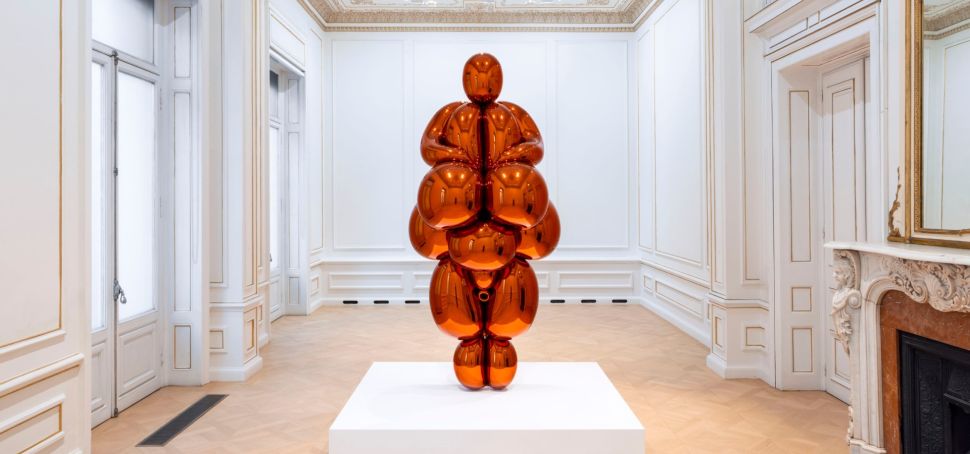
Over the past several years, the Museum of Cycladic Art has staged ambitious exhibitions that place contemporary artists in dialogue with its remarkable collection, which traces the early cultures of the Aegean islands with a particular focus on Cycladic civilization. Closely associated with Dakis Joannou, Jeff Koons is already a familiar presence in Greece each June. Indeed, his smiling sun atop DESTE’s Slaughterhouse on Hydra has become an emblem of the annual art-world gathering. This year, however, he takes an even more prominent stage, with his monumental, mirror-polished stainless-steel Balloon Venus Lespugue (Orange) (2013-2019) occupying an entire room of the museum.
Inspired by the approximately 28,000-year-old Venus of Lespugue, Koons transforms one of the earliest known representations of the human body into an imposing product of today’s hyper-material world. The sculpture preserves the Paleolithic figure’s exaggerated curves and lack of individual identity while recasting them through flawless industrial fabrication and a reflective surface that draws the viewer into the work.
In an adjacent room, the museum presents certified copies of the Paleolithic “Venus” figurines that inspired Koons, setting up a dialogue between ancient conceptions of the female body and motherhood, often bound to ideas of Mother Nature, and a contemporary culture preoccupied with image, desire and consumption. Increasingly detached from nature itself, that culture has also objectified, sexualized and commercialized even this primordial symbol of fertility and life. The pairing ultimately suggests that certain forms endure because they continue to offer ways of recognizing ourselves across time, even as they are repeatedly reshaped to serve changing beauty standards, ideologies and social value systems.
Jeff Koons, Balloon Venus Lespugue (Orange).
Photograph: Paris Tavitian © Museum of Cycladic Art
“Gen X: Tales from the Forgotten Generation”
DESTE Foundation, Filellinon 11, Nea Ionia 142 34
Through November 26, 2026
Hydra is a major draw, but DESTE’s annual weekend of programming always begins at its Athens headquarters with the opening of a new exhibition. Curated by Massimiliano Gioni together with Calvin Wang and Taeyi Kim, “Gen X: Tales from the Forgotten Generation” draws on the Dakis Joannou Collection to examine the work of artists born between 1960 and 1980, a cohort shaped by economic precarity, the collapse of post-war optimism and the transition from analog to digital culture. Generation X came of age just before computer technologies fully permeated everyday life—while the internet and cell phones arrived in the 1990s, its visual culture was still largely shaped by television, video and cinema. These were also the decades in which a new aesthetic emerged, influenced by the rise of 24-hour news and MTV, as well as mounting tensions around globalization, identity politics and the HIV/AIDS crisis.
Bringing together artists including Doug AItken, Matthew Barney, Maurizio Cattelan, Huma Bhabha, Olafur Eliasson, Urs Fischer, Douglas Gordon, Mark Manders and Chris Ofili, the exhibition shows how Gen X developed a visual language for navigating instability long before uncertainty became the defining condition of the present. Through irony, lowbrow aesthetics, mutant bodies, personal mythologies and new forms of social collaboration, these artists confronted a world in which truth was becoming increasingly blurred and the future ever more precarious.
In Hydra, American artist Nari Ward will take the stage with “Until That Day.” Although mounted in a paradisiacal Mediterranean summer destination, the project directly confronts the tragedy unfolding in the same sea. Ward invited Greek rebetika player Aggelos Aggelou and other Afro-Greek musicians to perform their response to the 1963 address by His Majesty Haile Selassie I, Emperor of Ethiopia, to the United Nations, in which he pleads for global cooperation between nations. Linking music traditions to migration, race and belonging, the entire project is an urgent plea for solidarity across national boundaries.
Installation view: “Gen X: Tales from the Forgotten Generation” at DESTE Foundation, Athens.
Giorgos Sfakianakis 2026
Aleksandra Waliszewska, “Irruption of Antiquity”
Benaki Museum, Koumpari 1, Athina 106 74
Through September 27, 2026
DESTE has also extended its reach beyond its own venues, collaborating with the Benaki Museum to stage a resonant dialogue between the densely symbolic painterly universe of Polish artist Aleksandra Waliszewska and the museum’s collection, with objects spanning Neolithic Greece, classical antiquity, the Byzantine world and the modern Greek era. The exhibition pays homage to Greece as the birthplace of figurative, narrative art and as a foundation of Western visual culture, while also tracing the enduring presence of specific myths and archetypes in the contemporary imagination.
Curated by Alison M. Gingeras and presented with DESTE, the exhibition takes its title from one of the chapters of Aby Warburg’s unfinished Mnemosyne Atlas, his attempt to map collective cultural memory through images and trace the persistence of classical forms across history. Echoing Warburg’s model, Waliszewska’s dark, psychologically charged tableaux appear as moments of epiphanic or ominous “irruption,” in which ancient visual tropes forcefully reenter the present from the depths of a shared symbolic and mythical subconscious.
Aleksandra Waliszewska “Irruption of Antiquity”
Benaki Museum, Athens.
Courtesy Benaki Museum
“The Way We Live Now”
George Economou Collection, Leof. Kifisias 80, Marousi 151 25
Through March 2027
Both the Dakis Joannou and George Economou collections are deeply contemporary in their aesthetics and narratives. At a moment of global uncertainty shaped by conflicts and tensions that have been unfolding for years, both collectors felt the need this summer to activate their holdings as a way of mapping and taking the temperature of the world we live in, reading and interpreting it through the eyes and symbolic language of artists who have grappled with these conditions over the past decades.
At the George Economou Collection in Marousi, “The Way We Live Now” offers a rare look at one of Greece’s most significant private collections through a distinctly literary and social lens. Co-curated by Hilton Als and Ann Philbin, the exhibition unfolds across three sections, Intimacy, Politics and Being, to examine how love, power, memory, vulnerability and alienation shape contemporary life. Assembled entirely from Economou’s collection, with the sole exception of one sculpture donated by Katharina Fritsch, the show brings together some of the most celebrated names in contemporary art, including David Hockney, Ellen Gallagher, David Hammons, Louise Bourgeois, Henry Taylor, Lorna Simpson, Fritsch and Charles Ray, within a shared social and existential reflection. Across three floors, it moves from private emotion to political identity and collective estrangement, revealing how the contemporary body is shaped by both intimate experience and larger historical forces.
“The Way We Live Now” is the first contemporary group exhibition of the George Economou’s collection.
Courtesy the George Economou collection
Marc Chaimovitz, “Celebration? Realife Revisited. (1972–2000)”
ARCH, Gkoura 5, Athina 105 58
Through September 12, 2026
At the foot of the Acropolis, ARCH is hosting what is arguably the most poetic and emotionally resonant exhibition in Athens this summer: a restaging of Marc Camille Chaimowicz’s seminal “Celebration? Realife Revisited. 1972-2000.” First conceived in the aftermath of the social upheavals of the late 1960s, the work reflects a broader desire to dissolve the boundary between art and life and to make art an active agent in the reimagining, and perhaps the reenchantment, of the world. It becomes a stage for shared experience, where meaning is produced collectively rather than imposed by established structures.
Bathed in purple-pink light, the room seems suspended outside time, filled with what appear to be the remains of a party, or of an entire imagined world, scattered across the floor. A vinyl recording of Bob Dylan’s “Like a Rolling Stone” accompanies the viewer into this emotional archive, where personal and collective memories gradually blur into the same atmosphere of melancholy and nostalgia.
Emerging in the early 1970s, Chaimowicz rejected the monumentality and masculine severity of much postwar art in favor of decoration, fragility, theatricality and lived experience. Fabrics, furnishings, floral motifs, mirrors, curtains and props became vehicles for exploring how identity, memory, desire and social conventions are embedded in the spaces and objects around us. Influenced by literature and performance, particularly Jean Genet and Jean Cocteau, Chaimowicz treated rooms as stages where public and private selves could overlap, collapsing the boundaries into an evolving Gesamtkunstwerk.
Here, the experience is as physical as it is emotional, reviving a form of romanticism and poetic imagination that now feels almost entirely suppressed, as if that question mark, after celebration, was actually the only state possible to stay festive rather than confront reality, the real world.
“Celebration? Realife Revisited. 1972-2000” at ARCH, Athens.
Courtesy Estate of Marc Camille Chaimowicz. | Ph: Stathis Mamalakis
Vasilis Papageorgiou,
“Grounding”
“Grounding”
Callirrhoë, Sina 9, Athina 106 80
Through September 26, 2026
Callirrhoë is one of the few younger Greek galleries to have established a presence at international fairs, most recently Independent in New York. Named after the water nymph of Greek mythology as an auspicious invocation of “good flow,” the gallery has, since its founding in 2021, built a solid program around some of the country’s most promising emerging voices, while giving them greater visibility abroad.
This summer, the gallery is presenting a solo exhibition by Vasilis Papageorgiou that extends his investigation into overtourism and the commodification of the Cycladic landscape. Suspended throughout the space is a series of cast-bronze sculptures molded directly from rocks on Koufonisia. These hybrid, almost alchemical formations embody the altered reality of a landscape in which ancient limestone has absorbed brick, cement, oyster shells and construction debris discarded along the island’s beaches.
The artist describes them as “screenshots of time”: material records of a landscape being rapidly commodified and reshaped for hotels, rental properties and seasonal consumption, irreversibly disrupting the ecosystem’s timeless rhythms. The work also echoes Greece’s recent “towel movement,” which challenged the privatization of beaches, similarly asking what remains public, shared or genuinely natural when every shoreline, rock and view can be sold as an amenity rather than preserved as a common good.
The exhibition title, “Grounding,” operates both literally and philosophically, prompting viewers, perhaps on their way to Greece’s paradisiacal beaches, to reflect on the reality of extraction that tourism so often brings, rather than any respectful connection to the land. A low-resolution image taken during the molding process shows the sunburnt neck of a technician wearing a cap emblazoned with the words “Koufonisia UTOPIA.” In the final room, a large LED screen shows an electrician suspended against a Cycladic cliff, attempting to ground a cable for a “rooms to let” property in the middle of an apparently untouched landscape.
Vasilis Papageorgiou’s “Grounding” at Callirrhoë, Athens.
Photo: Stathis Mamalakis
Urs Fischer, “Eugène Atget”
Gagosian, 22, Anapiron Polemou Street, Athina 115 21
Through September 12, 2026
Gagosian has turned over its Athens space to Urs Fischer, marking the Swiss artist’s first exhibition in the city. Humor, illusion and distortion have long run through his practice, but here they reach a new pitch as Fischer transforms the intimate neoclassical interior into a mirror of the cacophony unfolding outside. A series of metropolitan landscapes evokes the sensation of speeding through a contemporary city saturated with figures, faces, graphics and text.
Combining silkscreening, hand-painting and stenciling, Fischer applies a collage-like logic to observations drawn from his adopted home of Los Angeles. Layering original photographs with found and manipulated imagery, he moves between figuration and abstraction to capture the city’s indiscriminate sensory overload.
The exhibition’s title nods to Eugène Atget, the influential French photographer who set out to document the rapidly disappearing streetscape of “Old Paris” at the turn of the 20th Century. By turning his attention to Los Angeles and its endless film strip of “places that are not made to be looked at,” Fischer brings a comparable sensibility to a far more accelerated environment, rendering the city as a chaotic palimpsest of images, signs and textures.
Urs Fischer, Quadruple Elvis, 2026.
© Urs Fischer. Photo: Stathis Mamalakis
Guglielmo Castelli, “Crociere Estive”
Sylvia Kouvali, Polidefkous 41, Pireas 185 45
Through August 31, 2026
Already popular among Italian collectors, Guglielmo Castelli has recently drawn a surge of international interest, particularly after joining Mendes Wood DM’s roster in 2022. That move triggered a notable rise in his prices, which quickly shifted from the four- to the five-digit range following a series of sold-out shows. This summer, he surprised everyone by staging a new, spectacular site-specific solo at Sylvia Kouvali’s Piraeus location, creating a poetic and suggestive choreography that unfolds like the remains of a voyage, or of a dream, washed ashore or sedimenting inside the gallery’s cave-like interior. Paintings, collages and seven suspended puppet-like Idoletti form a theatrical world of swans, mythic figures, fragmented bodies and abandoned relics, where the promise of summer leisure gives way to melancholy, unease and longing. Trained in scenography, Castelli approaches painting as a stage on which inner and outer realities, memory and imagination continuously overlap. Here, constricted bodies, taut cords, elaborate costumes and incomplete figures return to his recurring tension between freedom and control, while fairy-tale imagery slips into something darker and more psychologically charged. The result is a poetic meditation on limits, absence and the difficulty of escaping the structures that shape us, even when the sea seems to promise another world.
Kouvali herself is another interesting case of a young, wise dealer who has been able to adapt to shifting collecting geographies and economies: founding her gallery under the name Rodeo in Istanbul in 2017, she moved to London and later opened a second space in Piraeus in 2018. In 2024, Kouvali renamed the gallery after herself, a shift that made more visible the personal, relationship-driven character of a program she had spent years building, now conveniently attracting collectors as they sail off to the islands.
Guglielmo Castelli “Crociere Estive” at Sylvia Kouvali, Pyreus.
Courtesy Sylvia Kouvali
Henry Curchod, “Lotteria”
The Intermission, Polidefkous 37A, Pireas 185 45
Through August 1, 2026
London-based artist Henry Curchod is also enjoying a distinctly summery Greek moment, with a new exhibition at The Intermission, the hybrid space launched in Piraeus by art advisor and former Venus Over Manhattan director Artemis Baltoyanni. The venue invites artists to develop projects in collaboration with their representing galleries, when applicable.
Born in Palo Alto and raised across several countries, Curchod draws deeply on both his Kurdish-Iranian heritage and his Western upbringing. That duality feeds a dense symbolic language that emerges through intuitive, gestural brushwork and deliberately raw marks moving across layered, atmospheric fields of color. Humanoid and animal faces surface from these fluid spaces, but the artist resists resolving them fully, using figuration to explore identity as something continuously metamorphic and unstable, suspended between the familiar and the uncanny, the conscious and the subconscious.
The exhibition revolves around “Lotteria,” an imagined restaurant Curchod has long dreamed of opening, and nearly did last year, to bring Mediterranean flavors and glamour to East London. Many of the works depict scenes of conviviality or the hard labor of the kitchen, focusing on restaurants as emotional and social spaces where rituals of care, exchange and connection unfold through food.
Henry Curchod’s “Lotteria” at The Intermission, Pyreus.
Ph. Paris Tavitian
Iva Lulashi, “Now Representing”
The Breeder, Iasonos 45, Athina 104 36
Ongoing
The Breeder is one of the art galleries in Greece with the strongest international profile, presenting both local and international artists while maintaining a regular presence at fairs including Frieze and Art Basel. Founded in 2002 by George Vamvakidis and Stathis Panagoulis, it evolved from an art magazine launched two years earlier to foster dialogue between the local scene and the wider art world.
In its multi-level space, a former ice cream factory in Metaxourgeio, the gallery has opened its first solo exhibition with Albanian-born, Milan-based artist Iva Lulashi. Already widely collected in Italy, Lulashi gained broader international attention with her striking presentation in the Albanian Pavilion at the Venice Biennale.
For years, Lulashi has explored the expressive territories of sensuality and eroticism, and the ways they are represented, beginning from an intensely personal impulse rooted in the specific history of her native country. Her paintings inhabit a liminal space between memory and the subconscious, where figuration deliberately blurs as she investigates both the psychic and physical behavior of her characters. Held in tension between pleasure and desire on one side and the danger of possession and control on the other, the works are animated by the very foundations of erotic charge, explored in both its spontaneous expression and its distortions.
Lulashi’s inquiry, however, extends well beyond the personal. Her paintings also engage in psychological and semiotic investigations into the narratives through which gender relations are represented across art and the media. In doing so, they reveal how specific visual regimes encode and impose ideologies and power dynamics between the sexes, and how, once absorbed into the collective imagination, those narratives become norms that regulate bodies within broader social structures. Ultimately, Lulashi examines the persistence of political and cultural memory while affirming the power of desire and imagination as sites of resistance and transformation.
Iva Lulashi, I just laughed and said no, 2025.
Courtesy the artist and The Breeder
“South by Southeast” and more
National Museum of Contemporary Art Αthens, Leof. Andrea Siggrou 51-53, Athina 117 43
Ongoing
The National Museum of Contemporary Art Athens (EMΣT) is always a worthwhile stop for anyone looking to understand the Greek contemporary scene. This summer, nine exhibitions unfold across the museum’s six floors, housed in the former FIX brewery on Syngrou Avenue, one of Athens’s most important surviving spaces of postwar industrial modernism. Located near the Acropolis and the city center, the building was redesigned and converted into a museum beginning in the 2000s by 3SK Stylianidis Architects, with collaborators including I. Mouzakis and Tim Ronalds Architects, before finally opening in full in 2020.
“South by Southeast” offers a compelling perspective on contemporary Greek art by staging a major rehanging of EMΣT’s collection curated by director Katerina Gregos and positioning Greece as a vital cultural crossroads connecting the Balkans, Turkey, the Middle East and North Africa, rather than the periphery of Europe.
Bringing together recent acquisitions, donations and existing holdings, the selection proposes a far more layered and plural understanding of Greek identity, shaped by migration, exchange, conflict and overlapping histories. Through major works by artists including Mona Hatoum, Lawrence Abu Hamdan, Diana Al-Hadid, Monira Al Qadiri, Lynda Benglis and Pier Paolo Calzolari, the exhibition not only proves the scope and ambition of the museum’s collection but also reframes the Mediterranean, southeastern Europe and the wider Near East as generative centers of artistic production, critical thought and cultural innovation rather than marginal zones of European modernity.
Also on view this summer is a retrospective devoted to Niki Kanagini, one of the most distinctive women artists of postwar Greece. Moving from monumental tapestries to participatory installations, Kanagini challenged both gender conventions and the boundaries between applied and fine art. On another floor, George Lappas’s “Art Always Begins With the Word ‘Supposing’” focuses on the more conceptual and installation-based side of his practice, where giant trucks, trailers, machinery and illuminated letters become luminous, uncanny environments and powerful allegories of the human psyche and social contradiction.
Near the entrance, a revealing survey of Greek avant-garde artist Stathis Logothetis shows how radically he expanded the possibilities of painting. By treating canvas, pigment and stretcher as analogs for skin, blood and bone, and by activating works through bodily action, audience participation and exposure to natural decay, Logothetis anticipated the idea of an expanded field of painting. His work pursued this territory with a freedom and intensity comparable to Arte Povera, Gutai and Viennese Actionism, while also recalling artists such as Alberto Burri and Lucio Fontana.
Installation view: “South by Southeast,” at the National Museum of Contemporary Art Αthens (ΕΜΣΤ).
Photo: Paris Tavitian