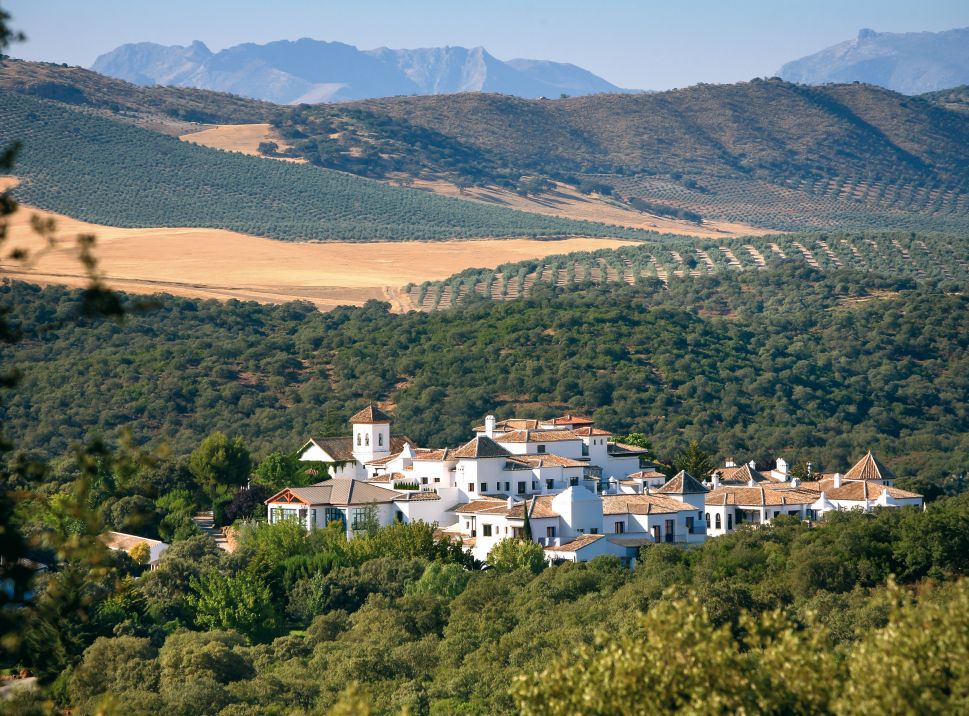
The hiking trails at Finca La Bobadilla are so extensive that when I set out on a solo walk one morning, I almost got lost. At this remote retreat in southern Spain, the chance to disappear in the wilderness is practically the entire draw. Rolling green hills and silvery olive trees go on for miles in every direction with no buildings or paved roads to interrupt them. Usually, I listen to music while hiking. That morning, I kept my earbuds out, tuning in to trilling birdsong and buzzing insects, lulled by the hypnotic atmosphere. I was totally zen…until I realized that I didn’t know which trail led back to the hotel.
Luckily, whitewashed buildings, designed to mimic a traditional Andalusian town, rise from the surrounding forests and hills like a citadel in the middle of nowhere. After I crested a hill, it appeared to my left and worked as a landmark guiding me back to the property. I went straight to the breakfast buffet and ate with a little more gusto than usual. There’s nothing like a near-brush with the great wide open to make you appreciate the perks of civilization.
I’m not the first one to get lost in the beauty of this place. Back in the 1980s, a pair of travelers, Rolf Egli and Rudolf Staab, became so enamored with this particular slice of Andalusian countryside that they decided to open a restaurant here. There’s nothing in the surrounding area; the closest town is 30 minutes away, which is, of course, part of the draw, but also made the success of a restaurant unlikely. Foolish, even. Except that the natural beauty that drew the founders to the space also drew others in. Almost immediately, the venue became so popular that adding a block of rooms so guests could stick around out in the country a little longer made sense.
Those rooms were always booked, so the owners doubled the footprint, and slowly, a boutique, family-run hotel was born. Architecture by the local Jesús del Valle has held strong over the years, and additions and renovations have only deepened the hotel’s lore. Brad Pitt, Tom Cruise and Jeff Goldblum are among the guests to have checked in at various points over the years. The hotel, which became a member of Leading Hotels of the World in 1991, stayed in the Egli family until 2006, when it was sold to Spanish-run hotel conglomerate Barceló.
In 2024, the company decided to search for a buyer, and ran a competitive set looking for similar properties in Spain—boutiques with thoughtful architecture and beautiful settings, and came up with one answer: Único Hotels. “The previous owner was friendly with Único’s owner, Pau Guardans, so he sent over the report,” La Finca Bobadilla’s general manager, Ingrid García Salazar, tells Observer. “Once Pau saw it, he knew La Finca Bobadilla needed to be part of Único’s portfolio. It’s exactly the kind of hotel the company looks for.” With the new owner, the once family-run hotel, now outfitted with 73 guest rooms, has gone back to its roots: Barceló has hundreds of hotels in its portfolio, whereas Único is focused largely on unique local hotels, with just eight Spanish properties in its collection.
Único emphasizes hotels that are destinations “where you visit and you can feel the essence of a place,” Salazar says. The brand didn’t have a presence in Andalusia, so acquiring the property helped them expand regionally. During a brief closure, Único augmented the existing interior design and bolstered outdoor activities by reviving a historic horse stable and establishing an equestrian program, as well as adding a bike center, new gym and pickleball court. They also significantly upgraded the spa.
The original restaurant, now called El Cortijo (formerly La Finca), is joined by two others, plus a series of outdoor pools in an oasis-like dell shepherded by palm trees, along with a chapel near the lobby that boasts the largest private pipe organ in Spain. The most unexpected part of the property, though, is actually the lobby, where elegant stone arches and vaulted ceilings inlaid with delicately carved wood are modeled after the mosque-cathedral of Córdoba, a UNESCO World Heritage site. High ceilings echo back the sound of running water coming from indoor fountains, a nod to Alhambra tradition.
These regional elements are present throughout the hotel, from floors paved with worn-in terracotta tile to the local paintings, drawings, weaving and ceramics that serve as the decor. Every room is slightly different, with rates starting at €450 (around $510) inclusive of breakfast, but all boast generous proportions, especially in comparison to typical European hotel rooms. My suite included a sun-drenched terrace about the same size as the large living room, a separate bedroom, an adjoining bathroom with a seven- or eight-foot-long soaking tub, and a shower about the same size as my king bed.
Inside the shower, tiny stained-glass windows were secreted away behind small wooden doors fastened shut with metal latches. I’ve experienced plenty of decadence during my travel journalism career, but stained-glass windows in the shower were a first, and easily my favorite idiosyncrasy. The final welcoming touch: Local pastries made by nuns at the nearby Convent of Archidona.
The hotel’s sprawling layout, built in sections as it grew, feels more like a village than a guesthouse. The flagship restaurant is still set in a cobblestone courtyard, but has shifted away from fine dining. Now, it’s a more relaxed, bistro-style spot that is stocked with fresh bread, homegrown olive oil and Spanish wine, with a rotating menu designed by chef Óscar Velasco. The homespun feel marks a shift in focus from the original concept (which earned Michelin stars in 2023, 2024 and 2025), but the more approachable style aligns with Único’s philosophy. The venue serves plates made with local ingredients in a casual setting, complete with barbecue and live flamenco guitar on the weekends.
This ethos of barefoot luxury permeates the atmosphere of the hotel; you’ll find excellent food, drink and service delivered with style—and not a shred of snobbery. That was also the vibe at the spa, where an enclosed area with a pool and hot tub includes sensory showers and two saunas, plus treatment rooms with premium products from Barcelona-based Natura Bissé. If you do decide to go for a hike, a run or a horseback ride, I highly recommend a visit to the spa afterward. During my massage, the therapist even took a moment at the end of the session to do some extra work on my neck and cervical spine, targeting these desk-worker problem areas with a firm but necessary touch.
Dinner at La Jara, the fine-dining outlet, delivered a formal, adults-only experience, but my most frequented restaurant ended up being El Mirador, the lunch eatery overlooking the outdoor pools. For one thing, it’s the most casual by far; I sat for tomato and burrata salad, creamy rice (akin to risotto) with asparagus and parmesan, and a glass of Mallorcan white wine from another Único estate while clad in just a swimsuit and shorts, and the well-heeled staff, some in suit coats themselves, didn’t bat an eye.
Still, the best parts of the stay were the time spent outdoors. Sunning and swimming at the oversized outdoor pools, kept mostly quiet thanks to separate pool areas for kids, and, of course, hiking through the miles of crisscrossing trails on the 350 hectares (over 850 acres) of private land the hotel is set on. Most guests wander these trails on horseback; the new equestrian program has become a huge draw for the property. Others opt for bikes.
Many hotels talk about a sense of place, but at Finca La Bobadilla, the place and the hotel are one and the same. “Único would never want to have four hotels in Andalusia,” Salazar says. “This is the destination, in the heart of Andalusia. You won’t find this anywhere else.” But if you do head out into the wilderness during a stay, make sure to watch the trail.