The South of France has long been a favorite retreat of artists for its Mediterranean light, atmosphere and landscapes that inspired generations of modernist pioneers to experiment with color and perception. Dealers and collectors soon followed, turning the region into one of the summer season’s most beloved escapes. Since the opening of Fondation Maeght in Saint-Paul-de-Vence in 1964—France’s first independent art foundation—the South of France has become home to a thriving art ecosystem that gained renewed momentum during the COVID-19 crisis and has continued to expand ever since.
It was in the midst of the pandemic that Plein Sud first set out to map the region’s art scene and build a cooperative network. From 20 institutions in 2020, it has grown to include more than 80 visual arts venues in 2026, stretching from Céret near the Spanish border to Menton near Italy and encompassing museums, public art centers, private foundations, artist residencies, sculpture parks, historic sites and collection-based institutions. To help you plan the rest of your summer season, we’ve assembled a list of the region’s must-visit art destinations and exhibitions, organized as a road trip that will take you from Nice southward.
Must-see exhibitions in the French Riviera
“Henri Matisse – Yves Saint Laurent”
“Ellsworth Kelly – At the Edge of Water”
“Abstract Constructions” and Jean Prouvé
Dan Flavin at the Venet Foundation
Rashid Johnson and Sheree Hovsepian at Château La Coste
Saodat Ismailova, Camille Henrot, Stan Douglas, Patti Smith and more at LUMA
Victor Vasarely, “Project for a Revolution”
Park Chan-wook and Pooya Abbasian at the Lee Ufan Museum
“Images, Body, Power,” “Le murmure des Libres” and Kim Gordon
“Henri Matisse – Yves Saint Laurent”
Musée Matisse, Nice
Through September 28, 2026
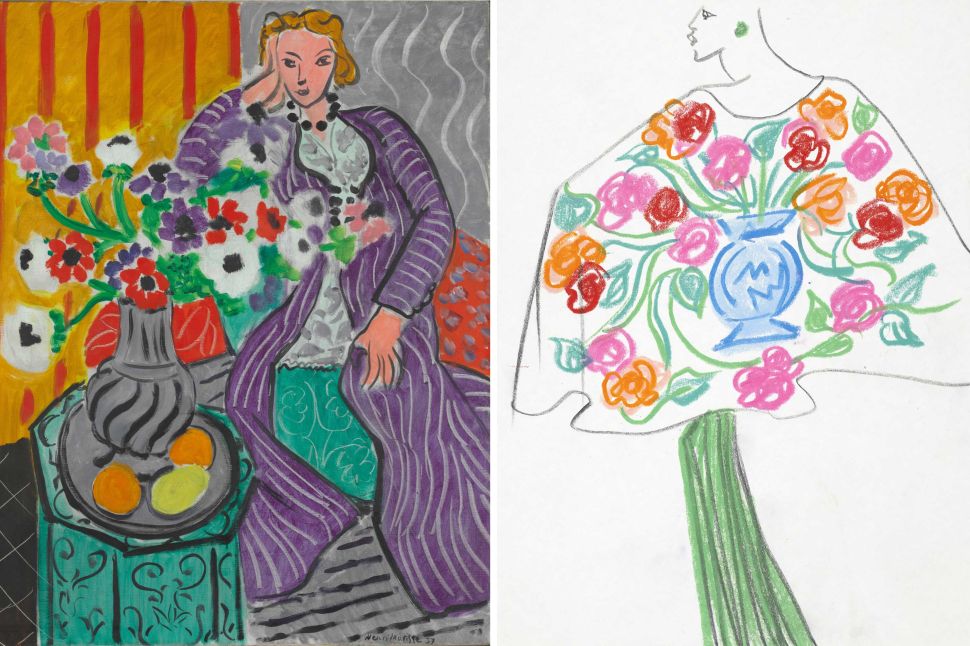
Some of Matisse’s most vibrant works were conceived during his years in Nice, beginning in 1917. While staying at the Hôtel Beau Rivage on the Promenade des Anglais, where his narrow room opened onto the sea through a large window, he became captivated by the Mediterranean’s bright, colorful reflections, finding its vivid clarity especially compelling in winter. The Musée Matisse in Nice houses works donated to the city by the artist and his heirs, many of them from this defining period. This summer, the museum is showing “Beauty, Fashion and Happiness,” an elegant dialogue between the French painter and fashion icon Yves Saint Laurent that reveals their shared vocabulary of body, material, color, light and pattern, as well as their mutual understanding of drawing as a source of experimentation. Organized in collaboration with the Musée Yves Saint Laurent Paris, the exhibition dissolves the boundaries between art and fashion and between the fine and applied arts. It brings together 160 works, including paintings, haute couture garments, traditional folk costumes, drawings, textiles, accessories and archival documents, to illuminate the visual and emotional bonds the couturier developed with Henri Matisse’s work.
Left: Henri Matisse, Purple Robe and Anemones, (1937). Right: Yves Saint Laurent, exploratory sketch, Fall/Winter 1988 haute couture collection.
Photo: Le Mitro Hood. Baltimore Museum of Art, The Cone Collection, established by Dr. Claribel Cone and Ms. Etta Cone of Baltimore, Maryland. Right: Yves Saint Laurent Paris © Yves Saint Laurent © Fondation Pierre Bergé–Yves Saint Laurent
“Ellsworth Kelly – At the Edge of Water”
Fondation Maeght, Saint-Paul-de-Vence
Through November 15, 2026
The Maeght Foundation was not only the first foundation of its kind in the region but also the first in France to be entirely devoted to modern and contemporary art, housing today one of Europe’s major collections of twentieth-century painting, sculpture, drawing and graphic art. Founded in 1964 by the art dealers, publishers and lithographers Marguerite and Aimé Maeght, it opened in Saint-Paul-de-Vence in a building designed by Catalan architect Josep Lluís Sert. Artists including Joan Miró, Alberto Giacometti, Georges Braque, Marc Chagall, Alexander Calder and Fernand Léger also contributed to its development, helping to shape the immersive, destination-based model that many later foundations across southern France would adopt. Highlights include the Giacometti Court, Miró’s sculptures and labyrinth, Braque’s mosaic pool and site-specific works throughout the grounds. This summer, the foundation is placing a special spotlight on Ellsworth Kelly, bringing together more than 100 works to examine a central yet long-overlooked theme in his practice: the inspiration he drew from water in developing his distinctive abstract language. Throughout his life, he was drawn to aquatic environments, from Belle-Île and the Côte d’Azur to New York and the Caribbean, where sustained observation of water gave rise to drawings, collages, paintings and sculptures. Rather than depicting landscapes, Kelly translated the perception of water itself: its shifting color, light and surface. The exhibition also commemorates Kelly’s early and enduring friendship with the Maeght family, with whom he regularly spent summers beginning in 1948, and forms part of an American season of concerts and events. (TIP: Have lunch, dinner or at least a verre at La Colombe d’Or, the historical Riviera’s unofficial artists’ club. Opened by Paul Roux in the 1920s, the bar-café became a gathering place for artists drawn to the Côte d’Azur. Roux became friends with many of them, often accepting artworks in exchange for meals or accommodation, which shaped the remarkable collection that still hangs in the dining rooms, corridors and gardens. Reservations are recommended, particularly in high season.)
Ellsworth Kelly, Long Bay Beach (study for White and Dark Gray Panels I), 1977. Postcard collage, 9.8 × 14.9 cm.
© Ellsworth Kelly Foundation
“Abstract Constructions” and Jean Prouvé
Fondation CAB Saint-Paul-de-Vence
Through October 31, 2026
Launched in 2021 amid the French Riviera’s renewed cultural boom, this is the second location of Fondation CAB, established in Brussels in 2012 by collector Hubert Bonnet and dedicated to championing Minimal and Conceptual art. Housed in a 1950s modernist building renovated by architect and designer Charles Zana, the foundation’s light, restrained interiors echo the elegance of the art and design on view. This summer, it has staged a revealing first-time dialogue between the painterly compositions of Greek artist Nassos Daphnis and the sculptures, installations and architectural models produced by Rita McBride over the past three decades. Fondation CAB is also turning its attention to Jean Prouvé and his ambition to bring the refined essentials of modern living together with constructive precision and structural lyricism. Archival materials, prefabricated elements and iconic furniture reveal his singular approach to architecture, in which form derives directly from structure to achieve flexible, economical and demountable construction. For those who want to experience Prouvé’s vision of living firsthand, the foundation also operates as a guesthouse, with four distinct bedrooms and a 6×6 Maison Démontable by the French architect for overnight stays.
Installation view: “Abstract Constructions : Nassos Daphnis – Rita McBride,” 2026.
Photo: Thomas Cimino | Courtesy : Fondation CAB Saint-Paul de Vence
“The Voices of Their Works”
Fondation Hartung-Bergman, Antibes
Through September 25, 2026
Hans Hartung and Anna-Eva Bergman were abstract painters who met and married in 1929, separated in 1937 and later married other people. After reconnecting in 1952, they fell back in love again and remarried in 1957, remaining together until Bergman’s death in 1987. In 1961, they acquired land in Antibes, where they created their shared villa and studios, which would later become the home of the Fondation Hartung-Bergman. Established in 1994 after their deaths to preserve their artworks, archives, studios and legacy, the Fondation Hartung-Bergman is one of the few artist foundations to have preserved both the artists’ studios and the traces of their daily life on the same site, offering a rare glimpse into their shared imaginative and emotional universe. The exhibition on view this summer reveals resonances between two practices otherwise often perceived as separate and distinct, drawing attention to the similar philosophical references and existential concerns that animated their shared exploration of the alchemy of matter through Bergman’s mineral beauty and Hartung’s calculated lyricism. Drawing on the extensive archives amassed by the couple, alongside paintings, drawings and prints, the exhibition also allows visitors to discover and consult the wealth of critical texts their work inspired over more than six decades.
Anna-Eva Bergman, N°15-1956 L’Étoile, 1956. Huile et feuille de métal sur toile, 130 x 162 cm.
Courtesy Hartung Bergamn Foundation
Dan Flavin at the Venet Foundation
Venet Foundation, Le Muy
Through October 3, 2026
Founded in 2014, the Venet Foundation not only showcases a selection from Venet’s extensive production but also comprises a 10-hectare site hosting monumental works by leading artists who shared with him the same Minimalist and Conceptual aesthetic, from Richard Long, Larry Bell, Tony Cragg and Sol LeWitt to Robert Morris, Richard Deacon, Frank Stella and James Turrell. Marking 30 years since his passing, “Dan Flavin: Simple Fluorescent Tubes” commemorates Flavin’s genius, bringing together more than 10 emblematic historical works that trace the conceptual rigor and lasting influence of his practice. After relocating to New York in the mid-1960s, Venet formed direct friendships with many artists who shaped Minimal and Conceptual practice, including Flavin. That proximity became foundational to the ethos of the Venet Foundation, which continues to foreground the transatlantic dialogue that shaped postwar art. Curated by art historian Erik Verhagen, the show includes The Diagonal of May 25, 1963, as well as several works from the landmark “monument” for V. Tatlin series, developed between 1964 and 1990. Loans come from the Anne and Wolfgang Titze Foundation and major private and institutional collections.
“Davin Flavin: Simple Fluorescent Tubes” at Venet Foundation.
© Venet Foundation
Peyrassol Wine and Art Estate
La Commanderie de Peyrassol, Flassans-sur-Issole
Ongoing
Located among the wooded hills of Provence, near Flassans-sur-Issole, the Commanderie de Peyrassol brings together contemporary art, wine, gastronomy and hospitality on a historic estate whose origins date to the 13th Century. Philippe Austruy and Valérie Bach acquired the vineyard in 2001 and gradually transformed it into one of southern France’s most significant privately developed art destinations. Anchoring its art program is the collection that Philippe Austruy has built since the 1980s, now comprising nearly 500 works of contemporary art, almost half of which are displayed at the Commanderie de Peyrassol. Following the model of other wine estates in the region, Peyrassol showcases its art both in a dedicated art center designed in 2016 by architect Charles Berthier and throughout its vineyard, with a dedicated sculptural park featuring more site-specific works by artists such as Daniel Buren, Niki de Saint Phalle, Dan Graham, Carsten Höller, Bertrand Lavier, Richard Long, Ugo Rondinone, Lee Ufan, Victor Vasarely, Joana Vasconcelos and Bernar Venet.
Daniel Buren at Peyrassol.
Courtesy Peyrassol
“Sea, Pop & Sun”
Fondation Carmignac, Porquerolles
Through November 1, 2026
Located in a beautifully restored traditional Provençal farmhouse on the island of Porquerolles, a protected natural paradise just offshore of Hyères, Fondation Carmignac blends harmoniously into its landscape, with its 2,000 square meters of indoor exhibition galleries lit by a ceiling of water surrounded by 15 hectares of outdoor space for sculpture. This season, the Fondation presents “Sea, Pop & Sun,” a major new exhibition curated by Dieter Buchhart and Anna Karina Hofbauer. Inspired by Serge Gainsbourg’s song title “Sea, Sex and Sun,” the show invites visitors into the dreamworld of a seaside escape, featuring over 80 works, bringing into dialogue icons of Pop Art—Roy Lichtenstein, Andy Warhol, Marjorie Strider, Evelyne Axell and Martial Raysse—alongside contemporary artists who extend or challenge this movement today, such as Derrick Adams, Théo Mercier, Cosima von Bonin and Judy Chicago. The exhibition grew out of Édouard Carmignac’s desire to activate a large part of his collection from his years in New York in the 1960s and 1970s, opening it to new readings and interpretations. If Pop is often linked to cities, advertising and the urban image-world, this exhibition instead looks to works shaped by seascape, cosmic and West Coast sensibilities, reflecting the hippie, spiritually attuned and ecologically aware culture that emerged during the same period. Particularly engaging is the way each room’s theme is paired with an iconic song from the era, heard through a localized listening experience centered on the wall text. The Beatles’ memorable “Lucy in the Sky with Diamonds,” for instance, inspires one of the first rooms, where a constellation of Niki de Saint Phalle’s inflatable sculptures floats overhead. In another room, the California dream is evoked by The Mamas & the Papas’ 1965 song “California Dreamin’,” in a space dominated by Jeff Koons’s iconic red Lobster inflatable. An entire room is dedicated to Miquel Barceló’s diorama-like expansive canvas produced on site for Villa Carmignac and inspired by the underwater caves and waters off the island of Porquerolles. It envelops visitors in a lively underwater world of giant squid and other cephalopods floating through space. (TIP: Plan to spend the entire day; take your time to wander through the extensive garden, featuring a number of site-specific sculptures perfectly integrated with and often inspired by nature; and have lunch or a tasting at the outdoor restaurant.)
The show brings together nearly 80 works of art, including 15 from the Carmignac Collection.
Photo : © Fondation Carmignac / Nicolas Brasseur
“Bonne mères”
The Museum of European and Mediterranean Civilizations, Marseille
Through August 31, 2026
From the earliest artistic traditions, motherhood and the generative power of the feminine have occupied a central place in images, myths and rituals that shaped entire societies. This summer, Mucem, the Museum of European and Mediterranean Civilizations in Marseille, is staging an expansive exhibition tracing the evolving representation of motherhood across cultures and centuries. Bringing together more than 400 works, the show moves from ancient mother goddesses to Marseille’s “Good Mother,” from patriotic heroines to contemporary artists. In doing so, it examines the many ways motherhood has been imagined and codified through religious, social and political systems, frameworks that have often imposed expectations while only rarely capturing the full complexity and diversity of maternal experience from women’s own perspectives. Mucem’s striking waterfront building, designed by Rudy Ricciotti, has also become one of Marseille’s defining architectural landmarks and is unmissable on any visit to this vibrant port city.
Pierre et Gilles, La Vierge à l’enfant, Hafsia Herzi et Loric, 2009.
© Pierre et Gilles
Rashid Johnson and Sheree Hovsepian at Château La Coste
Château La Coste, Le Puy-Sainte-Réparade
Through January 17, 2026
Located near Aix-en-Provence, in the middle of Provence, surrounded by vineyards and lavender fields, Château La Coste has become the ultimate destination for wine, art and architecture lovers. Its 500-acre estate today hosts, across a roughly four-kilometer trail, over 40 major works and three site-specific gallery architectures by some of the most important contemporary artists and architects, including the iconic spider sculpture by Louise Bourgeois, sculptures by Richard Serra, Sophie Calle and Yoko Ono, as well as buildings designed by Jean Nouvel, Renzo Piano and Oscar Niemeyer. Each sculptural and architectural intervention is deeply inspired by the genius loci of this special place and the winery’s history, with each project becoming part of the terrain itself, as art becomes inseparable from the experience of an entire landscape. This summer, Château La Coste is giving full stage to Rashid Johnson, with an extensive show taking over its airy and light-filled Oscar Niemeyer Auditorium, while in the Galerie Richard Rogers, the artist has invited 16 close friends and long-standing artistic peers into a show shaped by relations and that speaks about networks of care and exchange. There is also a show of Sheree Hovsepian in its Renzo Piano Pavilion, featuring three of the most ambitious sculptures the Iranian-born American has ever made, through September 6, and a selection of primarily landscape paintings by Julian Schnabel chosen in dialogue with his friend and longtime collaborator Donatien Grau, through August 15. (TIP: This is another destination worth dedicating a full day to, or at least a generous half-day. The complete trail takes three to four hours at an unhurried pace, and you can round off the visit with a glass of wine and local products at the casual outdoor café La Terrasse, or with authentic Provençal dishes at the family-style restaurant La Rôtisserie. For the full experience, book a longer meal at the Italian restaurant L’Italien, try the fire-driven cuisine of Argentine chef Francis Mallmann or indulge in a chef’s dinner with Florent Pietravalle’s signature menu inspired by the surrounding terroir.)
Rashid Johnson, Oscar Niemeyer Aufitorium, Chateau la Coste.
Photo © Stephane Aboudaram | WE ARE CONTENT(S)
Saodat Ismailova, Camille Henrot, Stan Douglas, Patti Smith and more at LUMA
LUMA Foundation, Arles
Through January 10, 2026
Arles has long been one of France’s most important art cities, known for its world-leading photography festival, its newer and increasingly popular drawing fair and its Van Gogh museum. The city hosted and inspired the artist through some of his most productive months, from the period he spent working alongside Gauguin to the darker episodes that led to his hospitalization. The arrival of Maja Hoffmann’s LUMA Foundation, with Frank Gehry’s 56-meter Tower and its spaceship-like metallic façade conceived in dialogue with the rocky forms of the nearby Alpilles, further reinforced Arles’s position as an unmissable destination for art lovers traveling through the region. Occupying the seven-hectare Parc des Ateliers, LUMA operates less like a conventional museum than an “interdisciplinary creative campus” hosting ambitious temporary exhibitions, permanent installations, performances, archives, residencies and research projects. At its core is the aim of offering artists and thinkers a space in which to develop work across culture, ecology, human rights and technological and social change. That proposition is reflected in its dense summer program, spanning film, photography, sound and publishing. One of the season’s key exhibitions is Saodat Ismailova’s “Amanat, The Sacred Forest,” in which the Uzbek artist and filmmaker explores Central Asia’s spiritual and cultural histories through myth, ritual and oral tradition, centered on a recently commissioned film set in Arslanbob, one of the world’s largest walnut forests, in southern Kyrgyzstan. Stan Douglas presents “Bodies Never Lie,” a newly commissioned multi-channel video installation structured as an Exquisite Corpse and set in Francoist Spain in the 1950s, examining flamenco as a coded language of identity, censorship and resistance. Camille Henrot presents her film In the Veins, while Patti Smith joins Soundwalk Collective in transforming field recordings, moving images and poetry into the immersive installation “CORRESPONDENCES.” Elsewhere, Gerhard Richter’s “Overpainted Photographs” continues his investigation into representation, hovering between performance and documentation. Additional highlights include the Dior Photography and Visual Arts Award for Young Talents, Offprint Arles and multimedia projects by Verena Paravel and Julianknxx. The latter, a fast-rising figure in the French art scene, presents “In Search of… Incredible,” a multimedia work developed during his residency at LUMA Arles.
LUMA Arles.
Courtesy LUMA Foundation.
Victor Vasarely, “Project for a Revolution”
Fondation Vasarely, Aix-en-Provence
Through November 11, 2026
Nestled in the hills outside Aix-en-Provence, not far from Château La Coste and within sight of Cézanne’s enduring obsession, Mont Sainte-Victoire, Fondation Vasarely can be read as Victor Vasarely’s final and most complete testament to his aesthetic vision, and to his belief that art should become part of architecture, urban life and everyday experience. Designed by the artist himself, the 5,000-square-meter building consists of 16 interconnected hexagonal cells, a form drawn from his “Hommage à l’Hexagone” series. Its façades alternate monumental black-and-white circles and squares, creating a dynamic optical rhythm that shifts as visitors move around the building. Set against the surrounding landscape, the foundation becomes a monumental “lumino-kinetic” sculpture in which architecture and visual art are inseparable. Listed as a Historic Monument in 2013 and designated a “Musée de France” in 2020, the foundation was conceived not simply to preserve and celebrate Vasarely’s work but as a forward-looking laboratory where artists, architects, scientists, engineers and industrial manufacturers could collaborate on new forms of environmental and architectural art. Today, it houses a permanent collection devoted to the master of Op Art, alongside temporary exhibitions and spaces for education and public engagement. Marking the foundation’s 50th anniversary, this summer’s exhibition, “A Project for a Revolution,” explores Vasarely’s “architectural tropism,” rooted in the legacies of the Bauhaus and Groupe Espace.
Fondation Vasarely.
Fondation Vasarely © Fabrice Lepeltier
The Rencontres d’Arles
Multiple venues, Arles
Through October 4, 2026
Founded in 1970 by photographer Lucien Clergue, writer Michel Tournier and curator and historian Jean-Maurice Rouquette, Les Rencontres d’Arles has grown from a small gathering of photography enthusiasts into one of the world’s most important photography festivals. Its 57th edition brings together more than 40 solo and group exhibitions, unfolding across venues in the city’s historic center and beyond, including the Abbaye de Montmajour, the Commanderie Sainte-Luce and other unexpected or alternative locations. Held under the title “Worlds in View” and directed by Christoph Wiesner, this edition seeks to create, as he writes, “a space for complexity and attentiveness” at a time increasingly dominated by artificial images that blur our understanding of violence, history and human connection. “Photography has a rare ability to chart new paths,” Wiesner also writes in his statement. One of this year’s central focuses is the exploration of narratives of African liberation, from Algeria to Ghana, Côte d’Ivoire and the Democratic Republic of Congo, through the work of photographers and artists who documented or revisited those histories, including Katia Kameli, Paul Kodjo and Sammy Baloji. Anchored in the conviction that photography can bring public history into dialogue with more intimate narratives, the festival argues for the medium’s enduring power to help us see the world differently.
Paul Kodjo, Abidjan, 1970s. Series Les Soirées dansantes (Dance parties).
Courtesy of Les Rencontres du Sud
Park Chan-wook and Pooya Abbasian at the Lee Ufan Museum
Lee Ufan Museum, Arles
Through October 6, 2026
Internationally celebrated Korean artist Lee Ufan opened his museum in Arles in 2022, shortly after the pandemic, taking over the Hôtel Vernon, a private mansion built between the sixteenth and eighteenth centuries in the city’s historic center. Renovated and adapted by Tadao Ando, the building became the perfect setting for Lee’s poetic paintings, sculptures and site-specific installations, works of alchemical material and energetic intensity suspended within meditative atmospheres. A leading figure of the Japanese Mono-ha movement, Lee creates works intended to heighten our awareness of space, light, distance, reflection and time. He plays with tensions between minimal presence and absence, fullness and emptiness, animated gesture and lingering sedimentation. A defining installation is Relatum—Sky Underneath (2022), conceived by Lee with Ando, in which visitors descend into a spiral structure to encounter an image of the sky below ground. Elsewhere, river stones rest against, or appear to strain, sheets of metal and glass, while Lee’s meditative brushstrokes gradually dissolve across expanses of otherwise empty canvas. In addition to its permanent installations, the museum hosts temporary exhibitions. This summer’s program includes the luminous abstract iridescences of French-Iranian artist Pooya Abbasian and a presentation of photographs by Korean filmmaker Park Chan-wook, organized as part of the associated program of Les Rencontres d’Arles and marking the 140th anniversary of diplomatic relations between France and Korea.
The Lee Ufan Museum in Arles.
Courtesy Lee Ufan Museum, Arles.
“En Miroirs”
Fonds Bustamante, Arles
Through October 30, 2026
Opened this summer in the newly restored 12th-century Église Sainte-Croix, Fonds Bustamante is the latest institution to join Arles’s rapidly expanding art ecosystem. Founded by French artist Jean-Marc Bustamante and renovated by architect and designer Charles Zana, the independent cultural hub was conceived not as a mausoleum for the artist’s career but as an active platform for exhibitions, education and exchange. Alongside preserving Bustamante’s works, library and archives, it will host year-round master classes, conferences and projects bringing together artists, academics and the public. Zana’s restoration revives traditional materials and techniques, including limewash, terrazzo and Arles stone, while Bustamante’s yellow enameled lava frieze pays tribute to Van Gogh’s palette. The inaugural exhibition, “En Miroirs,” sets the tone by placing Bustamante’s work in dialogue with artists from different generations and disciplines, including Cristina Iglesias, Thomas Schütte, Franz West, Rodney Graham, Rémy Zaugg and René Daniëls, reflecting the affinities and international networks that have shaped his life and practice.
“En Miroirs” is the inaugural exhibition of Fonds Bustamante in Arles.
Photo: Gregoire d’Ablon
“Images, Body, Power,” “Le murmure des Libres” and Kim Gordon
Collection Lambert, Avignon
Through September 20, 2026
Opened in 2000, the Collection Lambert grew out of the personal holdings of influential Parisian dealer Yvon Lambert, who assembled one of France’s most important collections of Postwar and contemporary art before donating nearly 600 works to the French state. Housed across the adjoining 18th-century Hôtel de Caumont and Hôtel de Montfaucon in central Avignon, the museum presents its permanent collection through a continuously evolving year-round display. Its current chapter, “Images, Bodies, Power,” focuses on the 1980s. For this summer’s temporary exhibition, the collection renews its longstanding commitment to women artists by turning its attention toward the Near, Middle and Far East at a particularly timely moment. “Le murmure des Libres” brings together three artists, Jumana Manna from Palestine, Shilpa Gupta from India and Geumhyung Jeong from South Korea, whose practices similarly confront political realities while countering them with poetry. Moving across sculpture, installation, performance and film, the exhibition examines bodies subjected to political, technological and social systems while foregrounding gestures of resistance and autonomy. A parallel exhibition dedicated to Kim Gordon, “Stories for a Body,” explores the musician and artist’s raw multidisciplinary practice across painting, collage, video, sound and performance. Meanwhile, the institution’s “Antechambers of Summer” program spotlights a young local artist—this year’s selection is Melika Sadeghzadeh, an Iranian artist based in Montpellier whose delicate sculptural works evoke the violence of memory and forgetting.
Shilpa Gupta, I want to live with no fear, 2010.
Courtesy the artist.