
Discussions about higher education in America—and, more specifically, elite higher ed—tend to be polarized, rapidly leap-frogging between exposés of systemic corruption, hand-wringing over students’ politics and uncritical defenses of institutional prestige. Yet hyperbolic narratives do little to dissect the inner workings of modern universities as the complex, evolving ecosystems that they are. This reading list considers the college value proposition through the lens of institutional histories, sociology, admissions trends and educational philosophy to offer a multifaceted examination of how some of the country’s most selective colleges operate, define merit and shape the democratic fabric of society.
What emerges is both a picture of institutions locked in a continuous struggle that pits tradition against changing social values and a paradox: top-tier universities are simultaneously engines of upward social mobility and entrenched strongholds that protect generational privilege. Far from throwing out the baby with the bathwater, however, the titles below offer a constructive look backward and forward along with a necessary defense of the transformative power of a liberal arts education. They remind us that at their best, our universities are an indispensable part of American success and capable of profound levels of self-correction.
The best books about higher ed
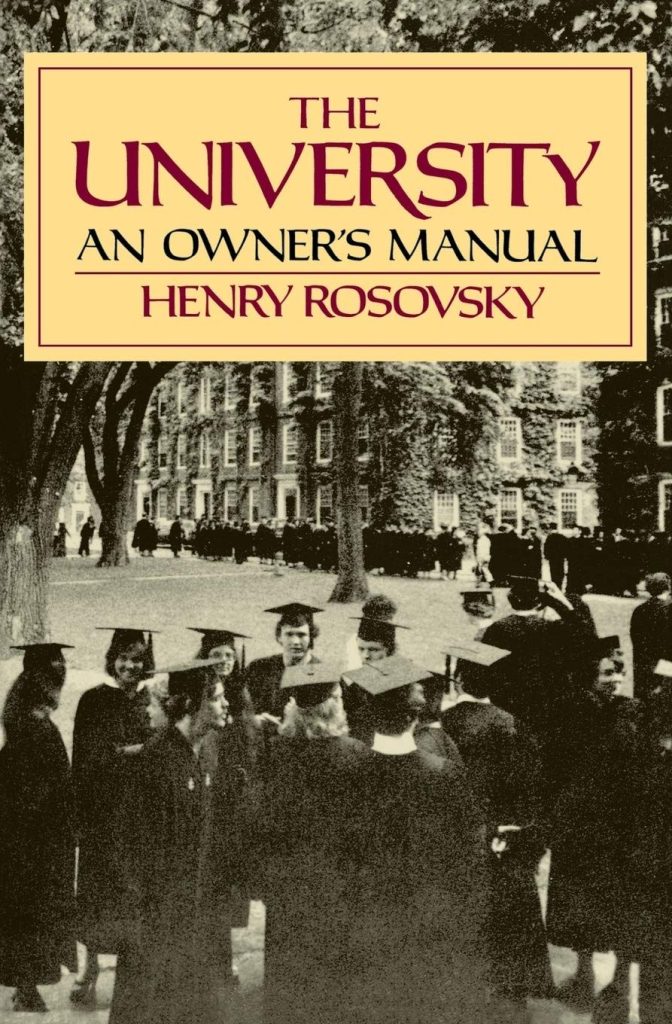
‘The University: An Owner’s Manual’ by Henry Rosovsky
‘The Qualified Student’ by Harold S. Wechsler
‘What Universities Owe Democracy’ by Ronald J. Daniels
‘The Price of Admission’ by Daniel Golden
‘Beyond the University’ by Michael S. Roth
‘College: What It Was, Is, and Should Be’ by Andrew Delbanco
‘The Chosen’ by Jerome Karabel
‘The Big Test’ by Nicholas Lemann
‘Academia Next’ by Bryan Alexander
‘The University: An Owner’s Manual’ by Henry Rosovsky
Written by a former dean at Harvard, this book provides a pragmatic, insider’s defense of the structure and governance of America’s research universities, focusing on not just the admissions process in elite institutions, but also the operational complexities of higher education, from tenure decisions and curriculum design to budget constraints and faculty management. The text argues that despite their flaws, these institutions are highly successful but require nuanced stewardship to maintain their global preeminence.
‘The University: An Owner’s Manual’ by Henry Rosovsky.
W. W. Norton & Company
‘The Qualified Student’ by Harold S. Wechsler
Originally published in 1977 and re-released with up-to-date forewords and afterwords, The Qualified Student: A History of Selective College Admission in America tracks how major pacesetter universities like Columbia transformed their admissions models over a century. Wechsler details the shift from rigid, purely academic gatekeeping to models designed to invite a broader cross-section of American students into higher education. The book frames selective admissions as an ongoing ethical evolution in which universities grapple with the fact that they are both social gatekeepers and social equalizers.
‘The Qualified Student: A History of Selective College Admission in America’ by Harold S. Wechsler.
Routledge
‘What Universities Owe Democracy’ by Ronald J. Daniels
The president of Johns Hopkins University candidly argues that elite higher education must actively reform itself to preserve its civic purpose. He believes that top-tier schools have increasingly become vehicles for socioeconomic stratification and proposes specific, actionable solutions—such as abolishing legacy preferences, expanding financial aid and fostering campus civic engagement—that can restore colleges’ capacity to strengthen democratic society.
‘What Universities Owe Democracy’ by Ronald J. Daniels.
Johns Hopkins University Press
‘The Price of Admission’ by Daniel Golden
The Price of Admission documents how universities reserve slots for the children of major donors, celebrity alumni, politicians and corporate executives. Golden moves beyond anecdotes to trace the institutional mechanisms behind the practice, detailing the use of legacy preferences and niche athletic recruitment to justify these admissions. He argues that in creating backdoors that displace more qualified applicants from other demographics, higher education has effectively become an affirmative action program for the ultra-rich.
‘The Price of Admission’ by Daniel Golden.
Crown
‘Beyond the University’ by Michael S. Roth
Written by a president of Wesleyan University, Beyond the University: Why Liberal Education Matters offers an elegant defense of a broad, non-vocational undergraduate education as a foundation of the American ideal. Roth traces the intellectual lineage of the liberal arts through thinkers such as Thomas Jefferson, Ralph Waldo Emerson and W.E.B. Du Bois, arguing that higher education’s primary purpose is to teach students to think critically and adapt to an ever-changing world. The text provides a counter-narrative to modern demands for fast-track, career-focused degree programs modeled after those in Europe, framing college as a vehicle for lifelong personal growth and engaged democratic citizenship.
‘Beyond the University: Why Liberal Education Matters’ by Michael S. Roth.
Yale University Press
‘College: What It Was, Is, and Should Be’ by Andrew Delbanco
Delbanco’s book pairs institutional history with modern analysis to examine the enduring value of the traditional undergraduate experience. He contrasts the corporate, research-heavy focus of modern elite universities with the historic, collegiate ideal centered on intellectual discovery, character formation and mentorship. Throughout, he delivers a thoroughly measured critique of America’s university system, acknowledging the historical exclusivity of top-tier schools while passionately defending the undergraduate college as a sacred space where young people learn to question authority and engage with the common good.
‘College: What It Was, Is, and Should Be’ by Andrew Delbanco.
Princeton University Press
‘The Chosen’ by Jerome Karabel
The Chosen tracks a century of admissions policies at Harvard, Yale and Princeton to unpack how merit has been redefined over time. Karabel, a sociologist, uses university archives to argue that elite admissions have never been based on pure academic achievement but have instead evolved via a series of defensive adaptations to shifting social realities. It explicitly focuses on the 1920s creation of the “holistic review” system, which was initially engineered to cap the enrollment of Jewish students by looking at vague criteria like “character” and “leadership.” Even after elite institutions reluctantly opened their doors to women and minorities, core admissions structures, according to Karabel, were still geared toward America’s ruling class.
‘The Chosen’ by Jerome Karabel.
Mariner Books
‘The Big Test’ by Nicholas Lemann
The Big Test: The Secret History of the American Meritocracy charts the origin of the American meritocracy by focusing on the creation and implementation of the SAT. Lemann explains that the test was originally envisioned by figures like Harvard president James Bryant Conant as a radical, democratic tool designed to dismantle old-money dynasties by identifying raw intellect in public school students. Yet this well-intentioned experiment ultimately backfired, inadvertently creating a new, hyper-competitive academic aristocracy that guards its own privileges just as vehemently as the one it was meant to supplant.
‘The Big Test: The Secret History of the American Meritocracy’ by Nicholas Lemann.
Farrar, Straus and Giroux
‘Academia Next’ by Bryan Alexander
Futurist Bryan Alexander examines how a convergence of massive external pressures—including demographic shifts, fluctuating economic models, advancements in A.I. and changing labor market demands—will shape how colleges and universities transform over the coming decades. Rather than predicting a singular doom-and-gloom collapse, Academia Next: The Futures of Higher Education turns data into a practical roadmap designed to help institutional leaders proactively navigate future disruption and redesign the student experience to meet the needs of tomorrow.
‘Academia Next: The Futures of Higher Education’ by Bryan Alexander.
Johns Hopkins University Press
‘Excellent Sheep’ by William Deresiewicz
Written by a former Yale professor, Excellent Sheep: The Miseducation of the American Elite and the Way to a Meaningful Life criticizes Ivy League culture for producing what he sees as intellectually timid, risk-averse conformists. He describes how elite campuses increasingly operate as corporate vocational schools, replacing original thinking with practical skill-building and training brilliant students to chase conventional status markers instead of pursuing genuine intellectual curiosity. Deresiewicz ultimately urges students to break free from this paradigm to build meaningful, autonomous lives and find a sense of purpose.
‘Excellent Sheep: The Miseducation of the American Elite and the Way to a Meaningful Life’ by William Deresiewicz.
Free Press
‘The Diversity Bargain’ by Natasha K. Warikoo
Instead of critiquing the institution from the outside, The Diversity Bargain: And Other Dilemmas of Race, Admissions, and Meritocracy at Elite Universities examines how the students who actually won the admissions game at Harvard, Brown and Oxford internalize concepts of race and meritocracy. Warikoo, in her research, uncovers a more nuanced student body that genuinely values diversity as a core asset to their education, while simultaneously grappling with the personal anxieties of individual competition. She offers a thoughtful look at how elite universities’ rhetoric on diversity and race shapes the values of future leaders, for better or worse.
‘The Diversity Bargain: And Other Dilemmas of Race, Admissions, and Meritocracy at Elite Universities’ by Natasha K. Warikoo.
University of Chicago Press